


Runner-Runner
Runner-runner means both the turn and river had to cooperate to make your hand or change the result. It's a two-card path, not a draw label. Worked examples for runner-runner flush and runner-runner straight, plus how often it actually happens.
Practice this in Poker Skill. The Out Counts & Cautions lesson has you spot where a runner-runner starts on the flop: a backdoor flush draw, three cards of a suit that need both the turn and the river, told apart from a real four-card draw.
Get the free appRunner-Runner in No-Limit Texas Hold’em
What runner-runner means
A runner-runner in poker is a hand where both the turn and the river had to come the right way for your hand to complete or for the result of the hand to change. The turn alone wasn’t enough. The river alone wasn’t enough. You needed both cards to cooperate.
The most common examples are a runner-runner flush (you needed two cards of one suit on turn and river) and a runner-runner straight (you needed two specific ranks across the next two streets). Players also use the phrase loosely for any two-card sequence that swung a hand, even when the two cards weren’t filling a draw.
In plain English: if your hand only got there because the board cooperated twice in a row, that’s runner-runner.
What a runner-runner flush is
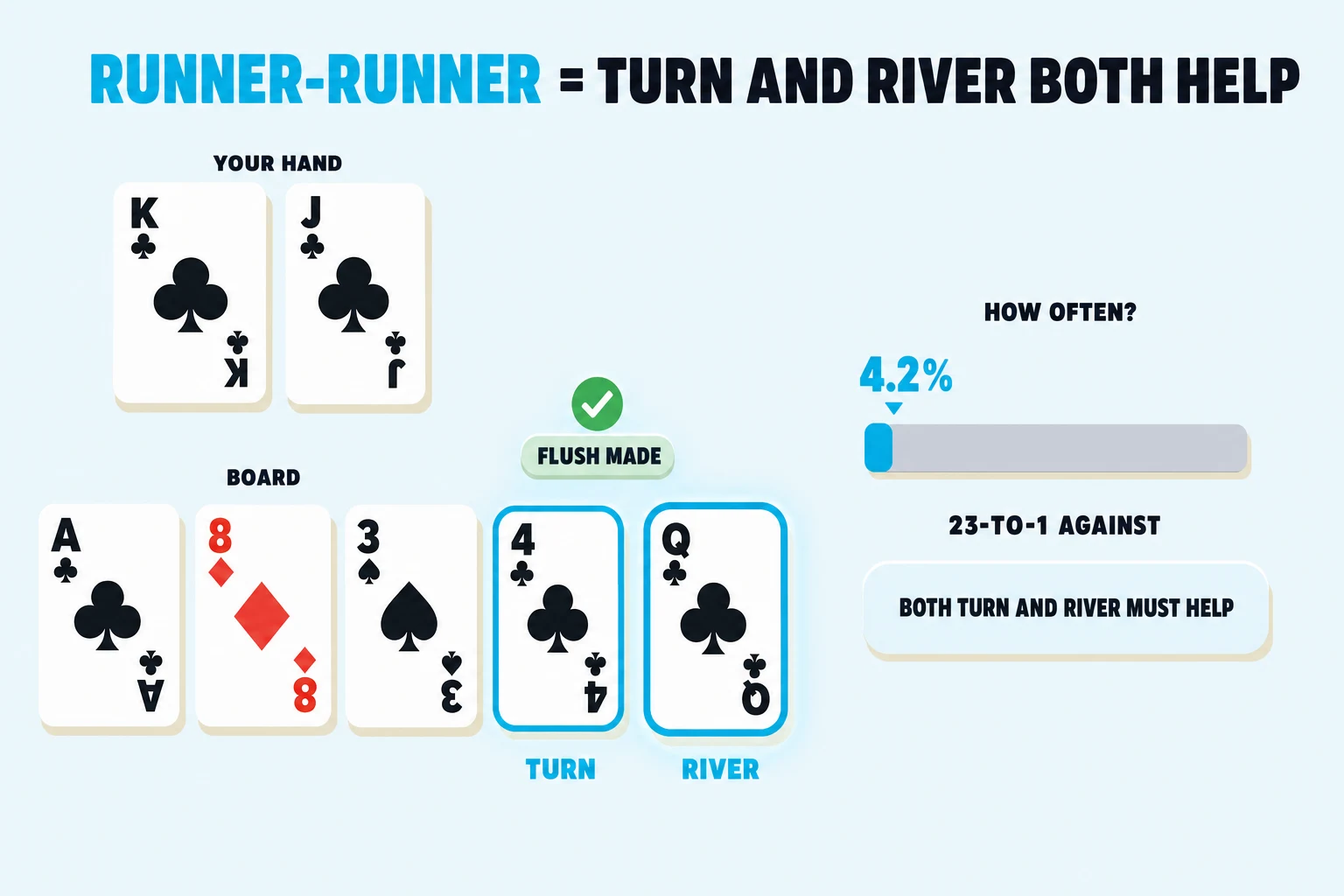
A runner-runner flush is a flush you only completed because the turn and the river were both the suit you needed. On the flop you held three cards of that suit instead of four, so a single suited card was never going to be enough. Two had to arrive back to back.
That is the whole gap between a runner-runner flush and an ordinary flush draw. An ordinary flush draw is four to the suit with nine cards left that finish it, and any one of them will do. A runner-runner flush needs two of the remaining ten in a row, which happens 4.2% of the time, about 23-to-1 against. The worked hand and the arithmetic are both below.
Runner-runner vs backdoor draw vs suckout
People mix these three terms a lot. Keeping them apart is most of the work.
| Term | What it names | When you say it |
|---|---|---|
| Backdoor draw | The flop-state draw that needs runner-runner to complete | On the flop, when you only have three to a flush or partial straight structure |
| Runner-runner | The two-card path that completes the hand | On the river, after both the turn and river helped |
| Suckout | The outcome when a worse hand catches up to win | After showdown, when the weaker starting hand won |
So a backdoor flush draw on the flop, completed by two clubs running off on turn and river, is a runner-runner flush. If that runner-runner flush beat someone’s earlier-made hand, the loser would call it a suckout. Same hand, three different words for three different things: the draw state, the path, and the outcome.
The cleanest way to say it: runner-runner is what just happened on the board, not what your hand was on the flop, and not how the loser feels about it.
Runner-runner flush example
Hold K♣ J♣ and the flop comes A♣ 8♦ 3♠.
Right now you do not have a flush draw in the normal sense. You only have three clubs total (two in your hand, one on the board). To make a flush, the board has to bring a club on the turn and another club on the river.
One detail worth noticing: the A♣ is already on the board, so every player can use it. That makes your K♣ the highest club anyone can hold, and this backdoor runs to the nut flush draw rather than to a second-best flush you have to pay off with.
Suppose the runout finishes:
- Turn: 4♣
- River: Q♣
You now have a flush. That’s a runner-runner flush. On the flop you had a backdoor flush draw; the runner-runner is the path that actually completed it.
The same hand history gives you the language to be precise:
- On the flop: “I had a backdoor flush draw.”
- On the river: “I made a runner-runner flush.”
- If you beat someone holding a set: they say “I got sucked out on.”
Runner-runner straight example
Hold 5♣ 6♦ and the flop comes A♠ 7♥ K♣.
You don’t have an open-ended straight draw. You don’t have a gutshot. You have a small piece of structure with two paths to a straight:
- Turn 4 and river 8, or
- Turn 8 and river 4.
Anything else and you whiff. If the runout finishes 8♥, then 4♦, you’ve made a five-high straight on the river. That’s a runner-runner straight.
You’ll also hear players use runner-runner for funnier paths: runner-runner trips when you pair up twice, runner-runner two-pair when both cards pair the board with your hand, runner-runner full house when a pair turns and pairs again on the river. The pattern is always the same: the turn and river both had to do something specific for your hand to land where it did.
The odds of hitting runner-runner
The numbers are smaller than people think.
- A runner-runner flush completes about 4.2% of the time. You’re roughly a 23-to-1 underdog when you’re sitting on three to a flush after the flop.
- A runner-runner straight completes about 3% of the time, depending on how many connecting paths exist. That’s roughly 33-to-1 against.
The math is unforgiving for a reason. After the flop, 47 cards are unseen for the turn, and 46 remain for the river. There are C(47, 2) = 1,081 possible turn-and-river card pairs. For a runner-runner flush you need both cards to be one of the 10 remaining suited cards, which is C(10, 2) = 45 favorable pairs. So 45 / 1,081 ≈ 4.2%.
This is also the spot where the usual shortcut breaks. The rule of 2 and 4 assumes any single one of your outs finishes the hand, so counting your ten remaining clubs as outs and multiplying by four gives 40%. The real answer is 4.2%. The shortcut is off by a factor of ten because it was built for draws that one card completes.
Two takeaways for table decisions:
- Runner-runner is real equity, not zero. The same math is what backdoor equity puts on a hand on the flop.
- Runner-runner is small equity. Whenever someone says “I had outs” and points at a runner-runner path, those outs were worth a few percent, not a lot.
Is it worth chasing a runner-runner draw?
Not on the strength of the runner-runner by itself. Price it out and it is not close.
You get there 4.2% of the time, so a call breaks even only when the chips you put in are about 4.2% of the final pot. That means you need roughly 23-to-1 on the money. A half-pot bet lays you 3-to-1 and asks for 25% equity. A quarter-pot bet lays you 5-to-1 and asks for about 17%. Nothing you actually get bet on a flop comes near 23-to-1, so immediate pot odds never justify a call on the backdoor alone.
The counter-argument is implied odds: a runner-runner flush is well hidden, so it gets paid when it lands. That is true, and it is also the argument that talks people into bad calls. Covering a 23-to-1 gap on later streets takes an enormous payoff, and a weak draw chased against opponents who are paying attention does not collect one often enough.
So treat the backdoor suit as a tiebreaker. When you already have a reason to continue (overcards, a pair, position, fold equity), the extra 4% is a genuine nudge toward the call or the semi-bluff. When the backdoor is most of what the hand has, checking and taking a free card is usually the better line than betting yourself off it. And if someone else makes the price a real bet, remember what you are buying: a quarter of the pot to win 4% of them.
Common mistakes
These are the four ways players misuse the word at the table.
Calling every two-card cooperation a “bad beat”
If you got there by runner-runner against a hand that was much further ahead, the other player may say it was a bad beat. Runner-runner is a common cause of bad beats, but not every runner-runner is a bad beat. Sometimes the hand that hit was already close to even. The path doesn’t dictate the equity gap.
Treating a backdoor draw like a regular draw
A backdoor flush draw on the flop is not the same thing as a regular flush draw. The regular draw needs one card. The backdoor draw needs runner-runner. They look similar on paper and play very differently, so see backdoor draw for the full comparison.
Crediting the win to the river card alone
When a runner-runner gets there, players often only remember the river: “the river was the third club.” But the turn was the first one. Without the turn card cooperating, the river never had a chance to finish the hand. Runner-runner is two cards of work, not one.
Calling any outdraw a runner-runner
If your one-card flush draw hit on the river, that’s a regular draw completing on the river, not runner-runner. Runner-runner specifically means the turn and river were both required to complete your hand. One-card completions get a different word: a hit, a got-there, a drawing hand finishing.
FAQ
What does runner-runner mean in poker?
Runner-runner means both the turn and the river had to come the right way for your hand to complete or for the result of the hand to change. It’s a two-card path. A runner-runner flush, for example, is a flush you only made because both the turn and the river were the right suit.
Is runner-runner the same as a backdoor draw?
No. Backdoor draw is the flop-state name (the partial draw on the flop that still needs two cards). Runner-runner is the path that actually completes it. A backdoor flush draw becomes a runner-runner flush only if both cards cooperate. If only the turn comes through and the river misses, you had a backdoor draw that turned into a regular draw, then a missed draw.
How often does a runner-runner flush hit?
About 4.2% of the time. That’s roughly 1 in 24, or 23-to-1 against. The math: after the flop you have 1,081 possible turn-and-river card pairs and 45 of them are two more cards of your suit, so 45 / 1,081 ≈ 4.2%.
Final takeaway
Runner-runner is a path word, not a feeling word. It names a specific thing on the board: the turn and the river both had to be right. Most of the time, that path doesn’t get there. When it does, it’s a runner-runner flush, runner-runner straight, runner-runner trips, or runner-runner whatever the cards made.
Keep the three layers separate when you talk about the hand:
- The draw state on the flop (backdoor draw).
- The path across two streets (runner-runner).
- The outcome at showdown (suckout or just “I won the pot”).
Use the right word for the right layer and the math gets clearer, the table talk gets cleaner, and the game gets easier to think through.
When you hold a real draw rather than a backdoor one, how to play a flush draw covers the bet, call and raise decisions on every street.