


Drawing Hand
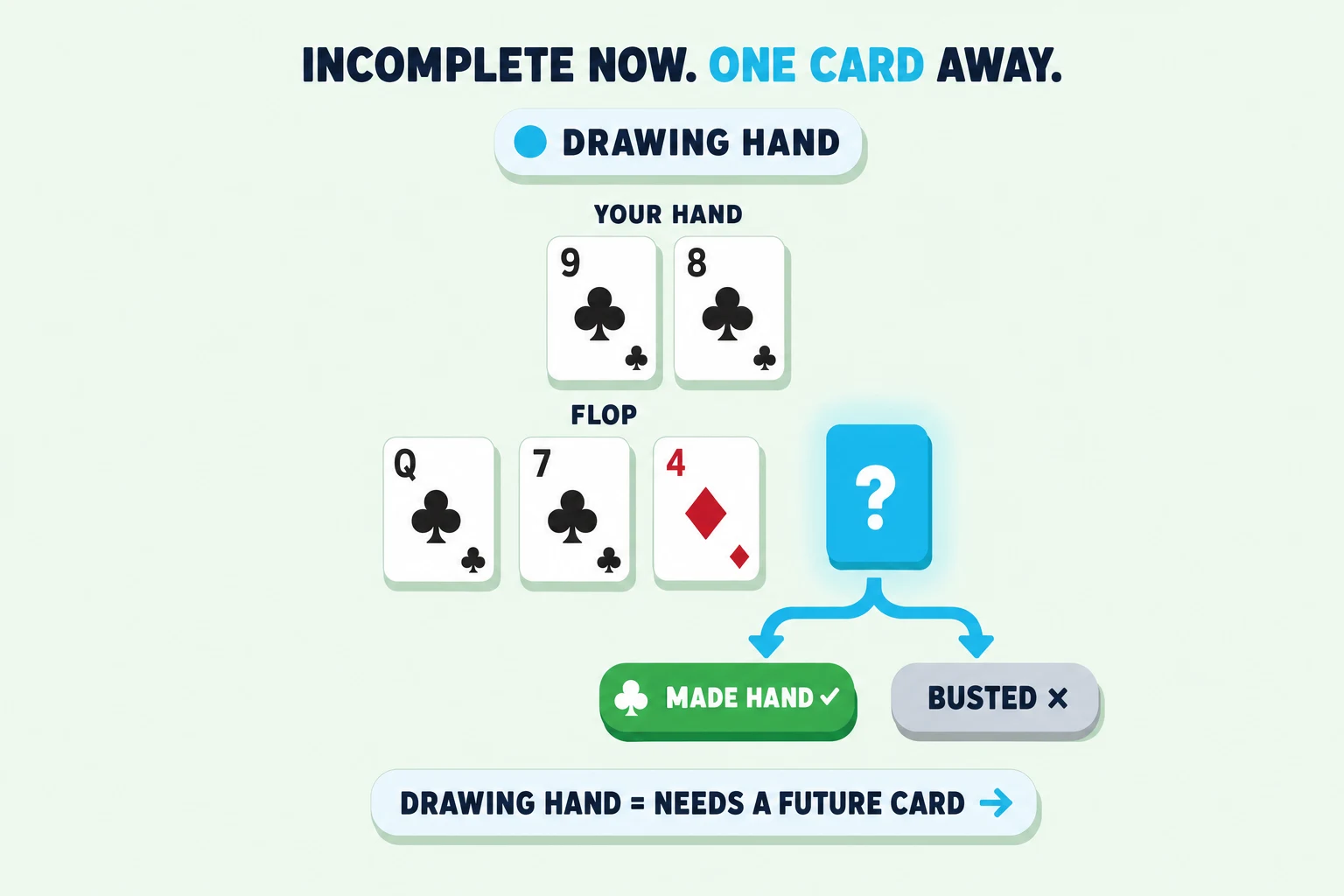
A drawing hand is incomplete right now. It has no showdown value yet, but a specific card on the turn or river would promote it into a made hand. The contrast is a made hand, which already wins at showdown without improving. In No-Limit Texas Hold'em, recognizing that you hold a drawing hand changes the question from "should I bet for value?" to "is continuing profitable, and would betting work as a semi-bluff?"
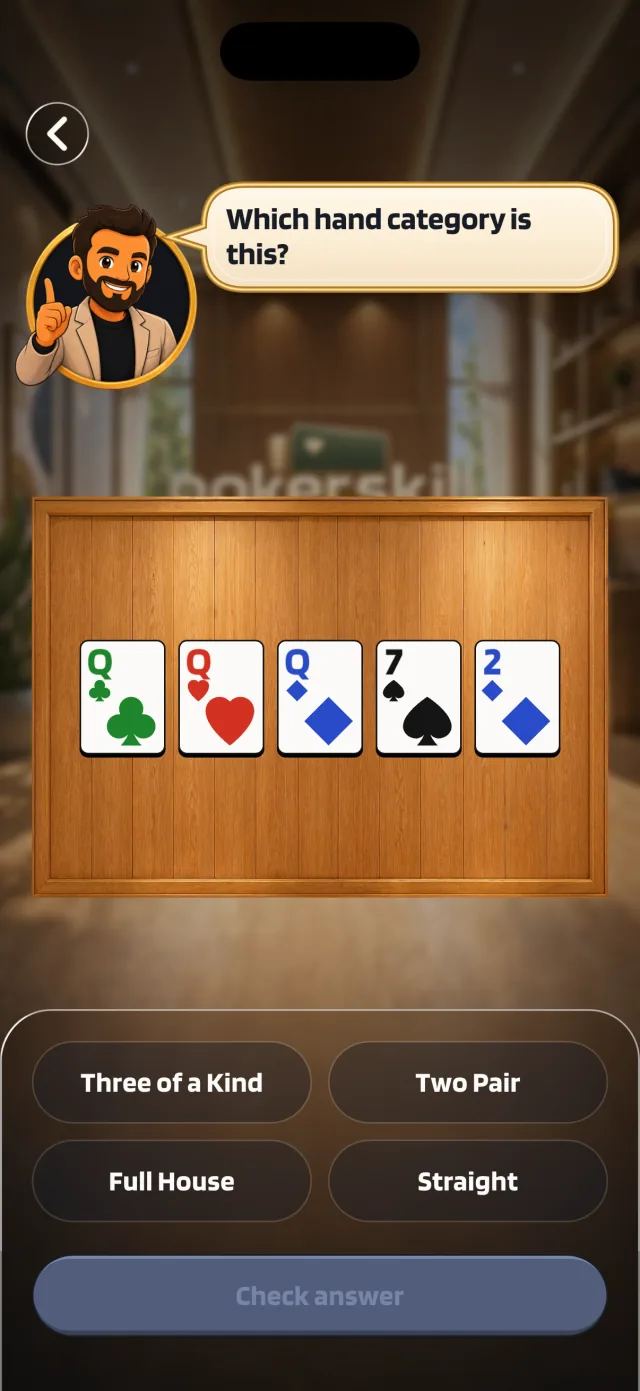
Practice this in Poker Skill. Strength decides the play in the lesson on bluffing and semi-bluffing: J♠ 4♥ on 3♦ 5♠ 6♥ bets its open-ender as a semi-bluff, while 7♠ 10♣ on 4♦ 8♠ J♣ has only four outs and checks.
Get the free appDrawing hands in No-Limit Texas Hold’em
What a drawing hand is and why it matters
A drawing hand is the categorical state of holding cards that have no showdown value right now but can be promoted into a made hand if a specific draw completes. A flush draw, an open-ended straight draw, and a gutshot are all drawing hands; so is a pair of underpairs hoping to spike a set. The contrast is a made hand, which already has showdown value without further help. In No-Limit Texas Hold’em, recognizing that you are in the drawing-hand state changes the question you are answering. With a made hand, the question is “should I bet for value, or control the pot?” With a drawing hand, the question is “is continuing profitable, and does betting work as a semi-bluff?”
The categorical state is not a hand-strength claim. A monster draw with twelve-plus outs and a gutshot share the same category and almost nothing else. The state tells you which question to ask; the strength tier within the state tells you the answer.
Related terms
Drawing hand vs made hand vs combo hand
Most postflop decisions hinge on which of three categories your cards sit in:
| Category | Showdown value now | Path to win | Default question |
|---|---|---|---|
| Made hand | Yes | Hold the lead, charge draws | ”Bet for value, or control the pot?” |
| Drawing hand | No | Promote on a future card, or fold equity | ”Is continuing profitable? Semi-bluff?” |
| Combo hand (made + drawing) | Yes, with upside | Win at showdown or improve | ”How aggressively can I play this?” |
Combo hands are the third category and the one beginners miss. A pair plus an open-ended straight draw is both a made hand and a drawing hand. So is top pair with a flush draw. These hands are made hands with extra upside, not draws with a backup plan, and they usually play more aggressively than either piece alone. The made-hand component lowers the cost of getting called; the draw component still wins extra chips when it hits.
The categories are also fluid across streets. A premium made hand can downgrade when an overcard arrives or an obvious draw completes; a flopped drawing hand becomes either a strong made hand (if it hits) or a busted-draw bluff candidate (if it misses). Reassess the category every street.
When the drawing-hand state matters most
The state is load-bearing in three spots:
- Facing a flop bet on a coordinated board. Whether you continue depends on which strength tier your draw sits in and what your opponent’s range looks like. Treating “I have a draw” as a single class hides the answer.
- Deciding whether to lead with a semi-bluff. Drawing hands can win the pot two ways: opponent folds now, or you complete on the next card. That double-headed equity is what makes semi-bluffing profitable; without a draw, the same bet is a pure bluff and needs more fold equity to break even.
- Reading opponent action escalation. Bet, raise, and shove on a wet board fits premium made hands and the very best draws. A medium drawing hand often loses chips to that ladder if you keep calling.
The state matters less on dry boards facing small bets, where a pot odds calculation alone usually answers the question.
Strength tiers inside drawing hands
Books consistently split drawing hands into three strength tiers based on outs to the effective nuts. The tiers determine the default play:
| Tier | Outs to effective nuts | Examples | Default action |
|---|---|---|---|
| Premium / strong | 12+ | Pair plus flush draw plus straight draw, double-gutter plus flush draw | Bet for value-as-equity; willing to stack off |
| Medium / marginal | 8–9 | Standard open-ended straight draw, bare flush draw | Bet or call a single raise; fold to large check-raises |
| Weak / junky | < 8 | Gutshot, backdoor draws, two overcards alone | Often fold; call only with strong implied odds or fold equity |
Two cautions on the tiers. First, count live outs, not gross outs. Cards that finish a stronger draw or flush for the opponent are dead from your perspective; subtract them. Second, the same nominal draw shifts tiers based on overcards. J♠ 10♠ on 8♥ 7♣ 3♦ is a stronger drawing hand than 5♠ 4♠ on the same board, because the J♠ 10♠ has clean overcards that add equity even when neither the straight nor the flush hits.
Worked example
You hold 9♣ 8♣ on the cutoff. You raise to 2.5bb, button calls, blinds fold. The flop comes Q♣ 7♣ 4♦. The pot is 6.5bb; effective stacks are ~97bb.
You have a flush draw plus a backdoor straight (a six gives you an open-ender on the turn). That is a drawing hand in the medium tier — nine flush outs, with backdoor straight equity that promotes the hand to the strong tier on a friendly turn. The default action is to bet as a semi-bluff: you fold out the button’s underpairs, ace-highs without a club, and weak King-highs, and when called you have ~36% equity to the river.
You bet 4bb. Button calls. Pot is 14.5bb. Turn is the 6♥. Your hand is now a flush draw plus an open-ended straight draw, fifteen live outs, top of the strong tier. The drawing-hand state has not changed (you still have no showdown value), but the strength tier jumped from medium to strong. Bet again, larger this time, say 11bb. Most of button’s flop-calling range either gives up or calls thin; the strong-tier draw justifies stacking off if villain raises, because premium draws have around 50% equity against the kind of range that raises a turn donk on this texture.
River is the 2♦. Your draws miss. You now hold 9-high, a busted-draw junk hand. The state has flipped from drawing-hand to junk. The earlier two streets of pressure tell a credible story for a made hand on a Q-high run-out, so a polarized river bluff for ~55% pot is reasonable against a thinking villain who has been folding rivers; against a calling station, give up. The river decision is not “did I miss?” but “what is my hand’s category right now, and what does the line tell my opponent’s range?”
Common mistakes
1) Treating a drawing hand as a single class
“I have a draw” is not a strategy. Premium, medium, and weak drawing hands are three different decisions on the same flop. The fastest reads is to count clean outs to the effective nuts, then sort: 12+ (premium), 8–9 (medium), under 8 (weak).
2) Putting the opponent on one hand
If you decide whether to call by asking “do I beat top pair?” you mismeasure the spot. Opponent has a range, not one hand. The same flush draw can be a 36% favorite versus top pair and a 28% favorite versus the realistic range that includes sets, two-pair, and better flush draws. Equity calculations against a range, not a hand, drive the decision.
3) Counting tainted outs
A nine-out flush draw plus a four-out straight draw is not thirteen outs if two of the straight cards are also flush cards; those are double-counted. Subtract before you compute pot odds. Tainted outs that complete a better hand for the opponent (your straight finishes the opponent’s flush) are dead outs from your perspective; subtract those too.
4) Raising to fold
Semi-bluffs are profitable because of the combination of fold equity and equity-when-called. If you plan to fold to a re-raise, you have given up the equity-when-called half of the equation and you are running a pure bluff at terrible odds. With a premium drawing hand, plan to call a re-raise; with a medium drawing hand, plan to fold to a re-raise but bet sizes that won’t get re-raised often.
FAQ
What is the difference between a draw and a drawing hand?
In everyday poker conversation the two are usually synonymous. The useful distinction is that a “draw” names a specific incomplete possibility (a flush draw, a gutshot, an open-ender), while a “drawing hand” names the categorical state of your hole cards plus the board, in which you may have one specific draw or several. “I have a flush draw” names the mechanism. “I have a drawing hand” names the state.
Can a hand be a made hand and a drawing hand at the same time?
Yes. These are combo hands. Top pair plus a flush draw is the textbook example. So is a pair with an open-ended straight draw, or two pair on a two-tone board where the third card of a suit lands on the turn. Combo hands have showdown value now and additional outs to a stronger hand, which is why they usually play more aggressively than either component alone. The made-hand component lowers the cost of being called; the drawing-hand component pays off when you hit.
When does a drawing hand prefer to call instead of raise?
A drawing hand prefers to call when it has enough equity, the pot odds are reasonable, and you can realize equity well, usually in position with a hand that has some showdown value. Calling is the right move when your fold equity is weak (opponent rarely folds) or when raising mostly inflates the pot for a future fold. Raising is the right move when calling is uncomfortable (especially out of position), when fold equity is real, and when the draw is strong enough that the equity-when-called half of the semi-bluff math holds up.