


Flush Draw
A flush draw has 9 outs: about 19% to hit on the turn and 35% by the river. Nut flush draws play aggressively; non-nut draws need pot-odds discipline.

Practice this in Poker Skill. With K♥ 9♥ on Q♥ 7♥ 2♣, eight of the nine hearts left give you a king-high flush, and the lessons teach it as a non-nut draw because a player holding the A♥ with another heart makes the ace-high one.
Get the free appFlush Draw in Poker: 9 Outs, Odds, How to Play It
A flush draw in poker means you have four cards of the same suit and need one more to make a flush in poker. In the standard spot, that gives you 9 outs.
From the flop, a 9-out flush draw gets there by the river about 34.97% of the time. From the turn, it gets there on the river about 19.57% of the time.
That is the fast answer. The better question is whether the draw is worth chasing. A flush draw can be a profitable call, a strong semi-bluff or an expensive mistake depending on price, position, stack depth and whether you are drawing to the nut flush draw or a weaker one.
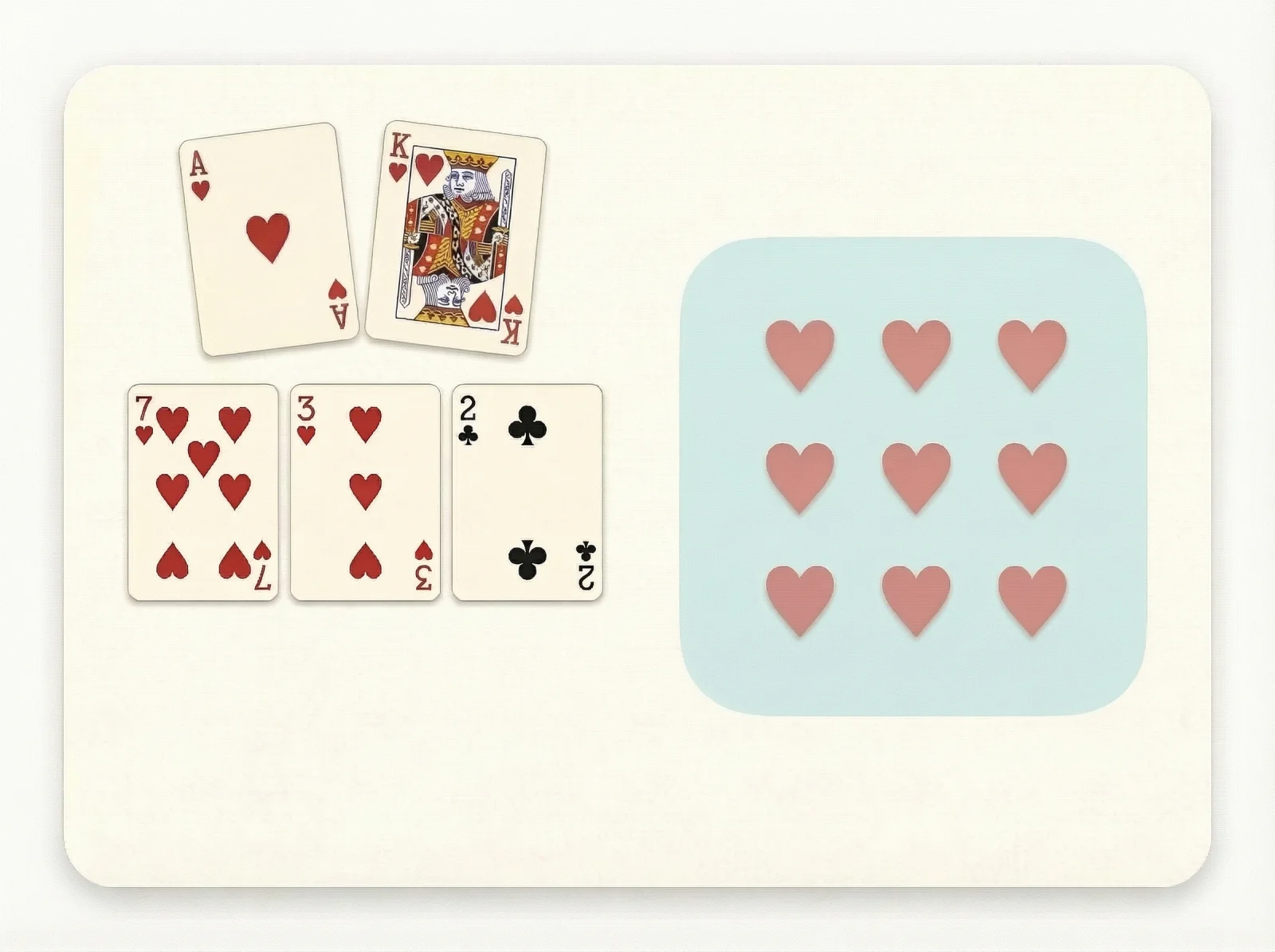
What is a flush draw?
A flush draw happens when you already have four cards of the same suit between your hole cards and the board, so one more suited card will complete a flush.
Example:
- You hold A♥ K♥
- The flop is 7♥ 3♥ 2♣
You now have four hearts total. Any heart on the turn or river makes a flush.
That is different from a backdoor draw, where you still need two perfect running cards to complete the hand.
Why a flush draw is usually 9 outs
A standard flush draw usually has 9 outs because there are 13 cards in each suit.
If you can already see 4 cards of that suit — 2 in your hand and 2 on the board — there are 9 unseen suited cards left in the deck.
| Suit math | Number |
|---|---|
| Total cards in one suit | 13 |
| Suited cards already visible | 4 |
| Remaining suited cards | 9 |
That is why players call a flush draw the classic 9-out draw.
The important catch is that 9 outs is the raw count, not always the real value. If you are drawing to a weak flush, some of those outs may be dirty outs because you can improve and still lose to a higher flush.
Flush draw odds
Most players want the math first, so here are the key numbers for a standard 9-out flush draw.
| Situation | Exact chance to hit | Shortcut |
|---|---|---|
| Flop to turn, 1 card to come | 19.15% | About 18%, nine outs times two |
| Turn to river, 1 card to come | 19.57% | About 18% to 20% |
| Flop to river, 2 cards to come | 34.97% | About 36% with the Rule of 2 and 4 |
Three fast ways to remember it:
- From the flop, you get there a little more than 1 time in 3.
- From the turn, you get there about 1 time in 5.
- The Rule of 2 and 4 gives you a close in-game shortcut when you need a fast estimate.
How to use flush draw odds in a real hand
Counting your outs is only step one. The better question is what those outs let you do.
Start with three checks:
- What price am I getting right now?
- If I hit, how strong is my flush?
- Can I win the pot without hitting by betting or raising?
That is where pot odds, implied odds, and fold equity matter.
A simple beginner-safe rule:
- Call when the price is good and your draw is likely to be clean.
- Raise when you have fold equity plus strong outs.
- Fold when the price is bad and your flush can still be second best.
Nut flush draw vs non-nut flush draw
Not all flush draws are equal.
Nut flush draw
A nut flush draw means that if you hit, you make the highest possible flush.
Example:
- You hold A♣ J♣
- The flop is 8♣ 5♣ 2♦
If another club comes, you make the ace-high flush. No one can make a higher flush.
Why that matters:
- Your outs are usually cleaner.
- You can continue more confidently.
- Semi-bluffing becomes more attractive.
- Deep stacks become better for you because you can win a big pot when you hit.
Non-nut flush draw
A non-nut flush draw means you can make a flush, but not the best flush.
Example:
- You hold Q♣ J♣
- The flop is A♣ 7♣ 2♦
If a club comes, you make a flush, but an opponent holding the K♣ with another club can still beat you.
Why that matters:
- Some of your apparent outs are weaker than they look.
- Multiway pots get more dangerous.
- Strong action should make you more cautious.
- Reverse implied odds become a real problem.
The beginner version is simple: a flush is not automatically great if it is not the nut flush.
3 worked examples
Example 1: Nut flush draw facing a flop bet
You hold A♠ Q♠ on J♠ 7♠ 2♦. The pot is $60 and your opponent bets $20.
What you have:
- Nut flush draw
- 9 flush outs
- Two overcards that can matter sometimes, but the flush draw alone already does a lot of work
If you call $20 to win a final pot of $100, you need 20% equity on the call. Counting only the turn, the flush draw alone hits about 19% of the time, just short of that price, so the call leans on the two overcards and on the bets you can still win when a spade lands.
Raising can also make sense against the right opponent because you may win the pot immediately and still have strong equity when called.
Example 2: Combo draw with more ways to improve
You hold A♥ T♥ on Q♥ J♥ 2♣.
Now you have:
- A nut flush draw
- A gutshot to Broadway, the ace-high straight
- Overcard potential in some matchups
This is a strong combo draw, which means you have more than one way to improve. That extra equity often makes aggressive play more attractive because you can win now when opponents fold and still have plenty of outs when they call.
Example 3: Non-nut flush draw with reverse implied odds
You hold 8♥ 7♥ on A♥ K♥ 2♠. The pot is $80 and a tight player bets $55 into two people.
At first glance, this looks like a standard 9-out flush draw. In practice, it is the dangerous version:
- Your flush is not the nuts.
- The board already contains high hearts.
- The bettor can easily have stronger heart combinations.
- Even when you hit, you may still be second best.
This is the kind of spot where folding can be better than chasing. Raw outs are not enough when the draw is dominated.
Flush draw vs straight draw
Players often ask whether a flush draw or straight draw is better. The honest answer is that it depends on the number and quality of outs.
A standard flush draw usually has 9 outs. A standard open-ended straight draw usually has 8 outs. In a vacuum, that makes the flush draw slightly stronger.
But clean outs matter more than raw counting. A weak non-nut flush draw can easily be worse than a clean straight draw.
Common mistakes with flush draws
1. Auto-calling because you have 9 outs
Nine outs sounds strong, but a draw is not a license to continue at any price.
2. Ignoring whether the draw is to the nuts
Small and medium flushes can be dominated, especially in multiway pots or against strong ranges.
3. Forgetting that implied odds work both ways
Implied odds help when you hit and get paid. Reverse implied odds hurt when you hit a second-best flush and pay off a bigger one.
4. Playing every flush draw passively
Strong flush draws often make excellent semi-bluffs. If you only call, you give up fold equity.
5. Confusing a flush draw with a backdoor draw
A front-door flush draw needs one more suited card. A backdoor draw still needs runner-runner help and is much weaker.
FAQ
How many outs does a flush draw have?
A standard flush draw usually has 9 outs because 4 suited cards are already visible and 9 suited cards remain unseen.
What are the odds of hitting a flush draw by the river?
From the flop, a standard 9-out flush draw gets there by the river about 34.97% of the time. A quick shortcut is about 36% using the Rule of 2 and 4.
How should you play a non-nut flush draw?
Play it more carefully than a nut flush draw. Pay close attention to pot odds, the number of opponents, and how easy it is for someone else to have a higher flush.
Is a flush draw better than a straight draw?
Usually, a standard flush draw is slightly stronger than a standard open-ended straight draw because it has 9 outs instead of 8. But weak flush draws can still be worse than cleaner straight draws.
Final takeaway
A flush draw looks simple on the surface: 9 outs, about 35% from flop to river, and about 19.6% with one card to come.
The better players go one step further. They ask whether the outs are clean, whether they are drawing to the nuts, and whether the price makes continuing profitable.
Build that habit and your flush-draw decisions will improve fast.
For the decisions themselves, street by street, see how to play a flush draw.