


Backdoor Draw
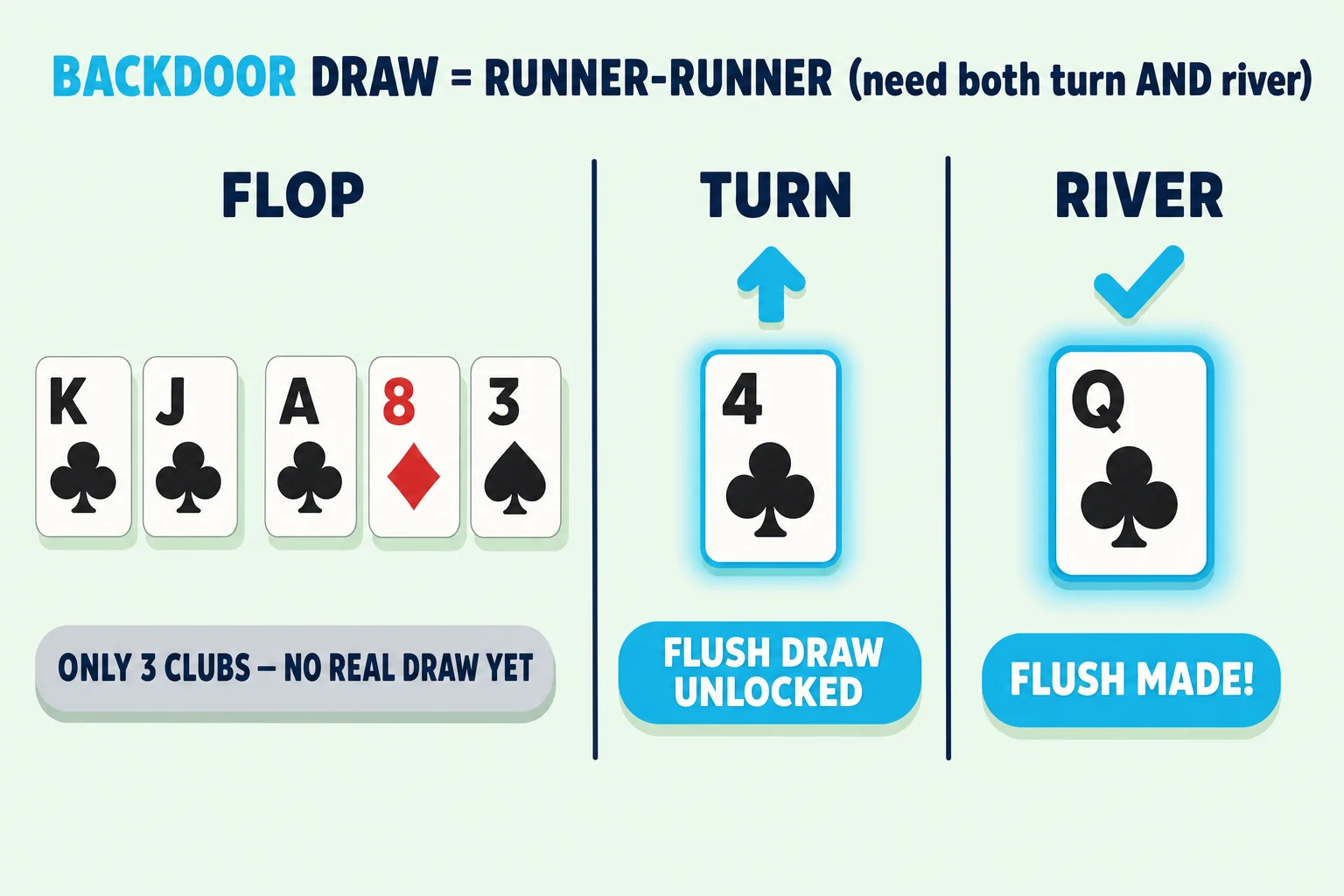
A backdoor draw needs both the turn and river to complete, also called runner-runner. It adds a thin slice of equity but is rarely a reason to put money in by itself.
Practice this in Poker Skill. When the pot-control lesson deals you top pair with a nine kicker and a backdoor diamond draw, you call to keep the pot small, and the pair is what earns the call.
Get the free appBackdoor Draw in Poker: Meaning + Runner-Runner Examples
A backdoor draw in poker means you need both the turn and the river to complete your hand. That is why players also call it a runner-runner draw. The most common examples are a backdoor flush draw and a backdoor straight draw.
Backdoor draws matter because they add a little equity to your hand, but the key word is little. They are not the same as a regular flush draw or straight draw. Most of the time, a backdoor draw is a bonus, not a reason by itself to put a lot of money into the pot.
What is a backdoor draw?
A backdoor draw is a draw that cannot be completed with just one card. You need the right card on the turn and another helpful card on the river.
For example, if you hold A♠5♠ and the flop is 9♠ 7♦ 2♥, you do not have a regular flush draw yet. You only have three spades total. To make a flush, the turn and river must both come spades. That is a backdoor flush draw.
The same idea applies to straights. Sometimes the flop gives you the start of a straight pattern, but you still need two perfect cards across the next two streets to finish it. That is a backdoor straight draw.
In plain English: a backdoor draw is real equity, but it is runner-runner equity.
Backdoor draw vs regular draw
The easiest way to understand a backdoor draw is to compare it with a normal draw.
| Type | What you have on the flop | What you need | Strength |
|---|---|---|---|
| Regular flush draw | Four cards to a flush | One more suited card by the river | Stronger, more immediate |
| Backdoor flush draw | Three cards to a flush | A suited turn and suited river | Much weaker |
| Regular straight draw | Four cards working toward a straight | One rank to complete it | Stronger, more immediate |
| Backdoor straight draw | Partial straight structure only | Two helpful cards in sequence or combination | Much weaker |
A regular draw can often continue because it has direct, obvious outs right away. A backdoor draw is different. It needs the board to cooperate twice.
That difference matters in real decisions:
- Regular draws can often call or semi-bluff on their own.
- Backdoor draws usually need help from something else, like overcards, position, fold equity, or a board that can change a lot on the turn.
If you remember one thing, remember this: front-door draws are a main reason to continue; backdoor draws are often just an extra reason.
Backdoor flush draw example
Imagine you hold K♣ J♣ and the flop is A♣ 8♦ 3♠.
Right now, you do not have a flush draw in the normal sense. You only have three clubs total: two in your hand and one on the board. To make a flush, the board must bring:
- a club on the turn, and
- another club on the river.
That makes this a backdoor flush draw.
Why does this matter? Because your hand may have more going for it than just the backdoor flush:
- two overcards to the 8 and 3,
- the chance to pair the king or jack on later streets,
- and some extra equity if a club appears on the turn.
That does not mean you should automatically continue. It means your hand may be a better bluff-catch or semi-bluff than a hand with no backdoor potential at all.
For a full comparison, see our guide to a flush draw.
Backdoor straight draw example
Now imagine you hold 5♣ 6♦ and the flop is A♠ 7♥ K♣.
You do not have an open-ended straight draw or a gutshot. But you do have three paths to a straight, each needing two running cards in either order:
- a 3 and a 4 (3-4-5-6-7)
- a 4 and an 8 (4-5-6-7-8)
- an 8 and a 9 (5-6-7-8-9)
That is a backdoor straight draw. You need runner-runner cards to finish the hand.
Here is another simple way to think about it: a backdoor straight draw starts as a weak piece of structure, not a real made drawing hand. It only becomes interesting if the turn improves it.
For a more direct straight-draw comparison, see our page on a straight draw.
Why backdoor equity matters (a little)
Backdoor equity matters because poker decisions are often close. A hand with a little extra equity can perform better than a hand with none.
But beginners often make the same mistake: they hear “backdoor draw” and treat it like a normal draw. That is wrong.
A backdoor draw matters for three main reasons:
1. It can break a close decision
If two weak hands are otherwise similar, the one with backdoor equity is usually slightly better. That extra chance to improve can matter when deciding whether to c-bet, call a small bet, or continue a bluff.
2. It can improve your turn-barrel potential
This is where backdoors become more interesting. If you bluff the flop and then pick up more equity on the turn, your hand can become a much better candidate to keep betting.
Example:
- You raise preflop with K♣ J♣.
- The flop comes A♣ 8♦ 3♠.
- You c-bet and get called.
- The turn is the 4♣.
Now your hand is no longer just two overcards. You have picked up a real flush draw, which gives you more reasons to apply pressure on the turn.
This is part of what players mean when they talk about backdoor equity. The flop hand starts small, but a favorable turn can create better bluffing opportunities later. If you want the companion concept, read our glossary entry on backdoor equity.
3. It interacts with board texture
Backdoor equity matters more on boards that can change a lot. On a more dynamic board, many turn cards can shift equity, create new draws, and change who wants to bet.
That does not mean every backdoor draw should become aggression. It means backdoor-heavy hands often play better on boards where future cards can create pressure.
In short:
- backdoor draws add equity,
- dynamic boards can make that equity more useful,
- but the starting equity is still small.
Common mistakes with backdoor draws
Overvaluing the draw
A pure backdoor draw is a long shot. If backdoor potential is the only good thing about your hand, it is rarely enough to continue against serious pressure.
Forgetting the rest of the hand
Backdoor equity is best treated as part of a package. Overcards, position, blockers, fold equity, and the chance to improve on multiple turn cards all matter.
Ignoring what the turn changes
The flop label is only the start. Once the turn comes, your hand may:
- pick up a real draw,
- lose its bluffing value,
- or stay too weak to continue.
Good players do not just say, “I had a backdoor draw on the flop.” They ask, “What did the turn do to my hand and my story?”
Confusing backdoor draws with bigger combo potential
Some hands can carry a pair, overcards, and multiple backdoor routes at once. Those hands can become strong semi-bluffs later. Others are just thin backdoor holdings with very little else going on. Do not lump them together.
If your hand can combine different kinds of equity, it may be closer to a combo draw on later streets. But on the flop, a pure backdoor draw is still only a small piece of equity.
Further reading
If you want a broader math refresher around drawing hands and outs, these are solid companion resources:
FAQ
What is a backdoor draw in poker?
A backdoor draw is a draw that needs both the turn and river to complete. That is why it is also called a runner-runner draw.
What’s the difference between a backdoor draw and a regular draw?
A regular draw needs only one more helpful card. A backdoor draw needs two. Because of that, backdoor draws are much weaker and should be treated as extra equity, not primary equity.
How much does backdoor equity matter?
It matters a little, not a lot. Backdoor equity can improve close decisions and make future bluffing cards more useful, but by itself it is usually not enough to justify putting a lot of money in the pot.
Final takeaway
A backdoor draw in poker is a runner-runner draw: you need the right turn card and the right river card to complete your hand. That makes it much weaker than a regular draw.
Still, backdoor draws are not meaningless. They can add enough equity to improve a close decision, especially when your hand also has overcards, blockers, or good bluffing potential on later streets.
The right mindset is simple: respect backdoor equity, but do not overrate it.