


Dynamic Board
A dynamic board is a flop where relative hand strength can shift dramatically on later streets. In plain terms: the best hand on the flop often won't remain best by the river. Typical traits include low-to-medium ranks, connected cards, and many possible straight or flush draws.
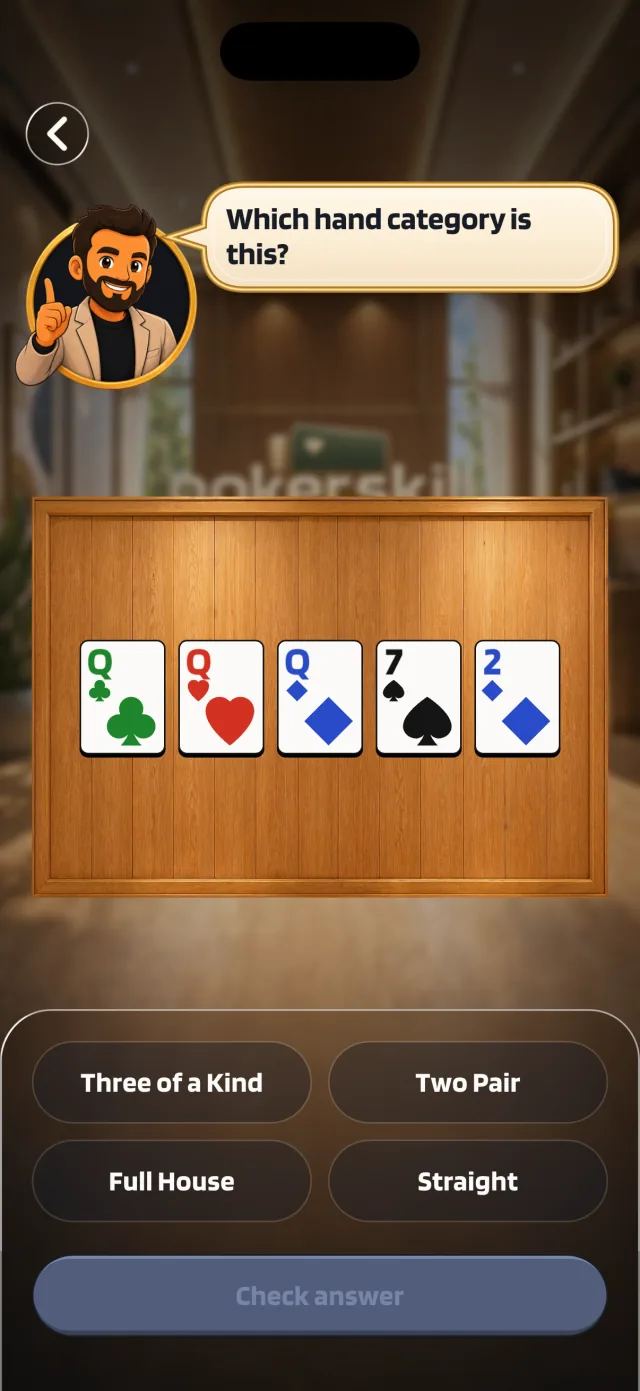
Practice this in Poker Skill. In the c-bet sizing lessons, A♦ 8♦ on 8♣ 7♦ 3♦ takes the big bet, while pocket sixes on 10♣ 9♦ 8♦ check because that board is too wet to bet them for value.
Get the free appDynamic Board
What a dynamic board is
A dynamic board is a flop where relative hand strength can shift dramatically on later streets. In plain terms: the best hand on the flop often won’t remain best by the river. Typical traits include low-to-medium ranks, connected cards, and many possible straight or flush draws.
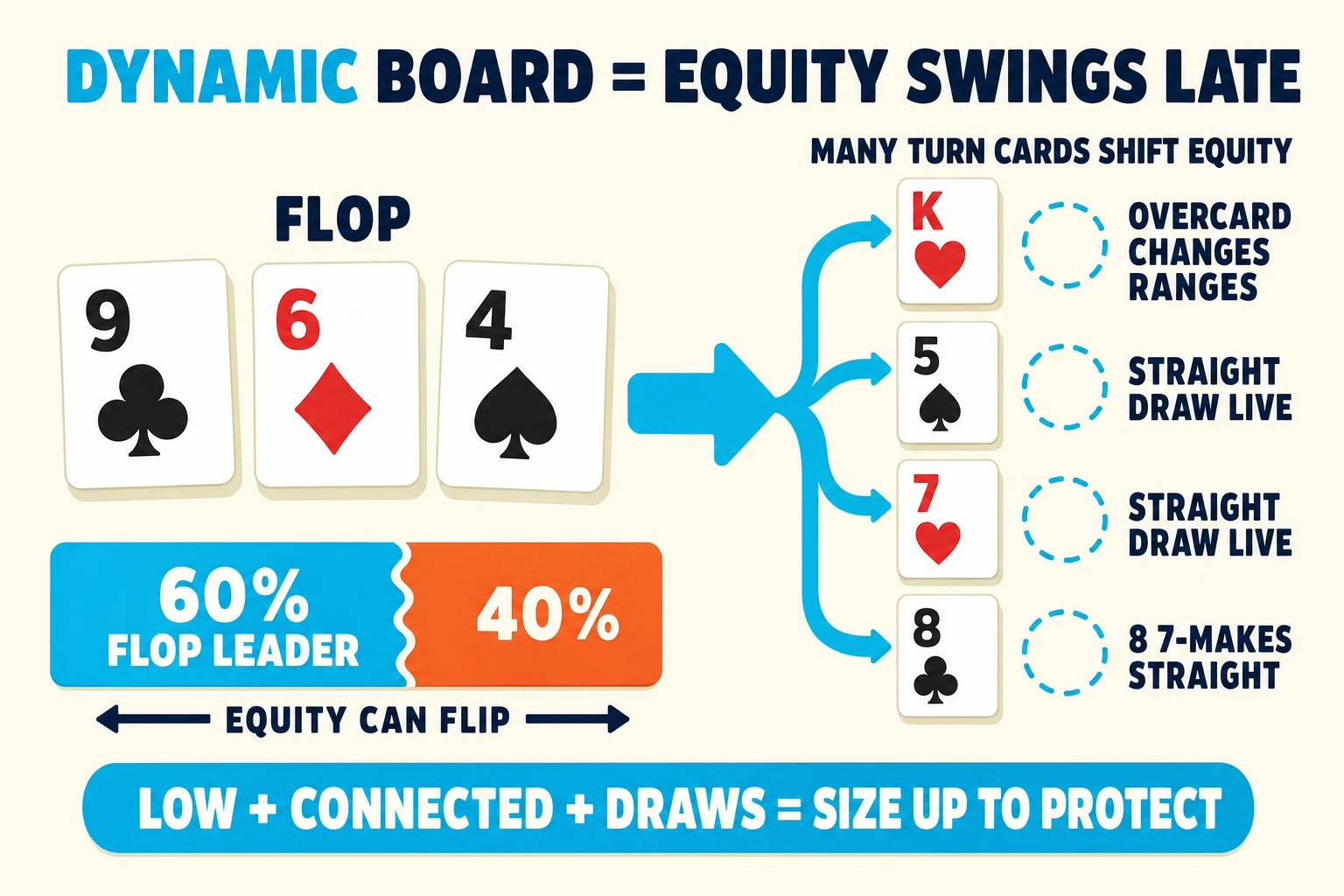
Example: 9♣6♦4♠ is highly dynamic. Many turn and river cards (5, 7, 8, 10, even some face cards) complete straights or open new draws. By contrast, A♠9♠6♠ may look “wet” because of spades, but it often stays more static: top-pair Aces or a made flush on the flop usually remain ahead.
Quick jargon: an “out” is any card left in the deck that completes your draw; an “overpair” is a pocket pair higher than any card on the board.
How to spot a dynamic flop quickly
Spotting dynamic texture fast saves chips. Use this short checklist at the table:
- Scan ranks and connectivity. Look for low-to-medium cards that connect (example: 9-6-4), which make straights likelier.
- Count live outs. If many turn or river cards complete straights or flushes, the board is dynamic. Example: holding 7-8 on 9♣6♦4♠ gives an open-ended straight draw with eight outs.
- Don’t be fooled by “wet” looks. Monotone high-card flops (example: A♠9♠6♠) can appear dangerous but often leave the preflop stronger range ahead.
Use these cues in order: connectivity -> outs -> range context.
Bet sizing principles on dynamic boards
On dynamic boards, size bets to protect and extract value. Key rules:
- Size up with your strongest value hands and most credible bluffs. Big bets deny drawing hands correct odds and seize value before the board changes.
- Bigger sizing serves two purposes: it protects vulnerable holdings (overpairs, top pair) and leverages fold equity against hands with decent but not dominant equity.
- Avoid mostly small, thin value bets that let many drawing hands see cheap turns and rivers.
Concrete example: on 9♣6♦4♠, holding JJ (an overpair) calls for a larger bet to charge hands like 7-8 or pocket pairs that can still outdraw you.
Range construction and in-hand adjustments
Shape your range to maximize fold equity and protect value:
- Polarize your range. Bet with very strong hands and selective bluffs rather than many medium-strength holdings. “Polarize” means your betting range contains mostly nuts/near-nuts and bluffs, not middling hands.
- Protect vulnerable value hands. Size so opponents don’t get correct odds to call profitably with draws.
- Adjust facing aggression. If an opponent raises on a dynamic board, consider how many turn or river cards flip equity. Fold marginal holdings more often because a single turn card can turn your best into second-best.
Practical in-hand rule: if an opponent’s raise prices you to chase draws where many outs remain, fold marginal top-pair-type holdings more frequently.
Solver-backed examples and practical numbers
GTO solvers support aggressive sizing on dynamic textures:
- On flops like 9♣6♦4♠, solvers often favor very large bets-commonly around 120% of the pot-with overpairs, top pair, and strong draws. The goal: win now or force drawing hands to pay dearly.
- On monotone or high-card boards like A♠9♠6♠, solvers recommend small bets (about 25-33% of the pot) because ranges stay more stable and you want to keep weaker hands in for value.
Use these as guides: big sizes to protect and polarize on dynamic boards; small sizes to extract thin value on more static/monotone flops.
Quick checklist
- Identify dynamic features: low/medium ranks, connectedness, many outs.
- Polarize ranges: strong value vs. vetted bluffs.
- Size up aggressively on dynamic flops to protect and extract (consider solver guidance ~120% pot).
- Size down on static/monotone flops to keep weaker hands in (~25-33% pot).
- Let potential turn/river equity shifts drive fold/call thresholds.