


Outs
An "out" is any unseen card that will likely make your hand a winner. In No-Limit Texas Hold'em unseen cards are those remaining in the 52-card deck. Outs drive draw decisions by letting you estimate improvement chances on future streets.

Practice this in Poker Skill. The Check-Call lesson counts the outs of a combo draw: nine diamonds plus eight straight cards make 15 outs, because the two cards that do both are counted once.
Get the free appOuts in No-Limit Texas Hold’em
What an “out” is and why it matters
An “out” is any unseen card that will likely make your hand a winner. In No-Limit Texas Hold’em unseen cards are those remaining in the 52-card deck. Outs drive draw decisions by letting you estimate improvement chances on future streets.
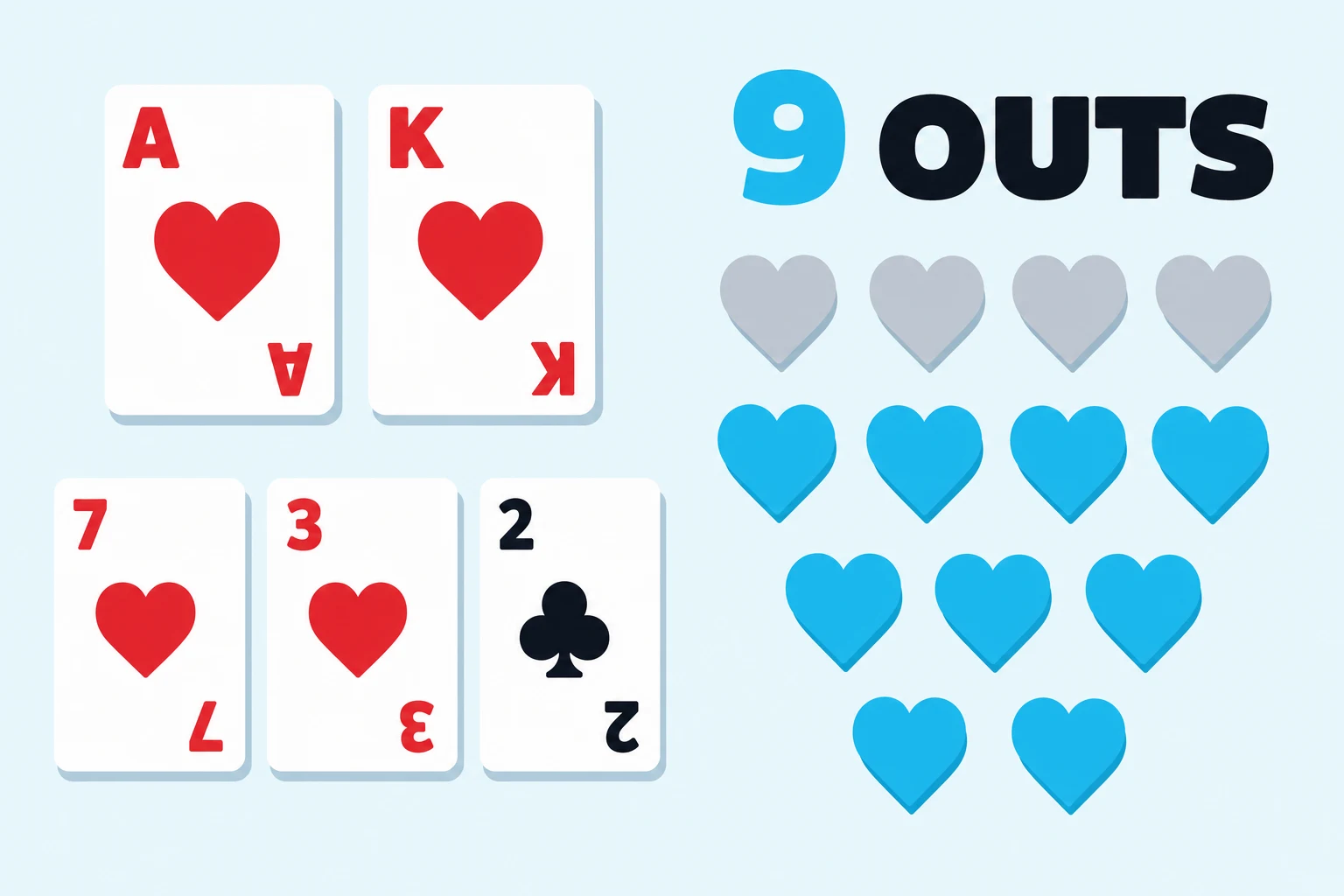
Quick jargon: your hole cards are the two private cards you hold. The flop is the first three community cards, the turn the fourth, and the river the fifth. Example: after the flop you hold two hearts and the board shows two hearts; you have a flush draw. Thirteen hearts exist; four are visible, so nine hearts remain unseen - nine outs.
Knowing outs lets you compare your chance to improve with the pot odds offered. Start by separating clean outs from dirty outs; then use Poker odds explained when you want the full outs, equity, pot-odds, and EV workflow.
How to count outs correctly
Use a simple, reliable method:
- List every card that would give you a likely winning hand on the next street(s).
- Compare that list to the full deck, counting only unseen cards.
- Exclude any cards already visible, including opponents’ face-up cards or known mucked cards.
Common pitfalls:
- Double-counting: if one card completes both a straight and a flush, count it only once.
- Over-valuing outs: outs that still lose to opponent holdings are dirty outs or weaker “phantom” outs.
Also factor opponents’ visible cards and betting into whether some outs remain valid.
For worked examples of which cards stay clean, read Counting outs: clean, dirty, and the ones in between.
Turning outs into hit probabilities (Rule of Four and Two)
Convert outs into quick probabilities with the Rule of Four and Two:
- From flop to river (two cards to come): outs × 4 ≈ percent chance to hit by the river.
- From turn to river (one card to come): outs × 2 ≈ percent chance to hit on the river.
Examples:
- 8 outs on the flop -> 8 × 4 = ~32% to make the hand by the river.
- 8 outs on the turn -> 8 × 2 = ~16% to hit on the river.
These approximations work well for fast, real-time decisions.
Using outs to make pot-odds and EV-based decisions
Pot odds compare the call size to the total pot after calling. They show the percentage chance required to break even on a call.
Steps to decide:
- Count your outs and convert them to a hit percentage using Rule of Four or Two.
- Calculate pot odds as call ÷ (pot + call).
- If your hit percentage exceeds pot-odds percentage, calling is usually +EV; otherwise fold.
Example: pot $100, opponent bets $50. Calling $50 wins $150 total. Pot odds = 50 ÷ (150 + 50) = 25%. If your hit chance exceeds 25%, the call is usually justified.
Outs link directly to EV by quantifying your chance to win future money.
Advanced considerations and common mistakes
- Phantom outs: cards that seem to improve you but still lose to better opponent hands.
- Don’t double-count: count a multi-purpose card only once.
- Implied odds: include potential future bets when a raw call looks borderline. Consider opponent tendencies: will they fold or pay you off?
- Redraws: remember some hands can improve again after you hit, changing equity.
Quick checklist
- Count only unseen cards that complete your hand; exclude seen cards.
- Use 4× outs on the flop and 2× outs on the turn for quick probabilities.
- Compare that probability to pot odds to choose call, raise, or fold.
- Watch for phantom outs, double-counting, and opponent holdings before acting.