


Backdoor Equity
The chance to make a strong hand by catching the right cards on both the turn and the river. A backdoor flush completes about 4% of the time; backdoor straights run a bit higher. Small, real, and worth counting when picking semi-bluffs.
Practice this in Poker Skill. Using it starts with spotting it, and the lesson on out counts drills that: A♣ Q♠ on K♣ 7♣ 2♦ holds three clubs, a backdoor flush draw that needs a club on both the turn and the river.
Get the free appBackdoor equity
What backdoor equity means
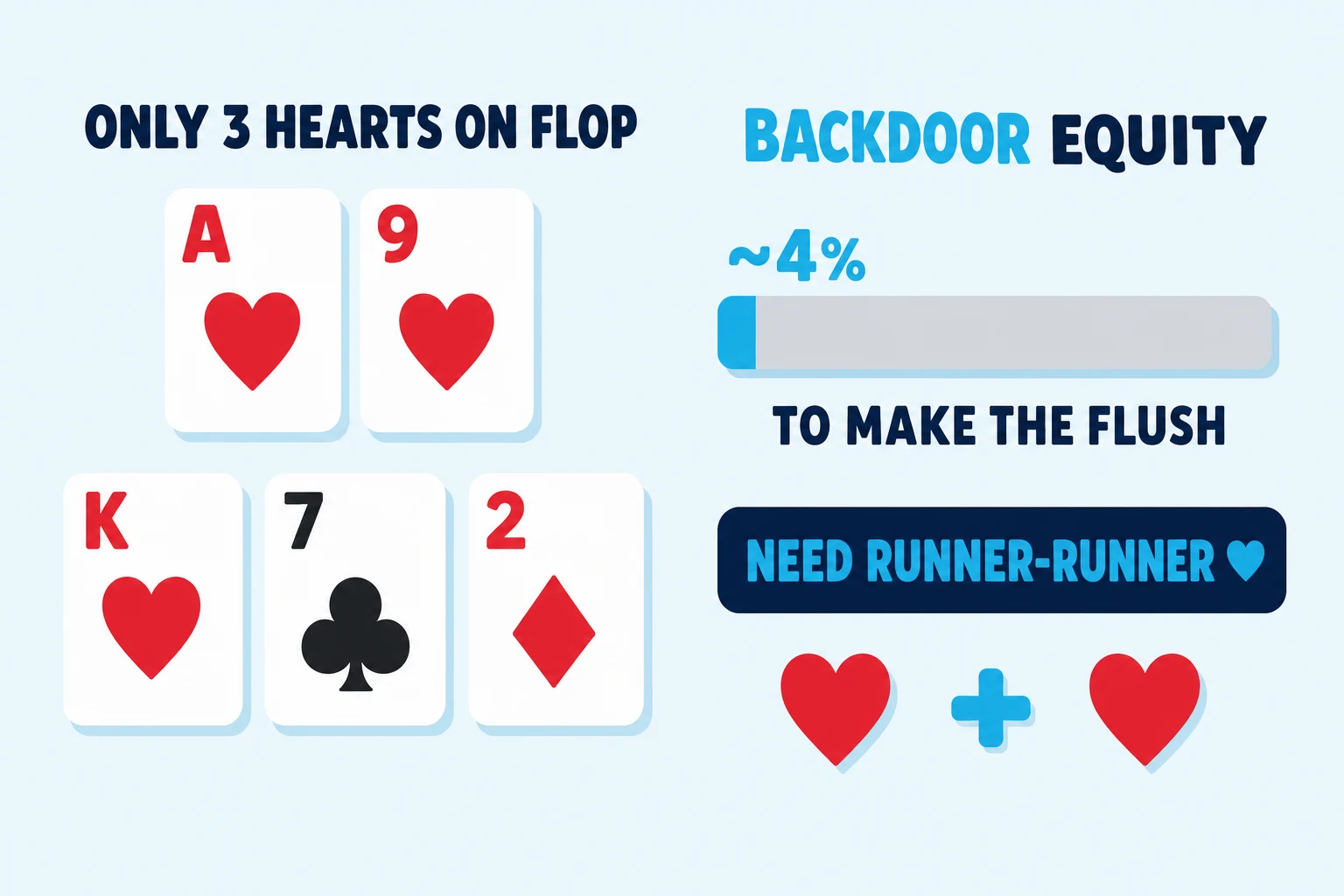
Backdoor equity is the chance to make a strong hand by catching two specific cards on the turn and the river. Those cards were not direct outs on the flop, so you need both streets to cooperate. For example, you hold A♥ 9♥ and the flop is K♥ 7♣ 2♦. Two hearts in your hand and one on the flop is not yet a four-card flush draw; to make the flush you need a heart on the turn and another heart on the river. That sequence is a “runner-runner” or backdoor completion.
Counting turn-and-river combinations
There are 47 unseen cards that can appear on the turn (52 cards minus your two hole cards and the three on the flop). After the turn, 46 cards remain for the river, producing 47 × 46 = 2,162 ordered turn-and-river sequences. Convert sequences into a percentage this way:
- Count favorable turn-and-river sequences that complete your backdoor draw.
- Divide that count by 2,162 to get the probability as a decimal.
- Multiply by 100 to convert to a percentage. For example, if 90 sequences give you a desired runner-runner, your chance = 90 / 2,162 ≈ 4.2%. This combinatoric base explains why backdoor chances are small but exactly calculable.
Typical odds for common backdoor draws
Most backdoor draws complete between about 4% and 12% of the time, depending on how many runner-runner routes exist and how many required ranks or suits remain. A backdoor flush, needing two suited cards, completes roughly 4% of the time. In the Ah 9h example above, only two hearts on turn and river in sequence will make the flush, so probability stays low. Backdoor straights can complete somewhat more often when multiple runner-runner paths exist; more possible rank combinations increase your favorable sequences and raise the probability toward the upper end of the 4%-12% band. Use these ranges as quick mental guides at the table when you don’t want to run full combinatorics.
How to use backdoor equity in strategy
Backdoor equity is small, but it does real work in flop ranges. It justifies semi-bluffs when paired with fold equity, because a small chance of improving plus the chance villain folds can make a bet profitable. Include hands with plausible backdoor routes in your continuation-bet range to keep your aggression credible across runouts. Smaller flop bet sizes on boards with backdoor potential let you apply pressure without bloating the pot when those routes don’t come in. Over many hands, picking backdoor-equity bets in line with position, stack depth, and opponent tendencies adds up.
Recognizing limitations and diluted equity
Not all backdoor outs are clean; completing a runner-runner can still lose if opponents hit stronger hands later. For example, you might make a straight on the river but still lose to an opponent’s full house developing on the board. Watch for blockers and dominated routes: opponents’ cards can remove some of your needed cards or leave your completed hand weaker than likely holdings. Advanced play requires spotting these situations and reducing aggression when your backdoor outs are effectively compromised.
Quick checklist
- Count unseen cards (47 then 46 = 2,162 ordered sequences) before estimating backdoor odds.
- Use the 4%-12% range as a quick guide; remember backdoor flush ≈ 4%.
- Include backdoor equity when planning semi-bluffs and range construction.
- Watch for diluted outs (possible full houses or stronger hands) and adjust aggression.