


Complete
Calling from the small blind to make up the chips needed to match the big blind preflop. The small blind already has half a bet posted, so completing only adds the difference.
Practice this in Poker Skill. With a limper already in, the SB vs One Caller lesson has you complete J♠ 10♠ and 9♥ 9♦ for the cheap flop and raise Q♥ Q♦ for value, even out of position.
Get the free appComplete: when the small blind calls up to the big blind preflop
What “complete” means
To complete is to call from the small blind, preflop, by adding the chips needed to match the current bet (almost always the big blind). The small blind has already posted half a bet, so completing only adds the rest. It is the small blind’s “I am in for one big blind, no raise” option, and it sits between the other two preflop SB choices: fold the half-bet, or raise.
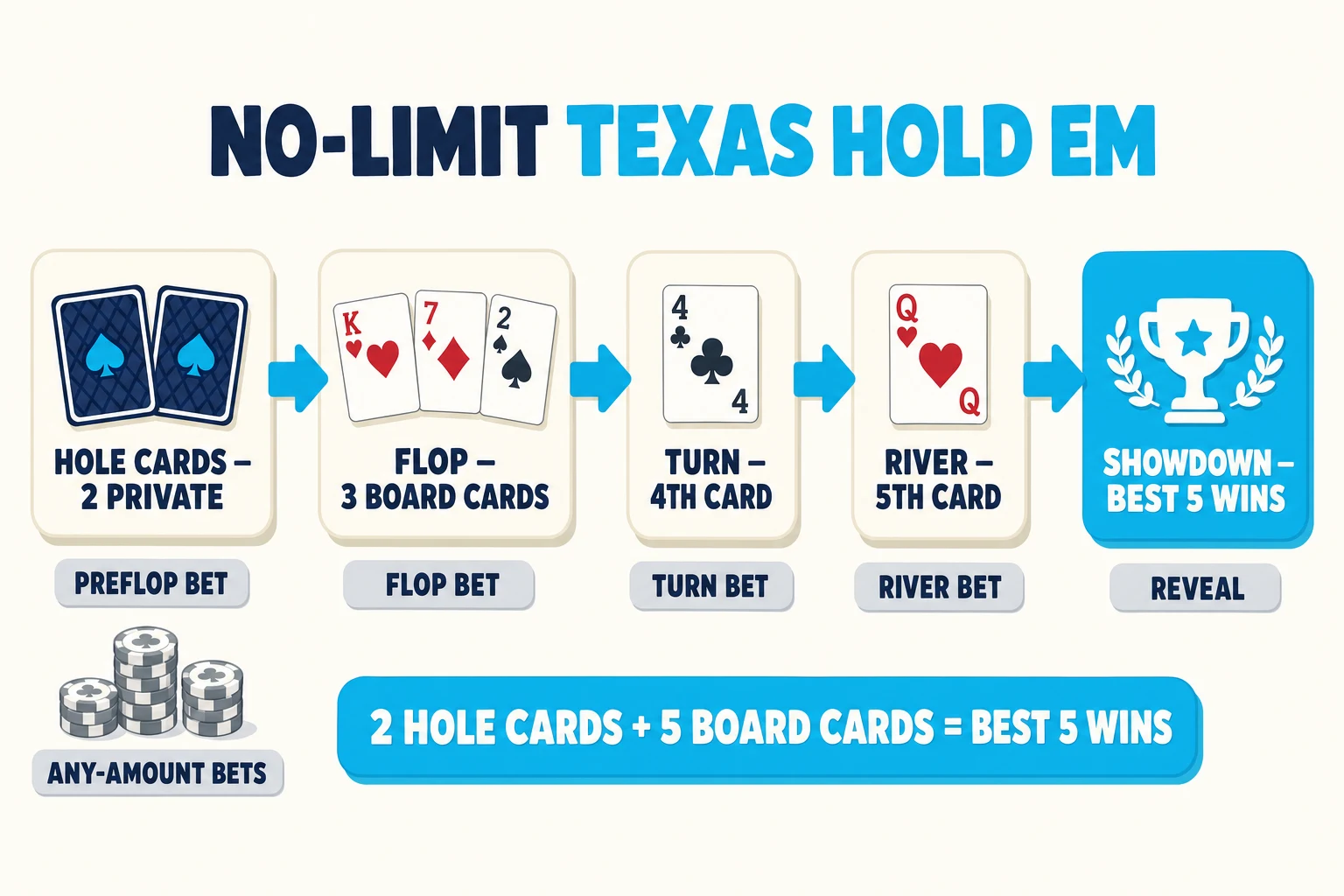
The small blind always faces three options when the action folds to it preflop: fold, complete, or raise. Completing is the lowest-commitment option that still keeps you in the hand. It uses the SB’s “discount” - the half-bet already in front of you - to see a flop for a single big blind out of position, against just the big blind.
A note on game format. In stud games (7-card stud, razz), “complete” describes a different action: the first player to act after the forced bring-in can complete the bet by raising it up to the full small-bet limit. Hold’em readers will mostly mean the small-blind action, and the rest of this entry describes that meaning unless called out.
Related terms
- Small blind - the seat that gets to complete preflop.
- Big blind - the bet you are matching when you complete.
- Limp - calling the big blind preflop without raising; modern usage often treats SB completes and SB limps as the same action.
- Open-limp - first-in limp from a non-blind seat.
- Preflop - the only street where completing exists in Hold’em.
- Raise-first-in - the alternative aggressive SB action.
- Closing the action - what the big blind does next when the SB completes.
Complete vs. limp vs. raise
Modern players often use “complete” and “limp” interchangeably when the SB enters for one big blind. Both put one bb in voluntarily without raising. The mechanical detail is that the SB adds only the missing half-bet because the other half is already posted; an “open-limp” from a non-blind seat puts in a full bb. Strategically the bigger split is between completing and raising: completing keeps the pot small and keeps the BB’s 3-bet less effective; raising takes initiative and tries to win the pot preflop or set up a clean c-bet line.
| Action | Where you can do it | Chips added by SB | Pot after action (BvB) | Why pick it |
|---|---|---|---|---|
| Fold | Any seat preflop | 0 | 1.5 bb | The hand is too weak to play OOP for one bb. |
| Complete | Small blind, action folded to you | 0.5 bb | 2 bb | Speculative hand, want a cheap flop, do not want to invite a 3-bet. |
| Open-limp | Non-blind seat, no one has entered | 1 bb | 2.5 bb | Almost never correct in modern cash; rake plus position math punish it. |
| Raise (RFI) | Any seat including SB | 2.5-3 bb | ~3.5-4.5 bb | Strong hand, want to deny BB equity, or build a pot you want to play big. |
A practical reading of GTO solver baselines for blind-versus-blind 6-max cash at 100bb: roughly a third of SB hands complete, a quarter raise, and the rest fold. Limping more than raising is unusual elsewhere in the preflop tree; blind-versus-blind is the place where it is correct.
When this matters most
Completing is a real decision, not a default. A few spots where it changes the hand most:
- Speculative hands you would not raise. Suited connectors, small pairs, weaker suited aces - hands that want to flop a piece against a wide BB defending range and dislike paying 3-bet pressure.
- Out-of-position discomfort. SB plays the rest of the hand OOP. Smaller preflop pots cap how badly that hurts you when you miss.
- Tough or aggressive big blinds. A BB who 3-bets a lot punishes a wide SB raising range. A wider completing range is your buffer.
- Deeper stacks. Solver baselines push SB toward more limping and less raising as stacks deepen - the cost of building a pot OOP keeps going up.
- Loose, passive games. When the BB rarely raises over a complete and rarely defends well postflop, completing in to take a flop with a big chunk of your range is cheap and keeps you out of bloated OOP pots.
It matters less when stacks are short. With about 17 bb and below, the SB’s preflop tree compresses into push, limp, or fold; with about 10 bb and below it usually shrinks further to push or fold. The “complete and play poker” texture of the action lives in deeper-stacked play.
Worked example
You are in the small blind in a $1/$2 6-max cash game, 100 bb deep. UTG, HJ, CO and BTN all fold. Action is on you with 7♠ 6♠.
The pot is $3 - your $1 small blind plus the big blind’s $2. Completing costs $1 more. You complete; the pot is now $4 and the big blind has the last action preflop.
The big blind checks with K♦ 9♣. Flop comes 8♠ 5♥ 2♠. You have an open-ended straight draw plus a flush draw and BB checks. You bet $2 into $4 and BB folds.
What completing bought you in this hand: a 1 bb investment to reach a flop where 7♠ 6♠ has a draw with strong equity against the BB’s checking range. If you had raised to $6 preflop instead, the pot would already be $9 going to the flop, and a missed flop or a 3-bet from BB would have cost more than the hand was worth. If you had folded preflop, you would have surrendered an SB discount on a hand that flops well.
A second example, against a different BB. Same spot, same hand, but the BB is a regular who 3-bets the SB north of 20% of the time. Now the case for completing is even stronger: raising to $6 invites a 3-bet to ~$22 that turns 7♠ 6♠ into a fold-or-call-OOP problem. Completing keeps the pot at $4 and lets you play your draw on a flop or quietly fold against a BB raise.
Common mistakes
1) Treating complete as the default with every weak hand
Junk like 8♣ 3♦ does not flop well enough to make 1 bb out-of-position profitable, even at the SB discount. Solver baselines fold the bottom third of the SB range. If a hand cannot make a pair, a draw, or a backdoor with any decency, fold the half-bet rather than complete.
2) Completing when there is a straddle or an opener still live
Completing is the SB option when the action folds to you. If a button straddle is live, or someone already opened, you no longer have a complete option - you are calling a raise, and the math, the pot odds, and the right ranges all change. Not all the chips you put in are “completing” the same partial bet.
3) Limp-folding the half-bet when raised
Completing a wide range is fine; folding the same range when the BB raises a check-back-able 3.5 bb is a leak. Build a small re-raise / call / fold tree against typical BB iso sizes. Completing is not a way to give up your bb cheaply once the BB raises.
4) Ignoring rake on tiny pots
The math that makes SB completing reasonable assumes a rake structure capped on small pots. In a high-rake live or online game where rake is taken even from limped pots, the SB discount shrinks and the case for completing weakens against folding. Always look up the table’s rake before treating completing as automatic.
FAQ
Is completing the same as limping?
In modern Hold’em usage, yes - when the SB calls one big blind preflop, “complete” and “limp” describe the same action. The mechanical wrinkle is that the SB only adds the missing half-bet because the other half is already posted, while an open-limp from another seat puts in a full bb. Strategically they sit in the same family of “enter for one bb without raising” choices.
Why would I ever complete instead of just raising?
Two reasons. First, raising builds a pot you have to play out of position, and the EV of that goes down on speculative hands and against aggressive 3-bettors. Second, splitting your range into a complete-and-raise mix protects your raises from being read as only premiums, which keeps the BB from over-3-betting profitably. Solver baselines for 100 bb 6-max cash blind-vs-blind complete more hands than they raise.
Does the small blind have to complete if everyone folds to it?
No. The SB has three options: fold the small blind, complete to one big blind, or raise. There is no rule that requires completing. Some new players assume they have to “play” their SB; nothing in the rules forces that, and folding the bottom of the SB range is normal and correct.