


Made Hand
A made hand is a hand that already has showdown value without needing future cards to complete. Top pair, two pair, sets, straights, and flushes are all made hands; the contrast is a draw, which still needs an out to finish. In No-Limit Texas Hold'em, recognizing a made hand is the first step in deciding whether to bet for value, control the pot, or fold to pressure. Not every made hand should always bet — strength runs on a spectrum from weak made hands like bottom pair to strong made hands like sets and flushes.

Practice this in Poker Skill. The Draws vs Made Hands lesson works through the split, dealing four hands on one board and asking you to pick the two that are still drawing.
Get the free appMade Hand in No-Limit Texas Hold’em
What a made hand is and why it matters
A made hand is a hand that already has showdown value without needing future cards to complete. Top pair, two pair, sets, straights, and flushes are all made hands; the contrast is a draw, which still needs an out to finish. In No-Limit Texas Hold’em, recognizing a made hand is the first step in deciding whether to bet for value, control the pot, or fold to pressure. Not every made hand should always bet — strength runs on a spectrum from weak made hands like bottom pair to strong made hands like sets and flushes.
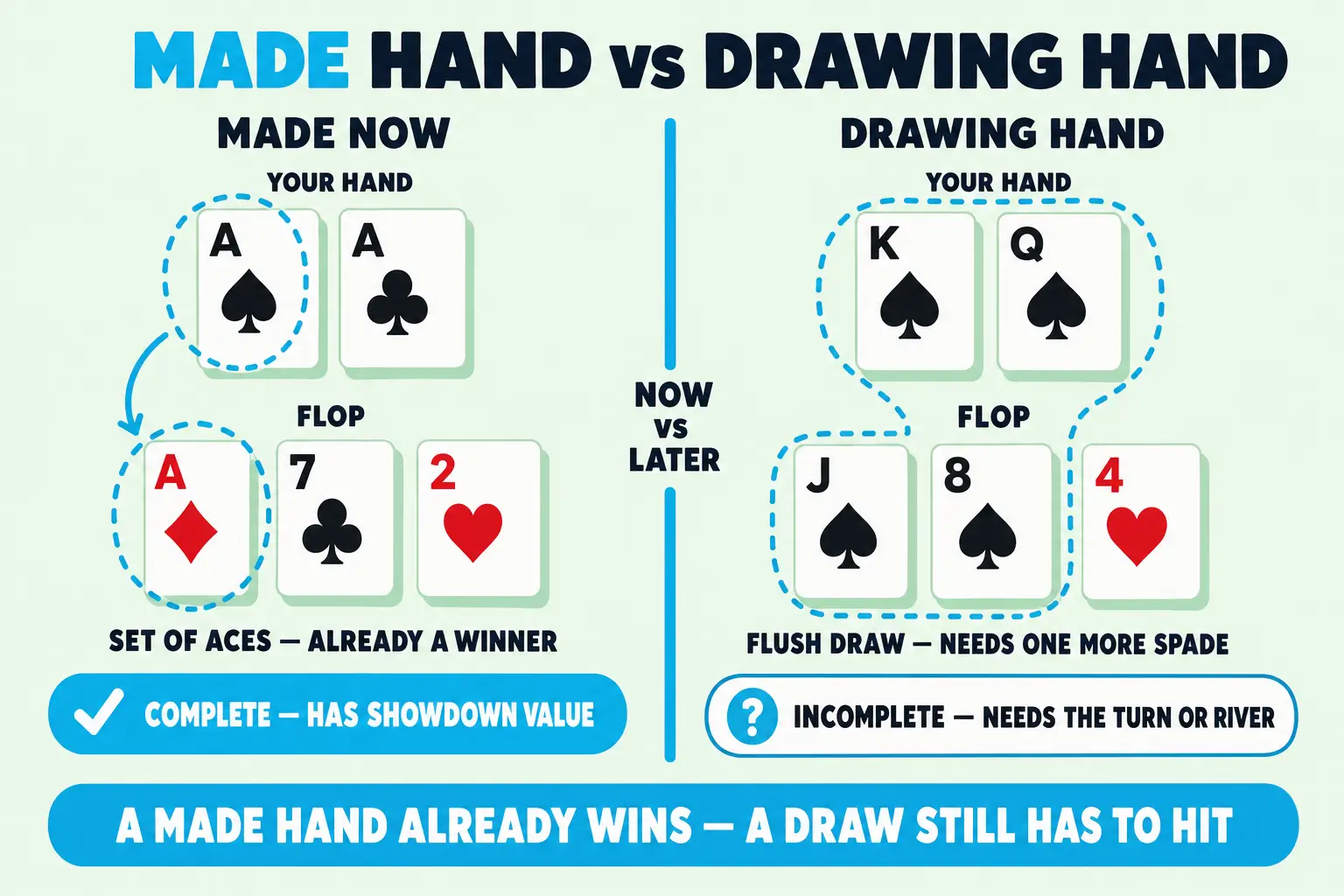
Made hand vs drawing hand
The distinction sets up almost every postflop decision:
- A made hand is a complete five-card hand right now. It can win at showdown without improving.
- A drawing hand is incomplete. It needs a specific out, usually one of nine flush cards or eight straight cards, to become a made hand.
The two categories shape different goals. With a made hand, you are usually trying to extract value or protect against draws. With a drawing hand, you are weighing pot odds, implied odds, and fold equity to decide whether continuing is profitable. Some hands sit in both categories at once: a pair plus an open-ended straight draw is a made hand and a draw, and that combination usually plays stronger than either piece alone.
The made-hand spectrum: weak, medium, and strong
Calling something a made hand does not say much about how to play it. Walk the spectrum from weak to strong:
A weak made hand wants to see a cheap showdown. A medium made hand often plays as a bluff-catcher: good enough to call one bet, not strong enough to invite three. A strong made hand wants to build the pot before scare cards land. The same nominal hand class can shift tiers as the board changes; top pair on A♣ 7♦ 2♠ is firmer than top pair on J♦ 10♦ 9♣.
When a made hand should not just bet
Beginners often treat “I have a made hand” as a green light to bet every street. That reflex costs chips in two specific spots:
- Marginal made hands out of position. With middle pair on a coordinated flop, betting often folds out worse hands and gets called only by better hands. Checking keeps your opponent’s bluffs in the pot. Use a value bet when worse hands will call; check or call when betting mostly invites trouble.
- Strong made hands on dynamic boards. Slow-playing a set on a two-tone, connected flop lets draws in cheaply. The right line is usually to bet, even though the hand is strong, because letting opponents draw for free costs more than the action you would gain by trapping.
The rule is not “always bet” or “always check” — it is “bet when worse hands will call or when you need to charge a draw, and check when betting mostly converts your hand into a bluff-catcher facing a raise.”
How board texture changes a made hand’s value
A made hand’s strength is relative to the current board, not absolute.
- Dry boards (uncoordinated, few draws) like K♠ 7♣ 2♦ favor made hands. Opponents who continue tend to have made hands themselves, and your top pair stays valuable across streets.
- Wet boards (connected, two-tone, multiple draws) like 9♠ 10♠ J♥ punish made hands. Opponents’ continuing ranges include flush draws, straight draws, and combo draws. The same top pair that was a premium hand on a dry board becomes a hand that mostly wants to charge draws and avoid bloated pots.
A turn or river card can downgrade a strong made hand quickly. An overcard to your top pair, a third card of a suit completing a flush, or a connector that finishes a straight all shrink your relative equity in one card. Reassess each street; do not assume the hand category you held on the flop still describes the hand you hold on the river.
Common mistakes
- Treating every made hand as a value bet. Bottom pair and weak medium pairs prefer pot control, not three-street betting lines.
- Slow-playing a strong made hand on a wet board. Letting flush and straight draws see free turns is more expensive than the extra calls a slow-play might earn.
- Anchoring on the flop category and ignoring the turn. A top pair becomes a marginal hand the moment an obvious draw completes; play the current board, not the one you flopped.
- Betting bigger to “protect” a marginal made hand. Oversized bets fold out worse hands and only get called by better ones, which is the opposite of what you want.
- Forgetting that a made hand can still lose. Completing a flush or straight matters only if your made hand beats the opponent’s plausible range; a non-nut flush on a paired board can be drawing thin.
Quick checklist
- Identify whether you have a made hand at all, or a hand that still needs an out.
- Place the made hand on the spectrum: weak, medium, or strong.
- Read the board texture; downgrade your made hand’s tier on wet boards.
- Match the line to the tier: value bet strong, pot-control medium, get-to-showdown weak.
- Recheck after each street; treat scare cards as forced re-evaluations, not just turn cards.