


Lowjack
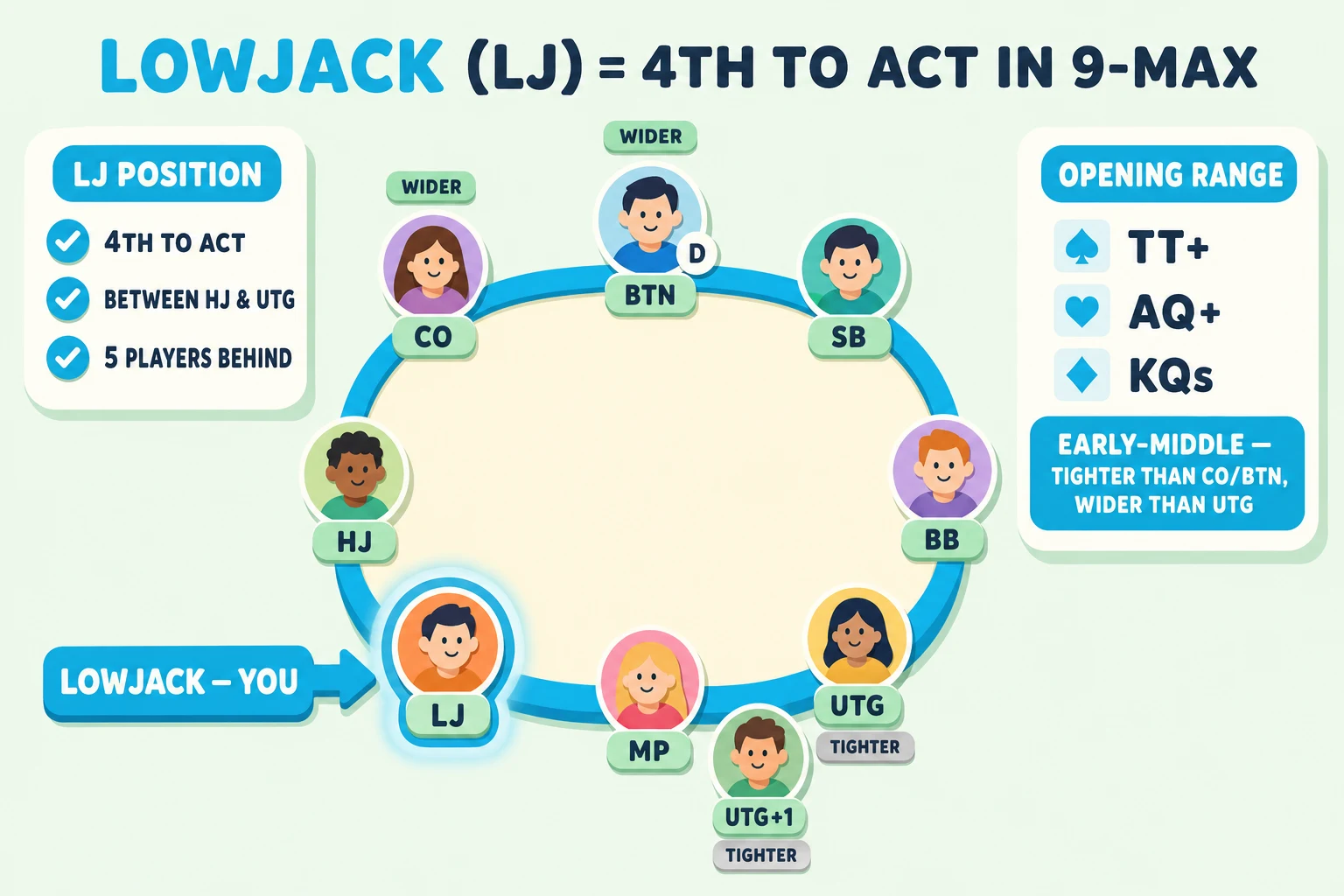
The fourth seat to act preflop in a 9-handed game, sitting between Under the Gun and the Hijack. Open tighter than late position; five players still act after.
Practice this in Poker Skill. Every lesson table has six seats, so the seat just before the hijack is under the gun, and the lesson on that seat keeps the range tight: A♥ Q♥ and 10♠ 10♥ raise, while A♠ 9♥, a weak offsuit ace, folds.
Get the free appLowjack (LJ) - Clear, Practical Guide
What the Lowjack is and where it sits
- The Lowjack (LJ) is typically the fourth seat to act pre-flop at a nine-handed table. It sits between the Hijack (HJ) and Under the Gun (UTG). (UTG is the first player to act pre-flop; HJ sits two seats to the right of the button.)
- Sometimes called “middle position,” the LJ is better seen as early-to-middle: you have more info than UTG but still face several players acting after you.
- That placement matters because the Cutoff (CO), Button (BTN) and the blinds still act. Opening or calling from LJ carries more pre-flop risk than from CO or BTN.
Opening ranges from the Lowjack
- Open slightly wider than UTG but keep tighter than late positions. Don’t use LJ to steal frequently; prioritize stronger holdings that can withstand later action.
- Favor hands that make top pairs or have solid postflop playability. Avoid speculative hands that rely on acting last, such as small suited connectors.
- Expand only when the table justifies it: add hands if late players fold too often or the blinds play passively. Tighten up when the table is aggressive.
Pre-flop tactics: handling 3-bets and squeezes
- A 3-bet is a re-raise after your open. A squeeze is a re-raise after you open and one or more players have called.
- Expect 3-bets and squeezes from CO, BTN and aggressive blinds. You’ll often be out of position postflop, so respect large pre-flop aggression.
- Practical reactions (range-based): Fold: release marginal hands that lack postflop playability and struggle out of position. Call: defend with hands that retain good equity and can realize value despite being out of position. 4-bet: use polarized 4-bets with strong value hands or credible bluffs when fold equity matters.
- Example: versus a standard 3-bet, tighten calling ranges and reserve 4-bets for commit-able hands or clear bluffs. Avoid thin calls that create difficult postflop spots.
Tournament adjustments for Lowjack play
- In tournaments LJ bridges early tight play and the wider middle game as antes and aggression rise. Adjust opens based on effective stack depth.
- With deep stacks widen some hands because implied odds increase. With short or medium stacks tighten and fold hands that cannot get chips in profitably.
- Account for payout pressure (ICM - independent chip model) and bounties. When survival or ICM protection matters, preserve fold equity and avoid marginal confrontations that can cripple your stack.
Postflop play and table-dynamics considerations
- Being out of position to many players makes speculative hands harder to realize. Favor strong made hands and those that flop well.
- When you c-bet, expect calls or raises from CO, BTN and the blinds; size bets accordingly. Check back with hands that block opponent ranges or retain good equity.
- LJ opening frequency shapes 3-bet and squeeze dynamics. Tighter opens reduce squeezes, while well-timed aggression can win pots preflop. Adjust bet sizes and aggression to the tendencies of players acting after you.
Quick checklist
- Locate the LJ: fourth to act pre-flop (between HJ and UTG) at nine-handed tables.
- Open slightly wider than UTG but stay relatively tight and disciplined.
- Factor likely 3-bets and squeezes from later positions into every decision.
- Adjust ranges and aggression for stack size, tournament stage, and payout pressure.
- Favor strong, postflop-friendly hands over speculation when acting from LJ.