


Rock
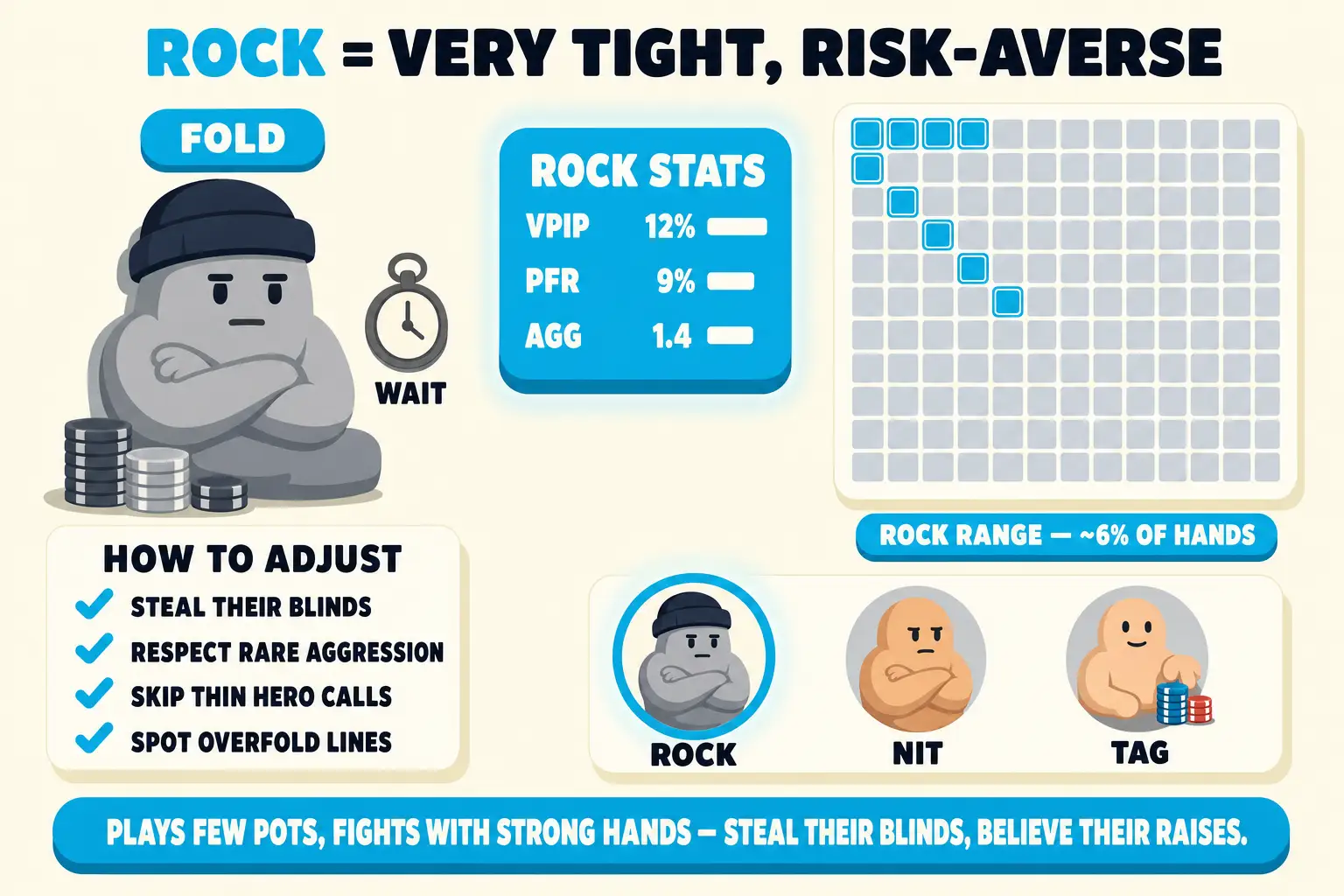
A rock is a very tight, risk-averse player who enters very few pots and usually shows up with strong holdings when they do continue. The label is a table read built from repeated folds and tight showdowns, not a permanent identity stamped on after one folded blind.
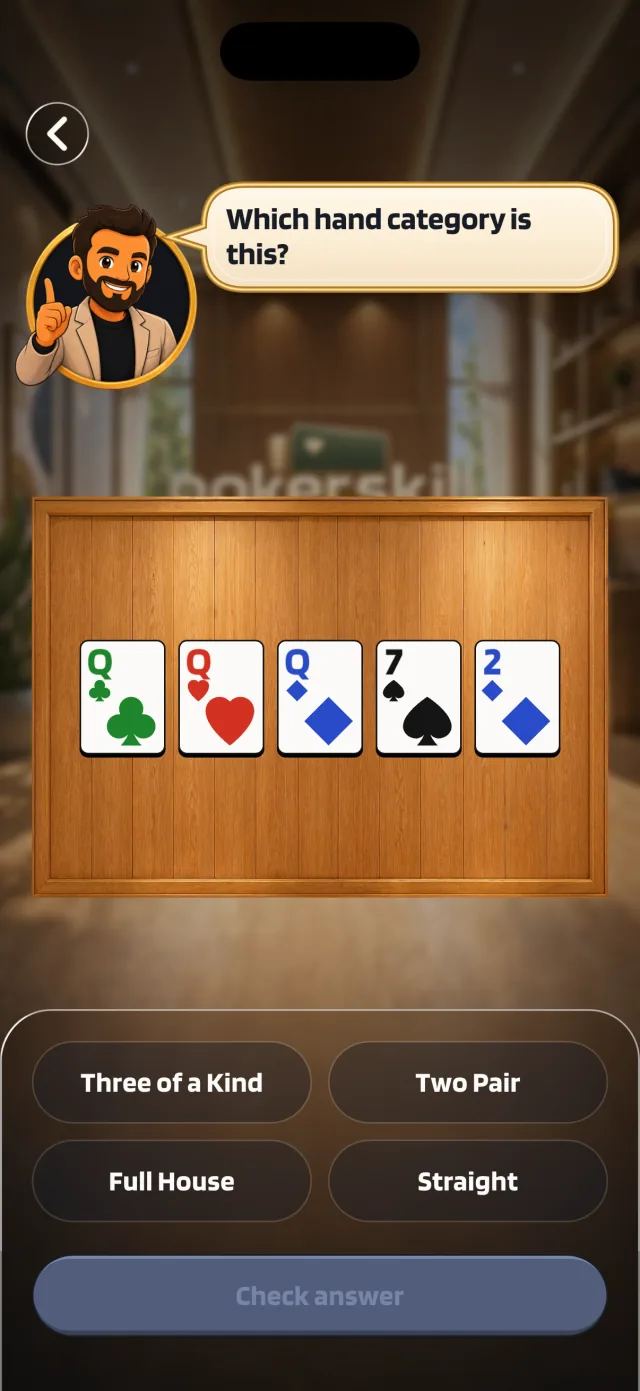
Practice this in Poker Skill. A rock overfolds to pressure, and the Good Barrel Cards lesson practices when to fire a second barrel: when the turn grows your threat, like a jack that gives king-ten a straight draw, and not when the card helps the caller.
Get the free appRock: a very tight, risk-averse player profile
What a rock is
A rock is a very tight, risk-averse player who enters very few pots and usually arrives at the river with a strong holding when they continue. The shorthand sticks because the behavior reads as immovable: most hands are folded preflop, postflop bets are credible, and the player rarely picks up bluffs of their own. A rock minimizes exposure to marginal spots and is willing to wait an orbit or two without putting chips at risk. This is a table read built from repeated folds and tight showdowns, not a label you can fairly stamp on someone after one folded big blind.
Related terms
- Nit: a very near synonym, often used for a more extreme or more passive shade of the same archetype.
- TAG: tight selection paired with steady aggression once entering a pot — a rock is the same on selection but quieter postflop.
- Regular: the broader category most rocks sit inside; calling someone a rock is a finer-grained read than calling them a reg.
- Tight-first: a learning strategy, not a player insult — a rock is the read, tight-first is a beginner’s discipline.
- VPIP and PFR: the two preflop counts that anchor any rock read.
- Aggression factor: the postflop ratio that separates a rock from a TAG at the same VPIP.
- Table image: how a rock looks to the rest of the table after a few orbits of folds.
- HUD: the on-screen readout where a rock’s tight stats jump out fastest in online play.
Rock vs neighboring archetypes
Most player labels resolve once you read two axes at once: how often they enter pots (loose vs tight) and how often they bet or raise versus call or check (aggressive vs passive). A rock sits in the very-tight corner, leaning passive once a hand starts.
| Archetype | Tight or loose | Aggressive or passive | Quick read |
|---|---|---|---|
| Rock | Very tight | Mostly passive | Folds most hands, usually has it when continuing, rarely runs multi-street bluffs. |
| Nit | Very tight | Mostly passive | A near synonym; often used for an even tighter or more passive shade of the same shape. |
| TAG | Tight | Aggressive | Plays a narrow range and keeps firing postflop with c-bets, double barrels, and three-bets. |
| Regular | Varies | Varies | A broader bucket — most rocks are regs, but not every reg is a rock. |
| Tight-first | n/a | n/a | A study posture for a learner, not a read on a real opponent. |
The rock label is a read, not a verdict. The same player can look like a rock at one stake and behave like a TAG at another, and a few orbits of cold cards can make any disciplined player look tighter than they really are.
Reference stat lines that read like a rock
Rocks are easiest to spot in tracker software, where the preflop counts give them away. The numbers below are reference points, not a definition of “rock”; the read sits in the combination, not any single stat.
| Stat | Typical rock range | What it means |
|---|---|---|
| VPIP | 8 to 14 | A small share of hands voluntarily entered. |
| PFR | 6 to 11 | Most voluntary entries come in as raises, not limps. |
| VPIP/PFR gap | About 2 to 4 | Limps and flat-calls stay rare. |
| Aggression factor | About 1.0 to 1.8 | Bets and raises do not clearly outpace calls postflop. |
| 3-bet | Around 2 to 5 percent | Three-bet share preflop is light. |
| Fold-to-3-bet | High | A rock surrenders to most three-bets unless holding a premium. |
A rock typically sits below a TAG on every count. A TAG anchored near 22 VPIP with an aggression factor near 2.5 still reads as tight; a player anchored near 11 VPIP with an aggression factor near 1.4 reads as a rock. Once the aggression factor lifts back toward 2 at the same selection, the read drifts toward TAG. Once VPIP drops below the high single digits with the postflop quiet still in place, the read drifts toward an extreme nit.
Position changes the picture. A rock who sits at 11 VPIP often plays barely anything from early seats and only a small share even from the button. The aggregate flattens that out.
Why this read matters at the table
A rock read is most useful in spots where you have very little else to lean on:
- A new opponent at the table whose first preflop raise has just landed in front of you.
- Defending the big blind versus a rock who opens from the cutoff or the button.
- Choosing whether to call a turn or river bet from a rock who has fired twice already.
- Deciding whether to barrel a second street into a rock who flatted your c-bet.
The read becomes less useful as postflop hands stack up. After a few dozen hands of seeing how the player handles double barrels, check-raises, river overbets, and bluff-catch spots, those concrete frequencies carry more signal than the archetype label. Use the rock read as a starting frame, not a closing argument.
Example: same low VPIP, different stories
Two players sit at a 6-max $1/$2 cash table. Both show roughly VPIP 11 and PFR 9 over a sample of a few hundred hands. The aggregate looks identical.
- Player A: 11 / 9, AF 1.4, fold-to-cbet 65 percent.
- Player B: 11 / 9, AF 2.4, fold-to-cbet 45 percent.
Player A reads like a textbook rock. They open from the cutoff with A♣K♦, get called, miss a 9♥ 7♠ 4♦ flop, and they often size up a c-bet only with the strong half of their range. They three-bet sparingly and almost never run a second-barrel bluff on a brick turn. When they do bet the river, they usually have it.
Player B looks like a tight TAG even on the same preflop counts. Same A♣K♦ open, same 9♥ 7♠ 4♦ flop — but Player B keeps firing postflop, double-barrels a J♠ turn often enough that overfolding fails, and three-bets a balanced share preflop. The same 11 / 9 line was telling two very different stories. Aggression factor and fold-to-cbet pulled the read apart.
The rock read is preflop tightness plus postflop quietness. Either half on its own is incomplete.
Common mistakes when reading a rock
1) Stamping the label on after one folded blind
Anyone can fold a few orbits in a row. Cold cards, table dynamics, or a couple of three-bet wars elsewhere can make a normal player look like a rock for half an hour. The rock read calls for repeated folds and a handful of tight showdowns where the showdown range matches the bet line. One folded big blind is not a read; it is one folded big blind.
2) Confusing rock with nit
The two labels overlap heavily, and many players use them interchangeably. Where they diverge is shade: nit usually implies an even tighter or more passive version of the same archetype, while rock often implies someone who still raises their premiums and defends their value range. If the player you tagged as a rock check-folds three turns in a row in spots where any pair would call, the read is sliding toward nit.
3) Forcing thin hero calls because the player “must be bluffing again”
A rock’s river bet is rarely a bluff. Most river overbets, donk leads, and three-streets-of-aggression lines from a rock represent the strong end of their range. Talking yourself into a thin hero call against a rock because the bet looks “weird” is one of the most common ways to misuse the read.
4) Missing the overfold opportunity
The flip side is just as common. Rocks fold to three-bets and to second barrels more often than balanced ranges suggest. Skipping a credible three-bet bluff or a second-barrel bluff in a clearly overfold-prone line wastes the leak. A rock read is not just a “do not call” sign; it is also a “more pressure works” sign.
5) Treating one stake’s rock as every stake’s rock
The same player can be a rock at $5/$10 and a TAG at $0.50/$1, or the reverse. Stakes change the surrounding pool, the typical aggression in 3-bet pots, and the player’s own stack-to-pool ratio. Carry the read across sessions, not across stakes.
FAQ
What VPIP and PFR count as a rock in 6-max cash?
A rough reference is VPIP in the 8 to 14 range with PFR in the 6 to 11 range and an aggression factor near 1.0 to 1.8. The specific numbers matter less than the combination: tight selection paired with quiet postflop play. Above that VPIP, the read drifts toward TAG; below it, the read drifts toward an extreme nit. Position-by-position frequencies are closer to the truth than the aggregate when you are deciding a single hand.
Is a rock the same as a nit?
The terms overlap, and many players use them interchangeably. The most common shading is that a nit is the more extreme, more passive end of the rock archetype — folding even more, defending blinds even less, and rarely fighting back postflop. A rock typically still raises their premiums and defends their value range. Treat both labels as table reads built from repeated behavior; do not lock in the distinction after a single hand.
How is a rock different from a tight-first beginner?
A rock is a read on an opponent. Tight-first is a learning posture a player adopts on their own — fewer hands, premium-heavy selection, and disciplined value betting while the fundamentals settle in. A tight-first beginner who has not yet added postflop aggression will look like a rock from the other side of the table, but the labels live in different boxes: one describes how someone is studying, the other describes how someone is playing. Calling a rock “tight-first” is a mismatch of frames.
Should I avoid every pot with a rock?
No. Rocks are easiest to attack preflop in steal spots, and they fold to three-bets and to second barrels more often than balanced ranges suggest. The advice that “matters” against a rock is to respect their rare aggression — believe river overbets, skip thin hero calls — while still picking up the light spots their tightness leaves behind. A rock is not untouchable; they are predictable, and predictable players show up in two directions.