


Tight-First
"Tight-first" means you play fewer hands and focus on strong starting cards. Fold marginal or speculative holdings-hands that depend on specific flops, like small suited connectors. Enter pots only when your odds favor you. The goal is simple: minimize avoidable losses and raise the chance your hand is best.

Practice this in Poker Skill. The first strategy lessons start tight: ace-queen opens under the gun, while queen-ten offsuit folds there as a common trouble hand.
Get the free appTight-First Strategy in No-Limit Texas Hold’em
What “Tight-First” Means
“Tight-first” means you play fewer hands and focus on strong starting cards. Fold marginal or speculative holdings-hands that depend on specific flops, like small suited connectors. Enter pots only when your odds favor you. The goal is simple: minimize avoidable losses and raise the chance your hand is best.
Example: instead of playing J-9 suited from early position, a tight-first player folds it and waits for A-K or a high pair.
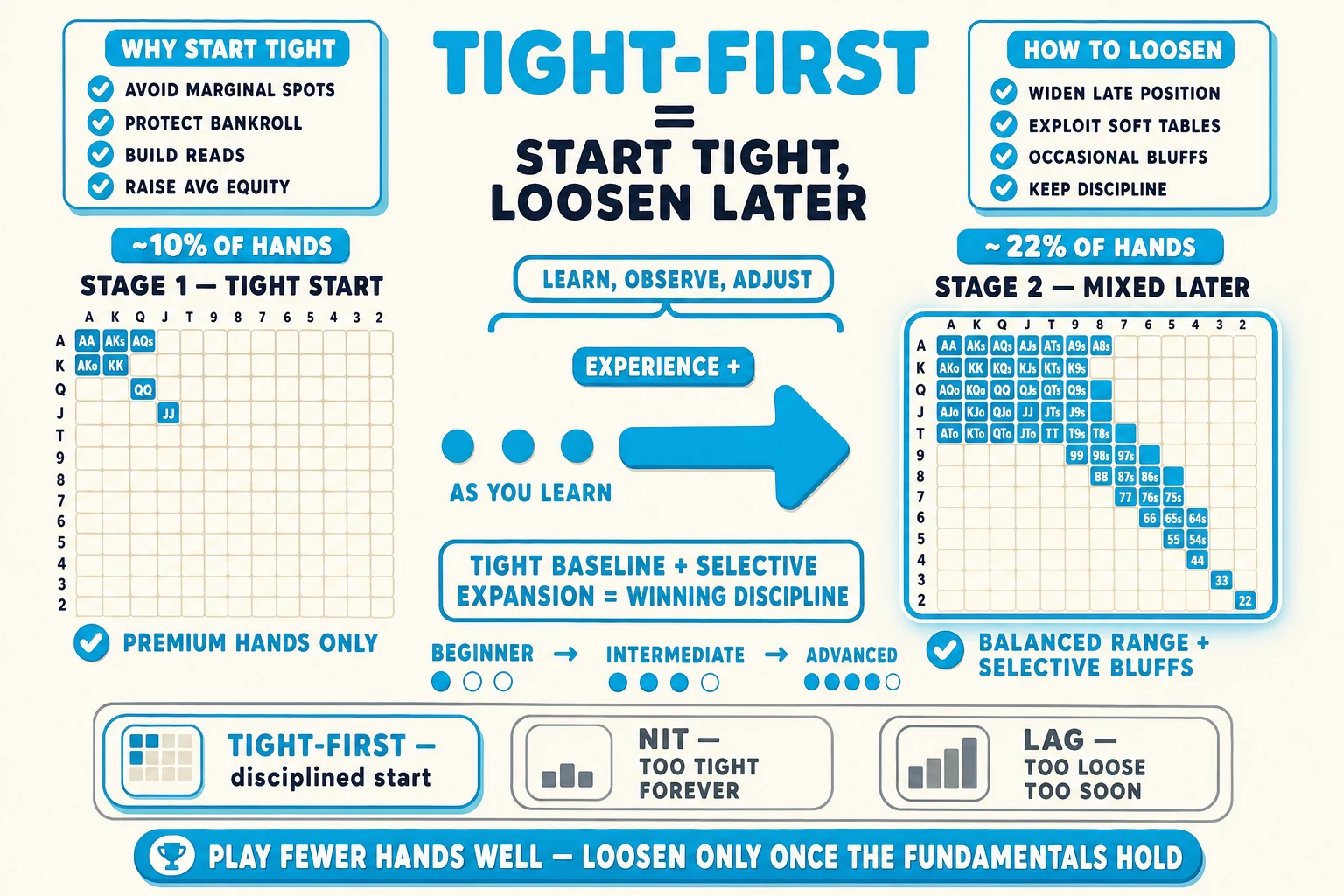
Choosing Starting Hands (Core Selection)
Be highly selective. Prioritize premium pairs (AA, KK, QQ) and high-card combos (AK, AQ). Avoid wide speculative ranges-weak offsuit hands and small connectors that need perfect flops. Playing fewer hands increases your average pot equity when you commit chips.
Concrete guideline: treat your opening range like a defined list for each seat. From early position, play top pairs and broadway hands (A-K, A-Q, K-Q). As you move later, widen slightly, but keep the baseline tight.
Playing When You Enter a Pot (Value and Aggression)
When you enter a pot, convert equity into chips with disciplined aggression. Value bet to get worse hands to call when you believe you are best. Aggression means betting and raising with real strength, not random bluffs or passive check-calling.
Practical steps:
- Open-raise standard sizes with premium hands to isolate opponents.
- On favorable flops, bet for value-top pair with a good kicker deserves a bet.
- If you hit strong draws or made hands, raise to build the pot when likely ahead.
Example: you raise with A♠K♠, get called, and the flop brings K♦7♣2♠. Bet for value-opponents with weaker kings or high cards often call.
Risk Management and Long-Term Goals
Tight-first reduces variance by avoiding marginal spots where big losses occur. Folding weak holdings protects your stack and preserves tournament life. Playing fewer, higher-quality pots supports steady chip accumulation and consistent bankroll growth. Over time, disciplined selection and value extraction compound into a stronger win-rate.
Adapting to Opponents and Table Dynamics
Keep the tight baseline, but adjust selectively:
- Against loose, inexperienced players, stay tight and exploit their mistakes-strong hands win more often.
- Versus other tight players, increase aggression or add timely bluffs to steal blinds and win uncontested pots.
- Advanced players tweak tightness as dynamics shift, but avoid abandoning discipline.
Common Pitfalls and Smart Countermeasures
Predictability is the main danger: opponents who know you only play premiums will fold to your strength and bluff you more. Counter this with occasional, well-timed deviations that remain believable. Avoid over-folding-don’t let tightness become passive. Mix in selective aggression: steal a few blinds from the cutoff or make a couple of well-timed bluffs. The “illusion of action”-occasional credible aggression-helps disguise your frequencies; use it sparingly against observant opponents.
Quick checklist
- Choose a conservative, clearly defined opening range and stick to it.
- Bet and raise for value with premium hands; avoid passive check-calling.
- Fold marginal hands instead of calling down on poor odds.
- Watch opponent types and adjust tightness selectively, not constantly.
- Mix occasional bluffs or loosen briefly to avoid being predictable.