


Tight-Aggressive
Tight-aggressive is a poker player style that enters a selective range of hands and tends to raise or bet instead of limping or calling. The shorthand is TAG, which most coaching writeups, HUD overlays, and forum posts use.
Practice this in Poker Skill. The aggression comes in step by step: the lessons teach flop c-bets well before the turn lessons that decide when a second barrel fires.
Get the free appTight-aggressive: the selective-entry, steady-pressure style
What tight-aggressive means
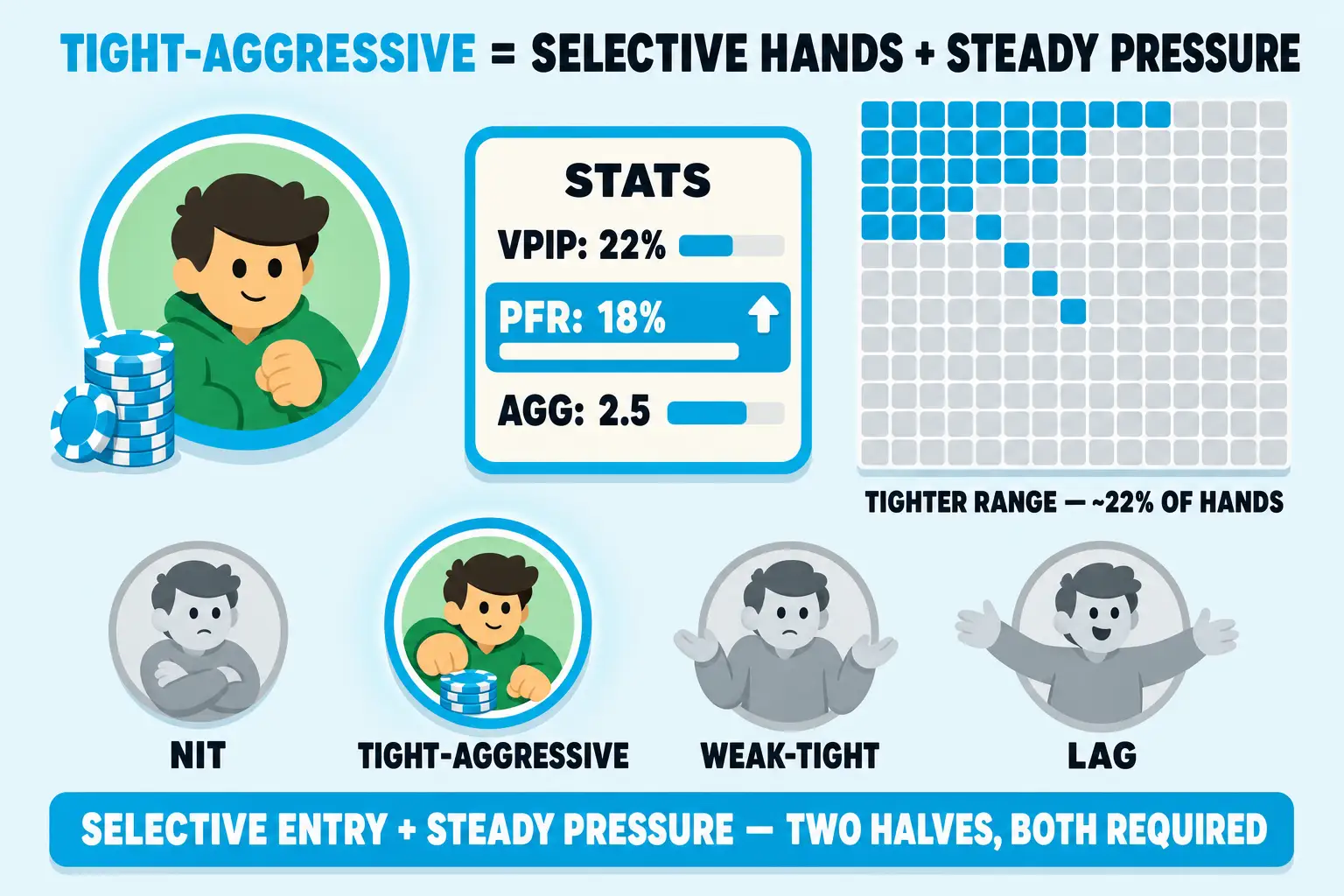
A tight-aggressive player is one who enters a selective set of starting hands and, once in the hand, tends to raise and bet rather than limp and call. Two halves carry equal weight. The “tight” half is about hand selection: only a portion of dealt hands are deemed worth playing. The “aggressive” half is about action choice: when this player does enter, they usually do it with a raise, follow up with continuation bets, and use re-raises rather than flat calls when they have a strong holding.
The shorthand is TAG, and most coaching content, books, and HUD writeups use the abbreviation interchangeably with the full phrase. The reference stat bands and the four-corner archetype map live on the TAG page; this entry stays focused on the expanded label, the practical signals that confirm it, and the misreads that show up when one half of the definition gets ignored.
Related terms
- TAG: the abbreviation; the same player style under its common shorthand and the canonical reference for stat bands.
- Nit: same tight starting selection, but mostly passive once a hand develops.
- Weak-tight: tight starting selection that folds too easily on flops and turns; the closest leak-shaped neighbor.
- LAG: aggressive in a similar way, but with a much wider entering range.
- Loose-passive: the diagonal opposite — wide range, mostly checks and calls.
- VPIP: the entry-frequency stat the tight half is measured against.
- PFR: the preflop-raise stat that captures the aggressive half before the flop.
- Aggression factor: the postflop ratio that confirms aggression after the flop.
- HUD: the stats overlay where the tight-aggressive shape gets read in real time.
Recognizing the tight-aggressive label in practice
Four signals tend to line up when an opponent is sitting in the tight-aggressive band. No single signal carries the read on its own; two or three of them together is the practical bar.
A tighter VPIP band than the table average
The first signal is a VPIP sitting below the room’s typical entry rate rather than at it. In a 6-max NLHE cash game, most pools average around 24 to 28 VPIP, while a tight-aggressive seat usually lives in the high teens to low twenties. The cap is the part that earns the “tight” half of the label: this seat skips most speculative offsuit hands, most weak suited gappers, and most early-position trouble combos. Live and online numbers shift across stakes, so use the table’s own average as the comparison rather than a fixed threshold.
A small VPIP/PFR gap
The second signal is the gap between VPIP and PFR. The smaller the gap, the higher the share of voluntary entries that come in raised. Tight-aggressive seats usually run a gap of about 3 to 6 points; a 22 / 18 line, for example, means 22 percent of hands are entered and 18 percent of them are raised, leaving only 4 percent for limps and flat calls. A gap above 8 to 10 points means the player is limping or cold-calling a lot, which slides the read toward the loose-passive corner. A near-zero gap means almost every entry is a raise; that pattern shows up at the high end of the tight-aggressive band and into the aggressive-regular and LAG profiles.
Pressure once they enter
The third signal is what happens after the flop. Tight-aggressive players continue with c-bets, barrel turns at a healthy rate, and use 3-bets preflop instead of just flatting. The cleanest single number for this on a HUD is aggression factor, usually around 2 to 3 for the style. AF below 1 with the same VPIP and PFR is the weak-tight read instead — same selection, missing follow-through. AF without sample size is noisy, so two or three orbits of “raise, c-bet, take it” against the same seat is a faster real-time confirmation than the raw HUD number alone.
Position-specific range width
The fourth signal is the spread across seats. A 22 VPIP aggregate hides a player who plays maybe 11 percent under the gun and 35 percent on the button. Tight-aggressive seats usually show a clear gap between positions: very few hands open from up front, much wider opens in late position, and steal frequency that climbs in the cutoff and on the button. A flat profile across positions points at a player who is not adjusting yet, which is closer to a static nit or a one-speed reg than a true tight-aggressive shape.
Tight-aggressive vs the closest neighbors
The compact way to keep these labels straight is to pin them to two axes: how often the player enters, and what they do once they do. The full archetype table lives on the TAG entry; this section keeps to the expanded-phrase contrasts that matter most.
- Tight-aggressive vs nit: both look quiet for the first orbit. The split is what happens after a hand develops. A nit gives up most pots without follow-through; a tight-aggressive seat keeps firing.
- Tight-aggressive vs weak-tight: identical preflop entry profile, very different postflop posture. The aggression factor is the cleanest divider; tight-aggressive sits around 2 to 3, weak-tight closer to 0.5 to 1.
- Tight-aggressive vs LAG: similar aggressive habit; the divider is range width. A LAG enters far more hands and runs a higher bluff frequency. Misreading a LAG as tight-aggressive often inflates a hero-call instinct on rivers.
- Tight-aggressive vs loose-passive: the opposite player on both axes. A loose-passive seat enters wide and mostly checks or calls; the tight-aggressive seat enters narrow and mostly bets or raises.
A useful self-check after the read: “Which of the two halves did I just see?” If only the tight half is visible — a player folded twelve hands in a row — the read is incomplete. Wait for at least one postflop sample before applying the tight-aggressive label.
Common misreads of the tight-aggressive label
Calling the read off VPIP and PFR alone
Two preflop counts cannot split a tight-aggressive seat from a tight-passive one. The aggression factor and at least one fold-to-c-bet sample carry the actual confirmation. A 22 / 18 line is consistent with both styles; the postflop frequencies are where they part ways.
Treating the label as a verdict on skill
Tight-aggressive describes a style, not a result. A seat in the band can still leak by overfolding turns, flatting too much from the blinds, or never widening on the button. The label is a starting frame for reads, not a stamp that says the player is solid.
Anchoring on one orbit
Two folds, one open, and one c-bet are not a profile. Tight starts happen for many reasons — an unfamiliar table, a cold deck, a careful mood — and one orbit of folds is closer to noise than a label. Two or three orbits of consistent behavior, paired with a postflop sample, is the lower bound.
Forgetting the position spread
A single VPIP is an average over six seats. The same player who looks tight from one seat may be opening half the hands from another. Position-specific frequencies are closer to the truth in spots like “should I three-bet their cutoff open” or “is the small blind worth defending against this button steal.”
Locking the label in across sessions
Players adjust. The same opponent who looked tight-aggressive last week may sit closer to a LAG after a stake change or a coaching session. Refresh the read every session, and let recent postflop evidence overwrite the older label when the two disagree.
Beginner-safe ways to adopt a tight-aggressive style
Most coaching curriculums recommend tight-aggressive as the starting frame for a learner, on purpose. The selection half is easier to train than the postflop pressure half, and starting tight reduces the number of marginal preflop spots a beginner has to play. A few safe-to-start ingredients:
- Tighten the starting range first. Drop offsuit broadway combos under the gun, drop weak suited gappers entirely, and keep the strong pairs and broadway holdings as the core. Position-aware tight ranges are the foundation.
- Default to raise-or-fold rather than limp. Open-limps blur the tight-aggressive shape. Raising-first preflop keeps the PFR close to the VPIP and signals initiative.
- Add c-bets in good spots before adding double-barrels. A simple “c-bet most flops in heads-up pots from the preflop-raiser seat” is enough to establish the aggressive half. Turn and river barrels can come later, once the read pool is bigger.
- Use 3-bets for value first, bluffs second. 3-bets with the top of your range is where the aggression habit forms cleanly. Bluff three-bets are a refinement, not a starting habit.
- Re-evaluate the position split. Once the basic ranges hold, widen on the button and the cutoff, and tighten under the gun. The gap between early and late seats is what turns a static profile into a true tight-aggressive shape.
The shortcut is: get the tight half right first, then layer the aggression in as the postflop reads land. Tight-aggressive is a destination posture for most learners, but it is a practiced one — not a default that arrives by accident.
FAQ
Is tight-aggressive the same as TAG?
Yes. “Tight-aggressive” is the long form of the label, and TAG is the three-letter shorthand most coaching content, books, and HUD writeups use. The TAG entry collects the reference stat bands and the worked example for the same style under its common name; this entry covers the expanded phrase and the recognition-and-misread side.
What does a tight-aggressive line actually look like in one hand?
A common pattern: cutoff folds, hijack folds. The player opens A♣Q♦ on the button to 2.5x, the big blind defends. Flop comes Q♥ 7♠ 4♦ and they c-bet about a third pot. Turn brings a 9♣ and they barrel again, sized to deny equity from gutshots and underpairs. River bricks and they value-bet thinner instead of checking back. The selection is tight (a strong broadway from a steal seat), the postflop is aggressive (c-bet, barrel, value-bet), and the line stays inside one consistent shape.
How does aggression factor confirm the read?
Aggression factor is postflop bets-and-raises divided by calls. A tight-aggressive seat usually sits around 2 to 3; a tight-passive seat sits around 0.5 to 1. Two players with identical 22 VPIP and 18 PFR can split on AF alone, which is why the postflop number is the standard tiebreaker. Sample size matters: an AF computed on fewer than 100 postflop actions is noisy, so use it as a corroboration rather than a sole verdict.
Should a beginner aim for tight-aggressive or for tight-first?
Tight-first is a learning posture; tight-aggressive is a style label. The two stack rather than compete. A beginner usually starts tight-first to keep the early sessions inside familiar spots, then layers in the raise-or-fold habit, the c-bet pattern, and the value 3-bet to migrate toward a tight-aggressive shape. The order matters: get the selection right before the aggression, since a wide, aggressive learner often turns into the discipline-free LAG shape rather than the tight-aggressive one.