


Aggression Factor
Aggression factor (AF) is the ratio of a player's postflop bets and raises to their calls, displayed on a HUD next to VPIP and PFR. It tells you whether someone pressures pots or drifts to showdown. AF needs sample size and context; one number is rarely a verdict on its own.
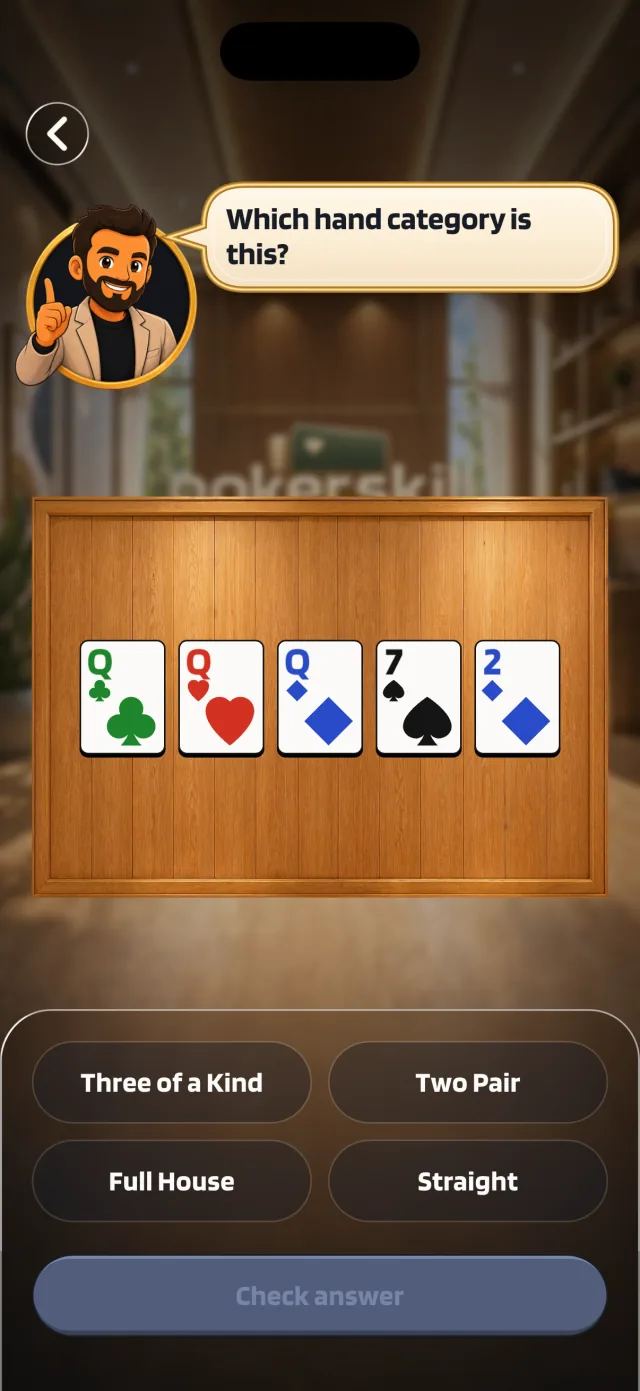
Practice this in Poker Skill. Against a player whose AF runs high, calling lets them keep betting into you, and the Check-Raise lesson drills that restraint with top pair: K♥ 9♦ on 5♥ J♥ K♦ calls the bet and lets the turn say more before the pot grows.
Get the free appAggression Factor (AF): the postflop pressure ratio
What aggression factor measures
Aggression factor, almost always shortened to AF on a HUD, is a ratio that tells you whether a player tends to bet and raise after the flop or call and check. It is computed as the number of postflop bets plus the number of postflop raises, divided by the number of postflop calls. If a player bets or raises 30 times for every 10 times they call, their AF is 3.0. If they call 30 times for every 30 they bet or raise, their AF is 1.0. The number is dimensionless and almost always sits between 0 and about 5 for real samples.
AF is a postflop measurement on purpose. The preflop counterparts are VPIP (how often the player enters a pot) and PFR (how often they raise preflop). Two players can have the same VPIP and PFR but very different AF, and that is exactly where AF earns its place on a HUD badge.
Related terms
- VPIP: the preflop entry stat. Pairs with AF for the standard 6-max profile.
- PFR: preflop raise frequency. AF reveals what PFR cannot.
- HUD: the overlay AF lives on, alongside VPIP and PFR.
- Aggressive regular: a high-AF profile, usually 2.5 or above.
- Calling station: a classic low-AF profile, often under 1.0.
- Regular: the baseline solid-player cluster AF helps disambiguate.
- Villain: the opponent the AF badge is describing.
Aggression factor vs VPIP and PFR
VPIP and PFR describe the preflop game. AF describes everything that happens after the flop. The three stats together produce the standard one-glance read most HUDs are configured around.
| Stat | What it counts | What it tells you | Streets covered |
|---|---|---|---|
| VPIP | Voluntary preflop entries (limp, call, raise) | How loose or tight the player is preflop | Preflop only |
| PFR | Preflop raises (opens and three-bets) | How often they raise preflop | Preflop only |
| AF | Postflop bets and raises divided by postflop calls | Whether they pressure pots or drift to showdown | Flop, turn, river |
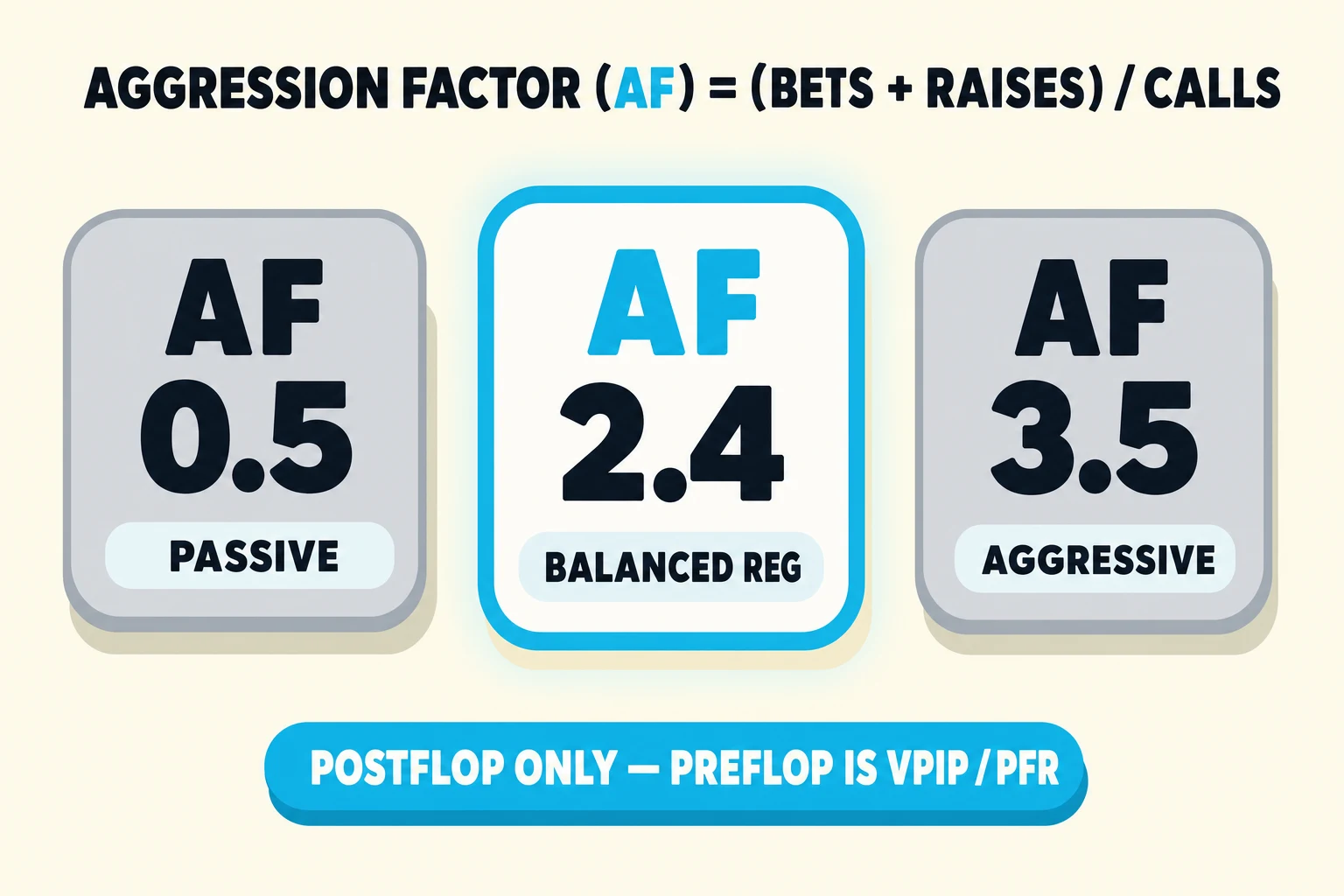
A 22/18/2.4 reads as “balanced regular”: tight-ish preflop, raises most of what they play, applies normal postflop pressure. A 22/18/0.5 has the same preflop fingerprint but plays passively after the flop, calling much more than they bet. A 22/18/3.5 raises and barrels postflop above the average. AF is the stat that splits those three players apart; VPIP and PFR cannot.
Reference bands in 6-max cash
These bands assume online 6-max no-limit cash at roughly 100 big blinds, with the AF computed across all postflop streets combined. They are clusters, not laws. AF is a ratio with no inherent ceiling, so a tiny sample can produce extreme values that smooth out with more hands.
| AF band | Profile | What it usually means |
|---|---|---|
| 0.0–1.0 | Passive | Calls more than they bet or raise. Drifts to showdown. Classic calling station signature when paired with high VPIP. |
| 1.0–2.0 | Mildly aggressive | Bets and raises about as often as they call. Common for tighter recreational players. |
| 2.0–2.5 | Balanced reg | A common solid-regular band. Bets and raises around twice as often as they call. |
| 2.5–4.0 | Aggressive reg | Wider barrels, more turn and river bluffs. Often the aggressive regular profile. |
| 4.0+ | Very aggressive / maniac | Very few calls. Sometimes a real loose-aggressive style; on tiny samples, often noise. |
Two caveats sit on top of the bands.
Format matters. Live full-ring AF runs a touch lower than 6-max because flops are more multiway, and tournament AF drifts higher in late stages where shoves and reshoves replace calls. Anchor the bands to the format you are looking at.
Per-street AF varies. Many HUDs split AF into preflop AF, flop AF, turn AF, and river AF in addition to the rolled-up number. Most players bet less and call more as the streets get later, so a player’s flop AF tends to be higher than their river AF. The headline number on the badge is the average; the per-street stats are where the real reads live once you have a sample.
When AF matters most
AF earns the most weight in spots where a single decision turns on whether the opponent likes to bet or call.
- Choosing whether to bluff a turn or river. A 0.6 AF reg almost never raises a barrel. A 3.2 AF reg raises turns and rivers as a normal frequency.
- Bluff-catching. Against low AF, fold the bluff catchers; they are not bluffing. Against high AF, call the bluff catchers; the bluffs are real.
- C-bet sizing. Against passive AF, bet thin for value and small as a bluff. Against high AF, slow down with marginal made hands and let them barrel into your range.
- Identifying calling stations. AF below 1.0 paired with VPIP above 30 is a near-textbook station signature. Adjust to a value-heavy plan and trim the bluffs.
AF tells you less in a few specific situations.
- Tiny samples. A 50-hand AF can swing two full points on one cooler. The number stabilizes faster than rare-event stats but slower than VPIP and PFR.
- Equal preflop, equal postflop. Two regulars with VPIP, PFR, and AF all close together can still play very differently in single-spot reads. The badge is a profile, not a hand-history.
- Lines where the player only ever calls or only ever raises. Per-street AF is more honest than the rolled-up number when the variance lives in one street.
Example: same VPIP and PFR, very different AF
Two players sit in a 6-max $1/$2 cash game. Both show 22 / 18 preflop over a sample of a few thousand hands. On VPIP and PFR alone they look identical.
- Player A: 22 / 18 / AF 0.5. Fold-to-c-bet 62. WTSD 33.
- Player B: 22 / 18 / AF 3.0. Fold-to-c-bet 41. WTSD 23.
Player A is a tight, passive postflop player. They open a normal range, three-bet a normal frequency, and then almost never put another raise in once a flop comes. They like to see showdown with a marginal made hand. Against Player A you can value-bet thinner, fire single-barrel c-bets at a normal rate, and slow down the bluffs after the flop. Their double-barrel and check-raise frequencies are low, so when they do raise, it is almost always real.
Player B has the same preflop fingerprint and the opposite postflop tendency. They c-bet wide, double-barrel often, and turn missed flops into bluffs. Against Player B the bluff catchers are more often calls than folds, and you can let them put chips in for you with their barrels rather than leading into them.
A worked-AF calculation makes the ratio concrete. Across one logged session against Player B, the HUD records 18 postflop bets, 4 postflop raises, and 7 postflop calls. AF for that session is (18 + 4) / 7 = 3.14, which lines up with their long-run 3.0. Player A in the same hands recorded 4 bets, 1 raise, and 9 calls, for an AF of (4 + 1) / 9 ≈ 0.56. The numbers are signals about postflop tendency; the action plan is what you do with them.
Common mistakes when reading AF
1) Trusting AF on a tiny sample
A 30-hand AF is mostly noise. AF stabilizes faster than rare-event stats like 3-bet percent or river check-raise, but it still needs hundreds of hands before the number settles. Below about 200 postflop spots, treat the badge as a working hypothesis. Above a few thousand, the number is real.
2) Treating high AF as automatically good or low AF as automatically bad
The 2.0 to 2.5 band is a tendency, not a verdict. Some strong players sit at AF 1.6 with a value-heavy postflop game; some overbluffing players sit at AF 4.0 with no postflop discipline. The number tells you what kind of postflop player they are, not how good. Pair AF with fold-to-c-bet, WTSD, and your direct read before deciding what to do.
3) Reading AF without VPIP and PFR
A standalone AF of 1.8 means very different things on a 12-VPIP nit versus a 38-VPIP recreational player. The nit’s range is so strong by the flop that even moderate AF means real value. The recreational’s wide preflop range pushes the AF down by sheer call volume from weak hands. Always read AF in the context of the preflop block.
4) Forgetting the math edge case
AF is a ratio. A player who has not yet called once postflop in your sample has an AF of “infinity” by the formula, which most HUDs display as ∞, blank, or capped at a configured maximum. Treat any AF computed from fewer than ten postflop calls as undefined. The fix is not to override the badge; it is to wait for the sample to fill in.
FAQ
What is a good aggression factor for 6-max NLHE cash?
A common solid-regular range is roughly 2.0 to 2.5, meaning the player bets or raises about twice as often as they call across postflop streets. That is a tendency band, not a target. Strong value-heavy players can sit below 2.0, and barrel-heavy players can sit above 3.0. Compare AF to fold-to-c-bet and WTSD before deciding what kind of postflop player you are looking at.
How is aggression factor different from aggression frequency?
Aggression factor is (bets + raises) / calls. Aggression frequency, sometimes labeled AFq or Agg%, is (bets + raises) / (bets + raises + calls + folds), expressed as a percentage. AF ignores folds entirely; aggression frequency includes them. The two stats often agree on whether a player is passive or aggressive, but AF can spike when a player almost never calls, while aggression frequency stays bounded between 0 and 100. Most HUDs let you display either; some show both.
How many hands do I need before I trust an AF read?
AF settles faster than rare-event stats but slower than VPIP and PFR because it weights every postflop decision. A few hundred hands gives a reasonable cluster read. A few thousand gives a stable number. Below 200 postflop decisions, the badge is a hint; if a player has only seen ten flops with you, ignore the AF and read the action.