


PFR
PFR (Preflop Raise Percentage) is the share of hands a player raises before the flop, counting both opens and three-bets. It is the cleanest single read on preflop initiative. PFR pairs with VPIP for the basic player profile.

Practice this in Poker Skill. In the raise-or-fold lessons every hand you play first in is a raise, which counts toward PFR as well as VPIP, and limping is never the answer.
Get the free appPFR (Preflop Raise Percentage)
What PFR measures
PFR is the percentage of hands where a player raises before the flop. It counts open-raises (entering the pot with a raise) and three-bets (raising over someone else’s open) in the same bucket. Limps, cold-calls, and big-blind defends do not count toward PFR. If you are dealt 100 hands and you raise preflop on 20 of them, your PFR for that sample is 20.
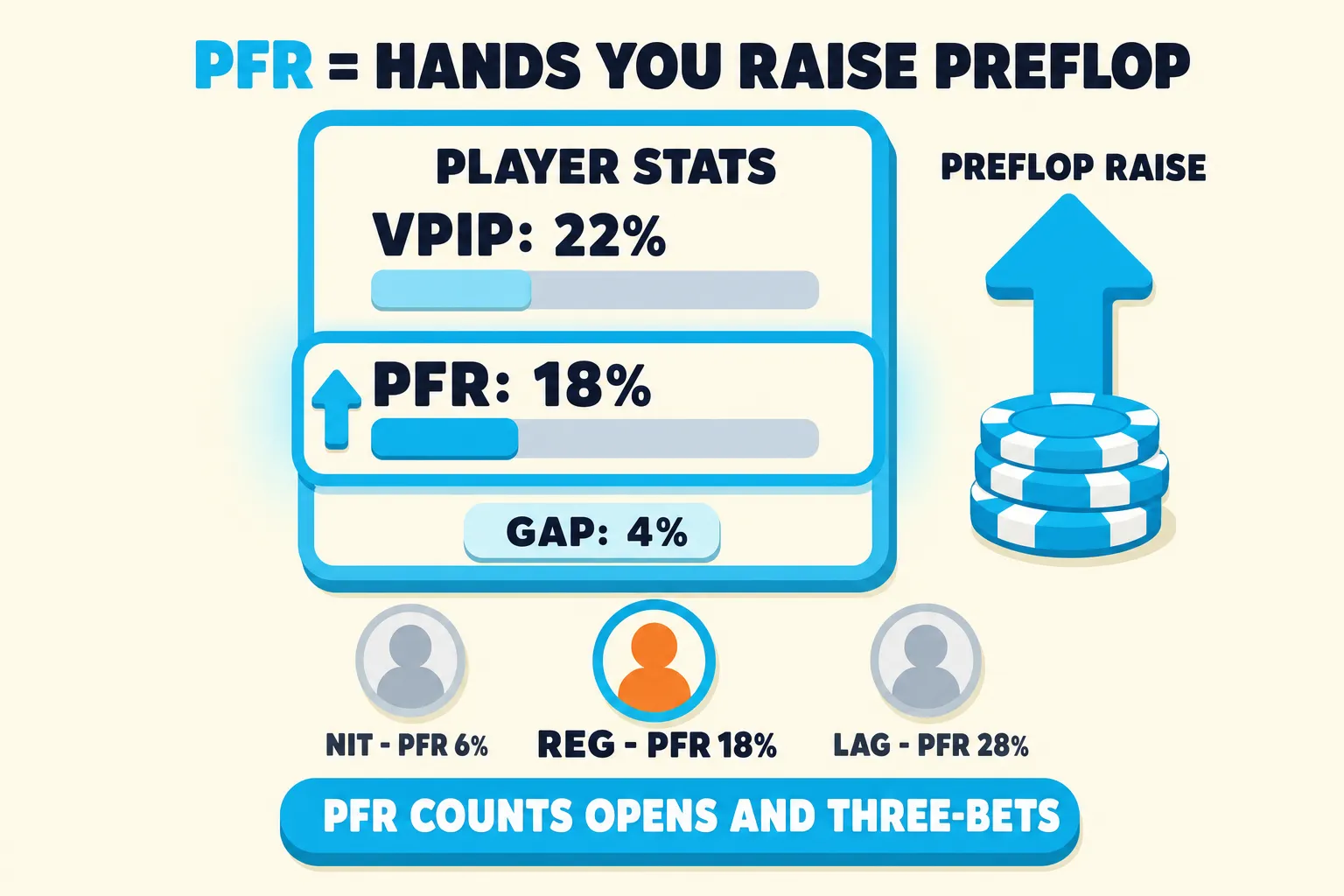
PFR is a measure of preflop initiative. It tells you how often a player chooses to put pressure on the pot before any community card lands. It does not tell you how strong their raising range is, and it does not tell you anything about postflop play on its own. A 22 PFR can belong to a careful winning regular or to a recreational player who raises too many hands; the number marks the frequency, not the skill.
Related terms
- VPIP: the sister stat. PFR is always a subset of VPIP.
- Opener profile: the position-by-position read PFR feeds into.
- Aggressive regular: high-PFR archetype.
- Nit: single-digit-PFR archetype.
- Calling station: wide-VPIP, low-PFR archetype with a big gap.
- Preflop raiser: the action PFR counts.
- 3-bet: one of the events folded into PFR.
PFR vs VPIP and the gap
PFR is best read next to VPIP. They share the same denominator (every hand dealt) but count different things. PFR is a strict subset of VPIP, because every preflop raise is also a voluntary chip in the pot.
| Stat | What it counts | What it tells you | Typical solid value (6-max cash) |
|---|---|---|---|
| VPIP | Any voluntary chip preflop (limp, call, raise) | How often they play | 20-25 |
| PFR | Only preflop raises (opens and three-bets) | How often they raise | 18-22 |
| Gap (VPIP minus PFR) | Limps and cold-calls | How passive their entries are | 4-5 |
A small gap means raise-or-fold. A wide gap means a lot of passive entries. The same VPIP can hide very different players depending on where the PFR lands. A 22/18 player and a 22/5 player play the same number of preflop hands, but one is raising almost every time and the other is limping in or flat-calling raises with most of them.
Reference ranges in 6-max cash
These bands are common reference points for 6-max NLHE cash at about 100 big blinds. They are guidelines, not laws; every game is different.
| PFR band | Profile | Notes |
|---|---|---|
| 0-12 | Very tight or limpy | Often a passive recreational; opens only premium hands. |
| 12-18 | Tight, solid | Cautious opener; rarely three-bets light. |
| 18-22 | Standard reg | Typical balance for a solid 6-max regular. |
| 22-28 | Active / loose-aggressive | Wider opens, more three-bet bluffs, more steals. |
| 28+ | Too loose for most games | Postflop skill needs to be sharp to keep this profitable. |
Two caveats sit on top of the bands.
Format matters. A 14% PFR online 6-max is tight. The same 14% PFR live full-ring is normal. The same 14% PFR in a deep tournament is short-stack-driven and reads differently again. Anchor the baseline to the format you are looking at.
Position matters. PFR averages across every seat. A solid 20% overall PFR might break down as 9% from under the gun and 32% from the button. The aggregate hides the spread. If your HUD shows position-broken-out PFR (sometimes labeled UOPFR for the open-only variant), prefer that for position-specific reads.
When PFR matters most
A few situations put real weight on PFR over other reads.
- Defending the big blind against an open. A 14% PFR opener has a much stronger range than a 28% PFR opener; defend tighter against the first, wider against the second.
- Choosing a three-bet bluff target. A low-PFR opener almost always has a real hand, so three-bet bluffing them works less often. A high-PFR opener is opening junk a fair share of the time, so three-bet bluffing them works more often.
- Estimating someone’s flop continuation range. A low-PFR player who continuation-bets has a stronger range on average because they pruned the weak hands preflop. A high-PFR player who continuation-bets has a wider range because the gate at the door was wider.
- Reading a fresh opponent at a live table. After two or three orbits of watching opens, you have enough to call them tight or loose, and that is essentially PFR by another name.
PFR tells you less in a few specific spots.
- Tiny samples. A 12-hand PFR is mostly noise. One run-up of premium hands swings the number by ten points.
- Format mismatch. Cash, tournament, and live full-ring PFR live on different baselines.
- Position weight. The displayed total is an average across seats; treat it as a rough cluster, not a fine measurement.
- Pure shorthand. PFR captures aggression frequency, not skill. Two players can share the same PFR and play very differently postflop.
Example: 25/20 versus 35/8
You sit down at a 6-max cash game and your HUD has meaningful samples on two opponents. One reads 25/20. The other reads 35/8.
The 25/20 player has a 5-point gap. They are entering a quarter of all hands, and almost every one of those entries is a raise. The small remainder is mostly big-blind defending. This is a balanced active regular. Treat their preflop raises with respect and their cold-calls as rare. When this player three-bets you, fold the bottom of your opening range and play the rest more carefully than usual.
The 35/8 player has a 27-point gap. They are entering more than a third of all hands but only raising eight percent of them; the other 27 percent is limping in or flat-calling raises. This is the classic passive recreational profile. Two practical adjustments work well against this player:
- Isolate their limps with wider opens. If they limp under the gun, raise from the cutoff or the button with hands you would normally fold. They will call light and miss the flop most of the time.
- When this player does raise, slow down. Their 8% PFR range is narrow and mostly real - big pairs, big broadway, occasional suited aces. The rare aggression usually means a strong hand, so respect it.
A clear 35/8 profile is exactly the kind of opponent PFR helps you play against. Isolate limps, respect rare raises, and avoid treating every loose player as the same loose player. The number gives you the shape of the adjustment before the postflop details arrive.
Common mistakes when reading PFR
1) Acting on a 12-hand sample
A PFR built off two orbits is mostly noise. The first hands you see fix in your head and the rest of the session is spent confirming that prior. Hold off on big PFR-driven decisions until the sample stabilizes, or at least give the early read a wide error bar.
2) Treating PFR as overall aggression
PFR is preflop initiative only. Aggression factor and the flop continuation-bet stat fill in postflop behavior. A 22/18 player can be a passive postflop showdown-chaser or a relentless triple-barreler - same PFR, completely different opponents. Read PFR alongside the other panels, not alone.
3) Comparing PFR across formats without adjusting
A 14% PFR online 6-max is tight. A 14% PFR live 9-handed is normal. A 14% PFR in a final-table push-fold spot is loose. Same number, three different reads. Always anchor PFR to the format you are looking at.
4) Double-counting blind defense
A solid regular’s 4-to-5-point VPIP/PFR gap is mostly the big blind defending against opens at a discount, not loose play. Do not treat that gap as a leak; treat it as the price of the seat.
5) Ignoring position skew
A 22% overall PFR averages a tight UTG opener with a wide button opener. If you only ever play this opponent in one seat, the displayed total can mislead. Use position-broken-out PFR when the HUD offers it; otherwise weight your read with the seats you have actually seen them in.
FAQ
What is a normal PFR for 6-max cash at 100bb?
A solid regular in 6-max cash sits around 18 to 22 PFR, with a VPIP three to five points higher. Under 14 is tight. Above 25 is aggressive. Above 30 is usually too loose to win without an unusually sharp postflop game holding it together. These are guidelines for cash; live full-ring runs lower across the board, and tournament PFR drifts higher in late stages.
Can PFR ever be higher than VPIP?
No. Every preflop raise is also a voluntary chip in the pot, so every PFR event is also a VPIP event. PFR is a strict subset of VPIP and is always less than or equal to it. A HUD that displays PFR greater than VPIP has a tracking bug somewhere upstream; ignore both numbers until the source data is fixed.
How many hands do I need before I trust someone’s PFR?
There is no clean threshold, but the usual answer is “more than you have.” A few orbits is enough to separate a clear nit from a clear maniac. A few hundred hands sharpens the middle of the spectrum where most regulars live. Until you have that, treat PFR as a soft prior - useful for general direction, not for thin spots where being wrong by five points changes the right line.