


Preflop Raiser
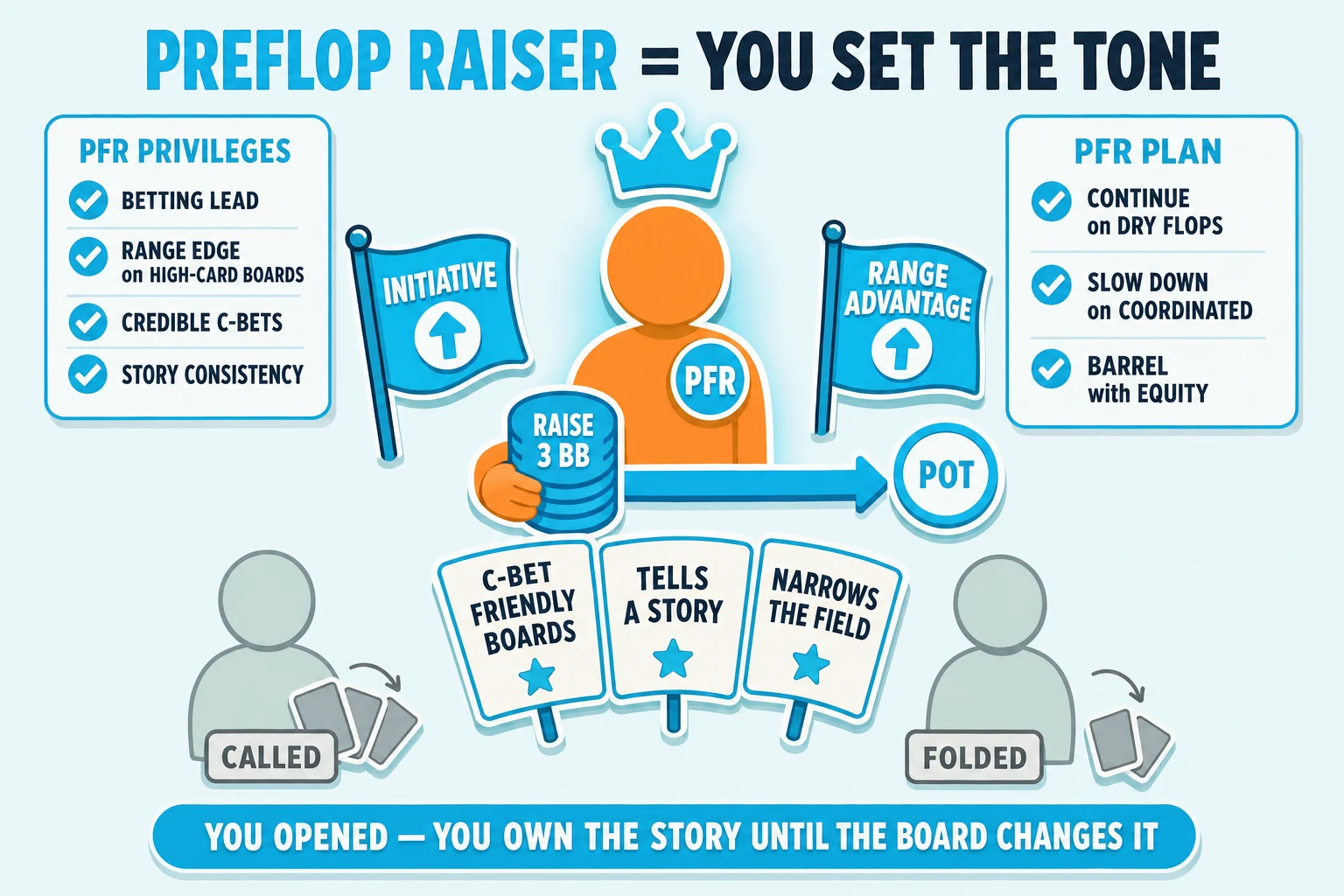
A preflop raiser makes the first increased bet during the preflop betting round, before community cards. This action sets the hand's immediate tone and forces opponents to call, fold, or reraise. Example: In a $1/$2 no-limit game, the button opens to $6. That player is the preflop raiser; remaining players decide to call $6, fold, or reraise. As soon as you raise, opponents' ranges (the sets of hands they might hold) narrow, shaping your plan for the flop, turn, and river.

Practice this in Poker Skill. The After You Raise: Simple Flop Plan lesson drills the raiser’s flop plan, betting small on dry flops you missed and checking wet ones.
Get the free appPreflop raiser
What a preflop raiser is
A preflop raiser makes the first increased bet during the preflop betting round, before community cards. This action sets the hand’s immediate tone and forces opponents to call, fold, or reraise. Example: In a $1/$2 no-limit game, the button opens to $6. That player is the preflop raiser; remaining players decide to call $6, fold, or reraise. As soon as you raise, opponents’ ranges (the sets of hands they might hold) narrow, shaping your plan for the flop, turn, and river.
How preflop raising shapes the hand
Raising preflop signals strength and often gives you the betting lead on later streets, letting you control pot size. It also reduces the number of opponents who see the flop, which simplifies postflop decisions. Example: You raise from the button with A♠Q♠ and three players fold; only the big blind calls. A heads-up pot is easier to play than a multiway pot where several callers can outdraw you. A successful raise lets you credibly represent strong hands later; a continuation bet (c-bet) on the flop fits that story. Opponents tend to fold marginal hands more often against raisers.
Choosing a raise size in No-Limit
No-Limit lets you raise any amount up to your entire stack, so choose sizes with purpose.
Consider these factors:
- Stack sizes: Deep stacks favor smaller opens to keep players in; short stacks justify larger sizing or shoves.
- Position: In late position, smaller opens steal blinds more often; early position calls for larger opens to protect against multiway calls.
- Opponent tendencies: Against wide callers, raise bigger to isolate; against tight folders, smaller opens pick up blinds more often.
Examples: A common open in tournaments is 2.5-3 big blinds early. To isolate a loose caller, raise to 4-6 big blinds. All-in moves apply when stack sizes or leverage demand maximum pressure.
Position and hand selection for raisers
Position dictates how wide you can open. Acting later gives you more information, so you can raise a wider range. Early position requires tighter, stronger hands because many players act after you.
Example ranges:
- Early position: pocket pairs Jacks+ (JJ+), A-K, A-Q.
- Late position: widen to suited connectors like 9♠8♠, weaker aces such as A♣5♣, and more speculative holdings.
Raising with stronger hands increases your equity (chance to win) and simplifies postflop play, especially on draw-heavy boards.
Postflop plans for the preflop raiser
Your preflop raise should come with a postflop plan. Continuation betting is the primary follow-up; it exploits the story you told preflop and can win the pot immediately. Adjust your line based on opponents’ reactions, board texture, and stack depth. Dry boards favor c-bets; wet boards demand more caution. Deeper stacks allow more maneuvering and complex lines.
Example: You raise with K♥J♥ and the flop is 8♠4♣2♦-a dry board. A small c-bet will often take the pot. If the flop is Q♠9♠8♠, proceed cautiously-opponents can hold many strong hands or strong draws.
Checklist
- Define your opening range by position before the hand.
- Choose raise sizes with stack depth and opponent tendencies in mind.
- Have a clear postflop plan (bet, check, or fold) tied to your preflop story.