


Premium Hand
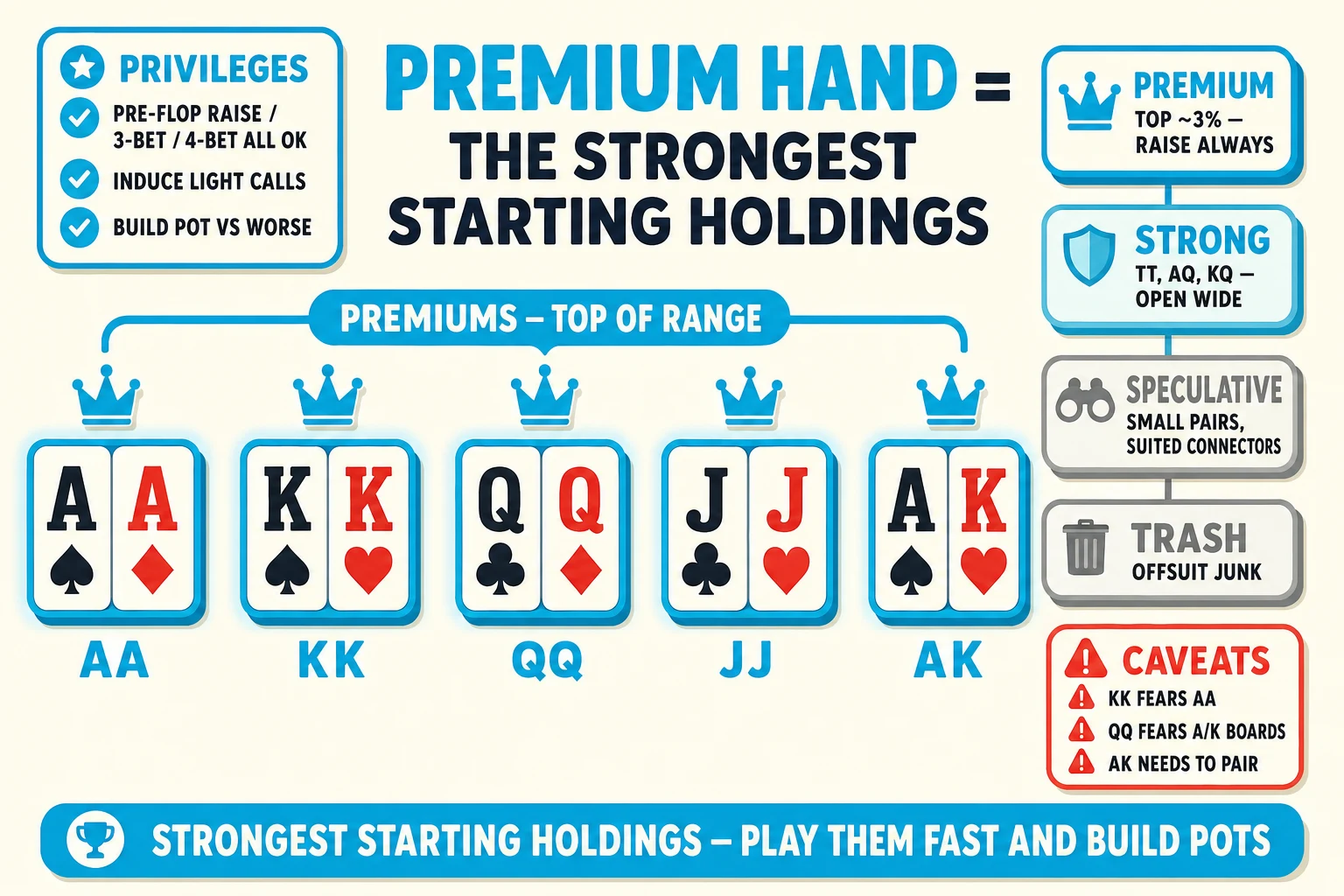
The strongest starting hands: AA, KK, QQ, JJ, and AK. They beat most random holdings preflop, so you raise, build the pot, and try to thin the field.

Practice this in Poker Skill. The BTN vs Two Callers lesson plays them against limpers, raising jacks and queens to build the pot while they are ahead of the hands limpers show up with.
Get the free appPremium Hand
What a “Premium Hand” Means in No-Limit Hold’em
A premium hand is a starting holding with much higher winning potential before any community cards appear. “Pre-flop” is the stage before the flop, the first three community cards. The archetypal premiums are the top pocket pairs: pocket aces (AA), pocket kings (KK), and pocket queens (QQ), with JJ and AK rounding out the group. These hands win more often than typical holdings, which lets you take value-heavy, aggressive lines that extract chips from weaker ranges. AA is a preflop favorite versus almost any two random cards, so you can open the action without much hesitation.
Why Premium Hands Change Table Dynamics
Premiums change how a hand unfolds at the table by shrinking the field and building pots. Aggressive betting with these hands charges weaker hands to see the flop, which reduces multiway action. A multiway pot involves more than two players; your equity, or chance to win, falls as more opponents enter. For example, holding KK and raising pre-flop gives you better equity heads-up than against two callers. Re-raising often isolates a single opponent and converts risky three-way spots into cleaner heads-up contests. Treat premiums like investments: construct spots that maximize expected value (EV) by inducing worse calls and minimizing being outdrawn.
Pre-flop Play: Raising, Re-raising, and Isolation
Use premium hands to seize control before the flop. Raise frequently to build the pot and charge speculative hands to continue. Re-raise (3-bet) against raises to increase the pot and often isolate one opponent. Prioritize isolation when facing limps: re-raise to force out speculative holdings. For example, open-raise QQ from early position to define the hand and reduce opponents. From late position, raise more often to steal blinds, but always seek to thin the field. From early positions, act assertively because more players act after you; raising compensates for that disadvantage.
Handling Pocket Kings and Exceptional Situations
Pocket Kings are elite but have a single true nemesis: pocket Aces. Raise KK pre-flop almost always to avoid cheap multiway pots where an Ace or coordinated draws can outdraw you. For example, face a late-position opener with KK and respond with a strong re-raise to define strength and keep the field small. Folding KK before the flop is an extreme, rare line reserved for very specific reads. Such spots might include an opponent who only ever raises all-in with AA in this particular game. Those situations are exceptional and depend heavily on reliable player tendencies.
Post-flop Caution and Value Extraction
After the flop, shift from raw aggression to controlled value extraction. Bet to get calls from worse hands (pairs and draws) while slowing down on dangerous boards. A dangerous board contains an ace when you hold KK, or it is highly coordinated, offering many straight and flush draws. With AA on an A-7-4 flop, keep betting for value. If you hold QQ and the flop comes K-Q-J, watch for overcards and straight possibilities despite the strong start. Mix aggression with caution as the board texture and the action change.
Quick checklist:
- Raise and re-raise premiums pre-flop to build pot and thin the field.
- Treat AA, KK, and QQ as value hands; induce weaker calls whenever possible.
- Play aggressively from early positions but remain alert to opponent reads.
- Slow down on post-flop Ace or coordinated boards that increase drawing chances.
- Consider exceptional opponent behavior only before folding an otherwise strong premium.