


Probe Bet
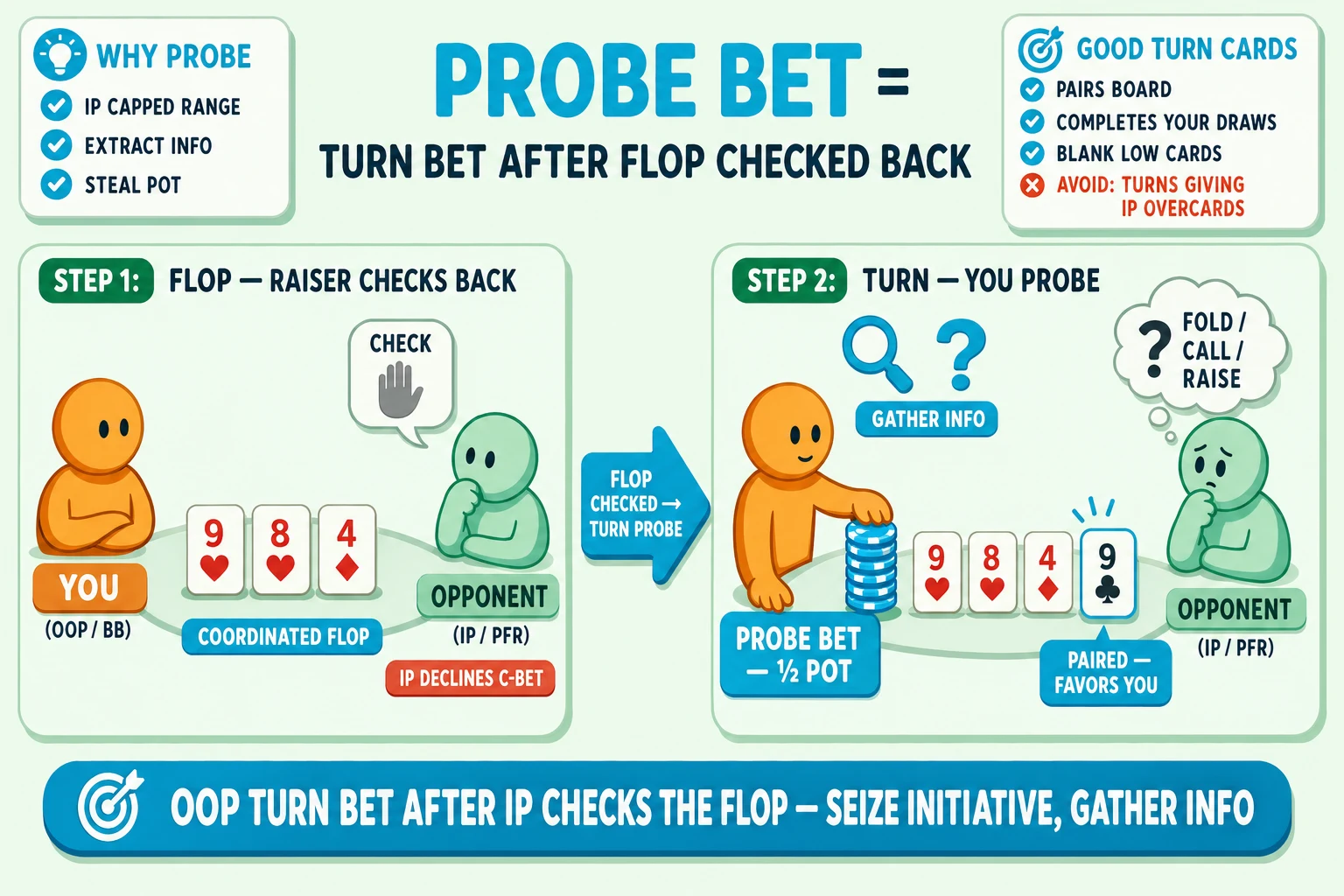
A probe bet is a turn bet by a player out of position (OOP). It occurs after the pre-flop aggressor (in position, IP) checks back the flop. The original raiser checked the flop, so the first-to-act player now bets the turn. The goal is to seize initiative on the turn and win the pot without a showdown.
Practice this in Poker Skill. The Read the Turn Card lesson practices the turn-card read from the raiser’s seat, asking of each turn whether it helps your hand or the hands that called.
Get the free appProbe Bet
What a probe bet is
A probe bet is a turn bet by a player out of position (OOP). It occurs after the pre-flop aggressor (in position, IP) checks back the flop. The original raiser checked the flop, so the first-to-act player now bets the turn. The goal is to seize initiative on the turn and win the pot without a showdown.
Why you use a probe bet
A probe bet serves three core strategic purposes. First, it extracts value from marginal or vulnerable hands by forcing opponents to pay for more cards. Second, it protects equity by denying free cards on coordinated or draw-heavy boards. Third, it forces the IP to reveal information. They must fold, call (showing weakness), or raise (showing strength).
A checked flop often indicates temporary weakness from the pre-flop aggressor. A probe bet tests whether that weakness is real.
Which turn cards favor a probe bet
Turn texture decides probe profitability:
- Turns that pair the board (for example, a second 9) often favor a probe. Many IP hands checked with single-pair or unpaired holdings.
- Cards that complete straights or flushes can favor probing. That holds when these completions fit your OOP range more than the IP’s.
- Blanks and low cards that don’t give clear overcards often make good probe candidates. They rarely improve the IP’s range dramatically.
- Avoid probing when the turn gives the IP obvious overcards. An Ace, for example, often connects with the IP’s capped calling range and shifts equity to position.
Bet sizing principles for probe bets
Choose sizing to apply meaningful pressure without overcommitting:
- Use larger probes when your OOP range is polarized between strong value and bluffs. Also use big bets when the turn clearly favors your range.
- Bigger bets maximize fold equity and extract more from calling hands.
- Use smaller probes when protecting against overcards or seeking thin value.
- Small bets charge draws and weak calls while keeping worse hands in play.
- Match sizing to board coordination. On highly coordinated boards, choose sizes that make opponents pay to continue. On dry boards, smaller bets often suffice.
Size to the range advantage you expect on that turn.
Practical adjustments by opponent type
Opponent tendencies should shape frequency and sizing:
- Probe more often against under-defenders - players who fold too frequently to turn aggression.
- Small-to-medium probes will collect many pots against these players.
- Be cautious versus players who often check back the flop with strong hands.
- These players can punish probes with raises or stubborn calls.
- Adjust sizing when opponents call small probes but fold to large ones. Exploit this by sizing up or down accordingly.
Example spot to visualize a probe bet
Imagine a 40bb-deep hand. OOP (Big Blind) faces the pre-flop aggressor, who checked back a flop of 9♥ 8♥ 4♦. The turn becomes decisive. On a card that pairs the board or completes obvious draws, OOP often gains a polarization advantage and can profitably probe. Because the IP checked the flop, their range is frequently capped. A well-sized probe can extract value or win the pot outright. Data shows OOP can achieve equal or superior equity realization on many turns. This holds especially when the turn does not give the IP strong overcards.
Quick checklist
- Confirm you are OOP and the pre-flop aggressor checked the flop.
- Evaluate the turn: does it favor your range (pairs, draw completes), or give IP overcards?
- Choose probe size: larger when polarized, smaller when protecting or seeking thin value.
- Adjust probe frequency and size for opponent tendencies (exploit under-defenders; beware players who check back strong hands).