


Protected Pot
A protected pot is a multiway pot whose dynamics are shifted by a third (or later) player still in the hand. That live extra opponent does not need to do anything aggressive to matter. Their existence reduces how often a bluff gets through, makes loose isolation raises less attractive, and tightens what you can value-bet thin.

Practice this in Poker Skill. In the Multiway Continuation Bets lesson a second caller doubles the players who have to fold, so a missed king-ten checks three-way on an ace-high board.
Get the free appProtected pot in 6-max no-limit hold’em
What a protected pot is
A protected pot is a multiway pot whose dynamics are shifted by a third (or later) player still in the hand. That live extra opponent does not need to do anything aggressive to matter. Their existence reduces how often a bluff gets through, makes loose isolation raises less attractive, and tightens what you can value-bet thin. The pot is “protected” because the next player to act cannot treat the spot as if they were closing the action against a single opponent.
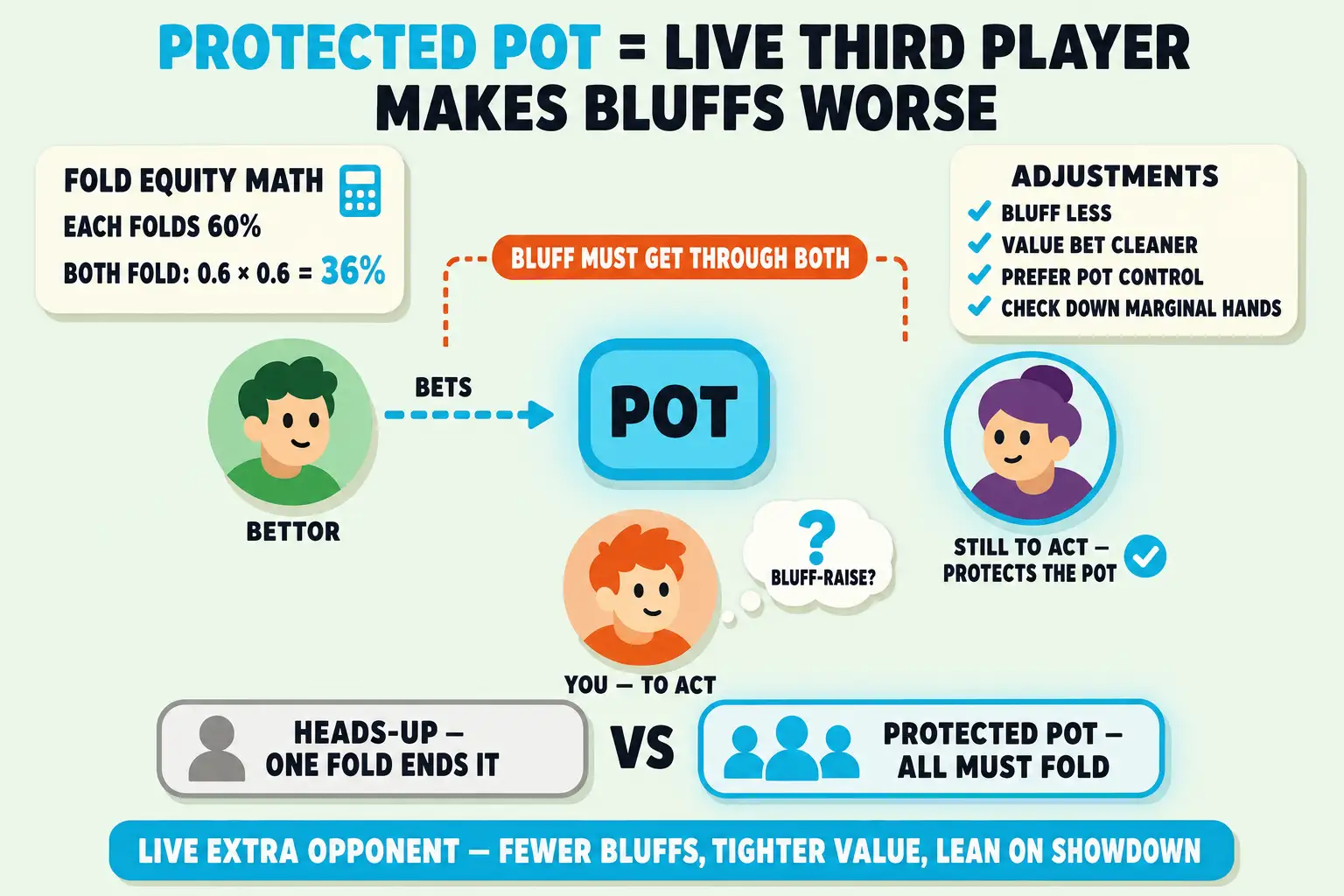
The mental shortcut: in a heads-up pot, only one player has to fold for a bluff to work. In a protected pot, every live player has to fold. That single change in the math drives almost every other adjustment.
Related terms
Heads-up pot vs protected pot
| Spot | Bluff frequency | Value bet | Marginal hands | Sizing tendency |
|---|---|---|---|---|
| Heads-up pot | Higher; one fold ends it | Wider; one range to beat | Bet thinner for value | Standard half-pot to pot |
| Protected pot (3+ live) | Lower; needs all to fold | Tighter; must beat several ranges | Lean toward checking down | Often smaller, field-narrowing |
The pattern across the table is the same: every line that depends on getting opponents to fold gets harder, and every line that depends on having a clearly better hand gets stricter. The exception is large value bets with strong made hands — those are often clearer in a protected pot, because someone is more likely to have a real piece of the board.
When pot protection matters most
These are the spots where the live extra opponent does the most work for you (and against you):
- A flop or turn where two players are still to act and one of them has shown any continuing range.
- River spots where you considered a thin bluff or thin value bet, and a live caller sits between you and the bettor.
- Drawy boards where multiple players can have connected with a flush draw, straight draw, or pair-plus-draw.
- Limped pots that flop multiway, where ranges are wider and harder to read.
When pot protection matters less:
- Heads-up pots, by definition.
- Spots where you already have the near-nuts and want value from any continuing range.
- Multiway pots where the live player has signaled extreme weakness (a tank-fold tell, a check-fold pattern, or a very short stack that is about to be all-in regardless).
Worked example
Three-handed flop on a wet board. You hold 9♣ 8♣ in middle position. The cutoff opens to 3bb, you call, the big blind calls. Pot is 9.5bb. The flop comes K♠ 7♥ 6♣, giving you an open-ended straight draw with a backdoor club draw. The big blind checks, the cutoff bets 5bb, and the action is on you.
Heads-up against the cutoff alone, raising as a semi-bluff is a clear option: you have outs if called, fold equity if folded on, and most of the cutoff’s continuation-bet range is air or weak top pair. But the big blind is still live behind you. If they fold to your raise 60% of the time and the cutoff folds to your raise 60% of the time independently, your raise succeeds outright only when both fold:
0.6 × 0.6 = 0.36 (36%)
The break-even fold percentages by sizing are the standard ones — a half-pot bluff needs about 33% folds to break even, a pot-sized bluff needs 50%. A 36% combined success rate barely clears the half-pot bar and falls short of the pot-sized bar before any equity-when-called is added in. The cleaner play is to call, keep the pot manageable, see a turn card, and let the board (or the big blind’s next action) tell you more. The protected pot does not forbid the raise — it just lowers the price you can pay for it.
Common mistakes
1) Treating a multiway pot like heads-up
The most common error is running a heads-up bluff frequency into a three-way spot. Bets that worked against one opponent’s missed range fail when there are two ranges to clear. The fix is to drop bluff frequency, bet smaller when you do bluff, and prefer value-bet lines.
2) Bluff-raising into a live caller
Raising a bet when a live player still sits behind you is one of the worst spots to add fold equity to. Even if the bettor folds, the live caller can come along with a real hand or simply call cheap and turn the spot into a worse multiway pot. Save the raise for the moments when you actually beat the calling range, or for a strong read that the live player is folding everything.
3) Iso-raising with marginal hands
Isolation works when you can cleanly play a heads-up pot against the bettor. In a protected pot, an iso-raise often fails to isolate — the third player calls or raises behind. With marginal hands, the cleaner default is to fold or flat with a plan, not to raise hoping the field melts.
4) Thin-value-betting against two ranges
A bet that beats one opponent’s continuing range often does not beat the next opponent’s continuing range. Hands that would value-bet thin heads-up frequently do better as a check-down candidate when a live player is still in the pot. Showdown value and pot control usually win you more chips than a forced thin bet that gets called by something better.
FAQ
Is “protected pot” the same as a multiway pot?
It is closely related but not identical. Every protected pot is a multiway pot, but the term emphasizes the strategic effect of the live extra opponent on bluffs and thin value, not the chip mechanics of multiple players contributing. A multiway side-pot scenario where the live player is already all-in and unable to act is multiway in mechanics but not protected in strategy.
Does protection only apply to bluffs?
No. The same dynamic tightens loose iso-raises, loose flat calls with marginal hands, and thin value bets. Anything that depends on the next opponent folding or the next opponent not waking up with a real hand gets weaker as live opponents pile up.
How much should I shrink my bluff frequency in a protected pot?
There is no single number, but a reasonable rule of thumb is to halve the bluff frequency you would use heads-up, and lean on smaller sizings when you do bluff. The exact adjustment depends on how often each opponent actually folds, what your hand’s equity-when-called looks like, and whether the board favors your range or theirs.