


Protection Bet
A protection bet is a wager when your hand is ahead but vulnerable to being outdrawn. A draw is an opponent's hand that can improve to a stronger holding, like a flush or straight. You bet to charge opponents to see more cards or to force folds, preserving your equity.
Practice this in Poker Skill. The Basic Betting Capstone lesson sizes bets by texture, with top set on a board full of draws taking the big bet to make the draws pay and a pair on a quiet low board taking the normal one.
Get the free appProtection Bet
Define the protection bet
A protection bet is a wager when your hand is ahead but vulnerable to being outdrawn. A draw is an opponent’s hand that can improve to a stronger holding, like a flush or straight. You bet to charge opponents to see more cards or to force folds, preserving your equity.
Protection bets do two things: deny opponents correct odds to chase draws and extract value from weaker hands. Charging draws reduces the chance an opponent improves for free and overtakes you on later streets.
When to prioritize protection betting (board texture)
Board texture - how many possible draws the community cards present - determines urgency.
- Wet boards (many straight or flush possibilities) increase the need to protection-bet. More opponents can improve, so charge them.
- Dry boards (rainbow, few draws) reduce the need to protection-bet; fewer hands can outdraw you, so smaller bets or checks often suffice.
- Also factor opponent count and stack depth. Multiway pots and deep stacks raise protection urgency by improving draws’ implied odds.
Sizing protection bets effectively
Size your bet to change callers’ odds, not only to advertise hand strength.
Simple sizing rules:
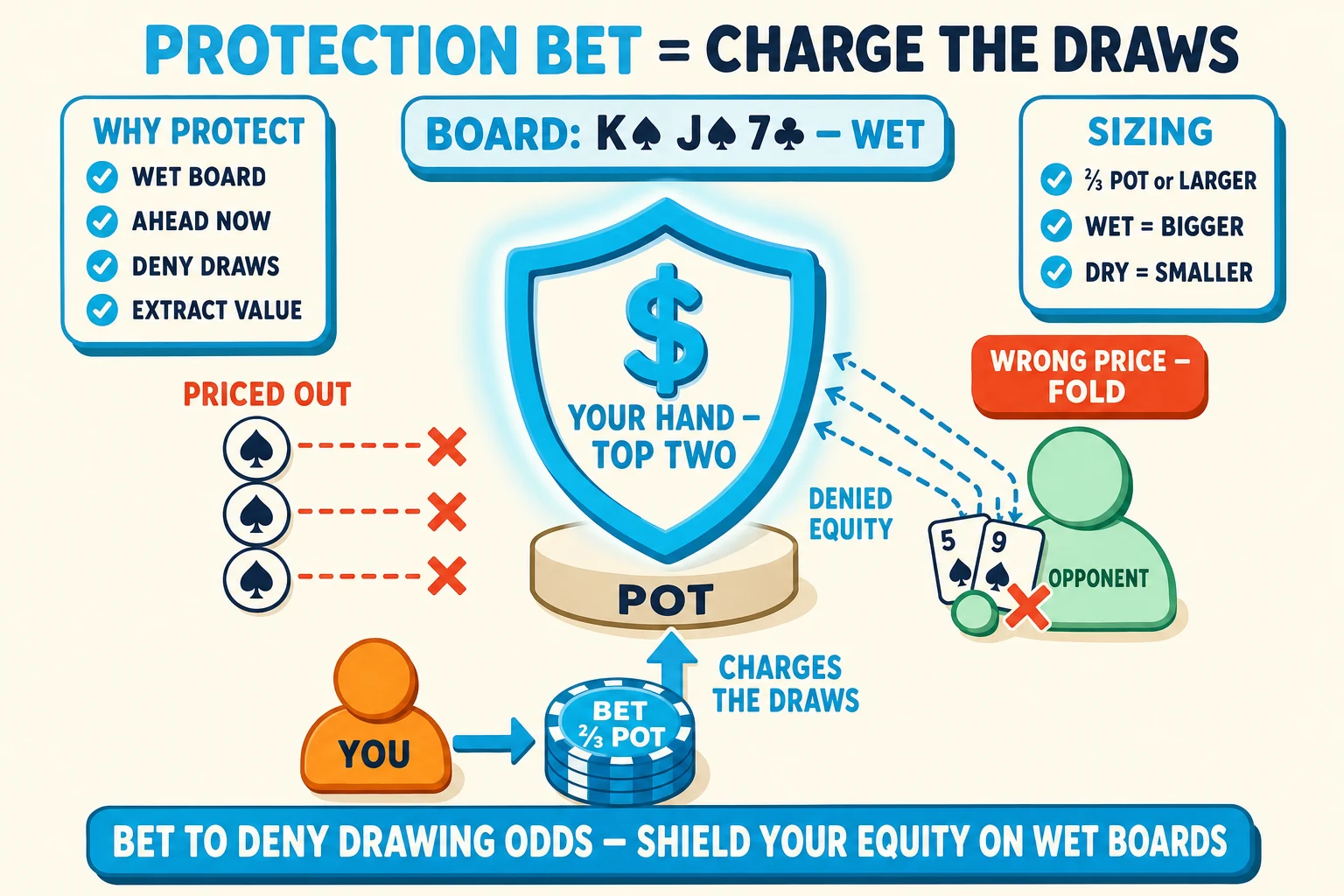
- On wet boards, prefer larger bets, commonly around two-thirds pot or more, to price out draws.
- On dry boards, use smaller bets or check; there are fewer draws to charge.
- Always size relative to texture: a spade-heavy flop needs a bigger bet than the same hand on a 7-4-2 rainbow.
Example: on K♠ J♠ 7♣ (two spades on board), a 2/3 pot bet makes single-spade draws expensive to chase. On a 7-4-2 rainbow, a small bet or check conserves chips because few realistic draws exist.
Balancing protection in your overall strategy
If you only protection-bet with strong hands, opponents will exploit your patterns by folding to bets and calling checks. Balance your approach.
- Mix protection bets with checks and occasional bluffs so frequency and size don’t reveal strength.
- Scale bet size to board texture, not only to hand strength, to keep your range ambiguous.
- Include protection bets in your continuation-bet plan, mixing value bets and bluffs so opponents cannot profile you.
Practical rules and examples
Quick table-ready rules:
- Rule of thumb: wet flop (e.g., K♠ J♠ 7♣) -> ~2/3 pot or larger with made hands. Dry flop (7-4-2 rainbow) -> tighten up; consider checking.
- Multiway pots or deeper stacks -> increase bet size to reduce multiway equity and implied odds.
- Size to deny drawing odds: ask whether the call price gives a draw correct pot odds (correct pot odds = the call has positive expected value). If it does, raise the price.
Example: you hold K♦ J♣ on a K♠ J♠ 7♣ flop (top two pair). An opponent from the big blind likely has a spade. Betting about 2/3 pot forces single-spade draws to pay or fold, protecting your hand and extracting value from weaker holdings.
Quick checklist
- Assess board texture first: wet vs dry.
- Size bets to alter opponents’ drawing odds, not only to reflect hand strength.
- Mix protection bets into your continuation-betting range.
- Increase bet size with more opponents or deeper stacks.
- Avoid predictable sizing patterns tied solely to hand strength.
At the table: read the texture, count opponents and stack depth, pick a size that denies correct drawing odds, and mix in checks and bluffs to stay balanced.