


Expected Value (EV)
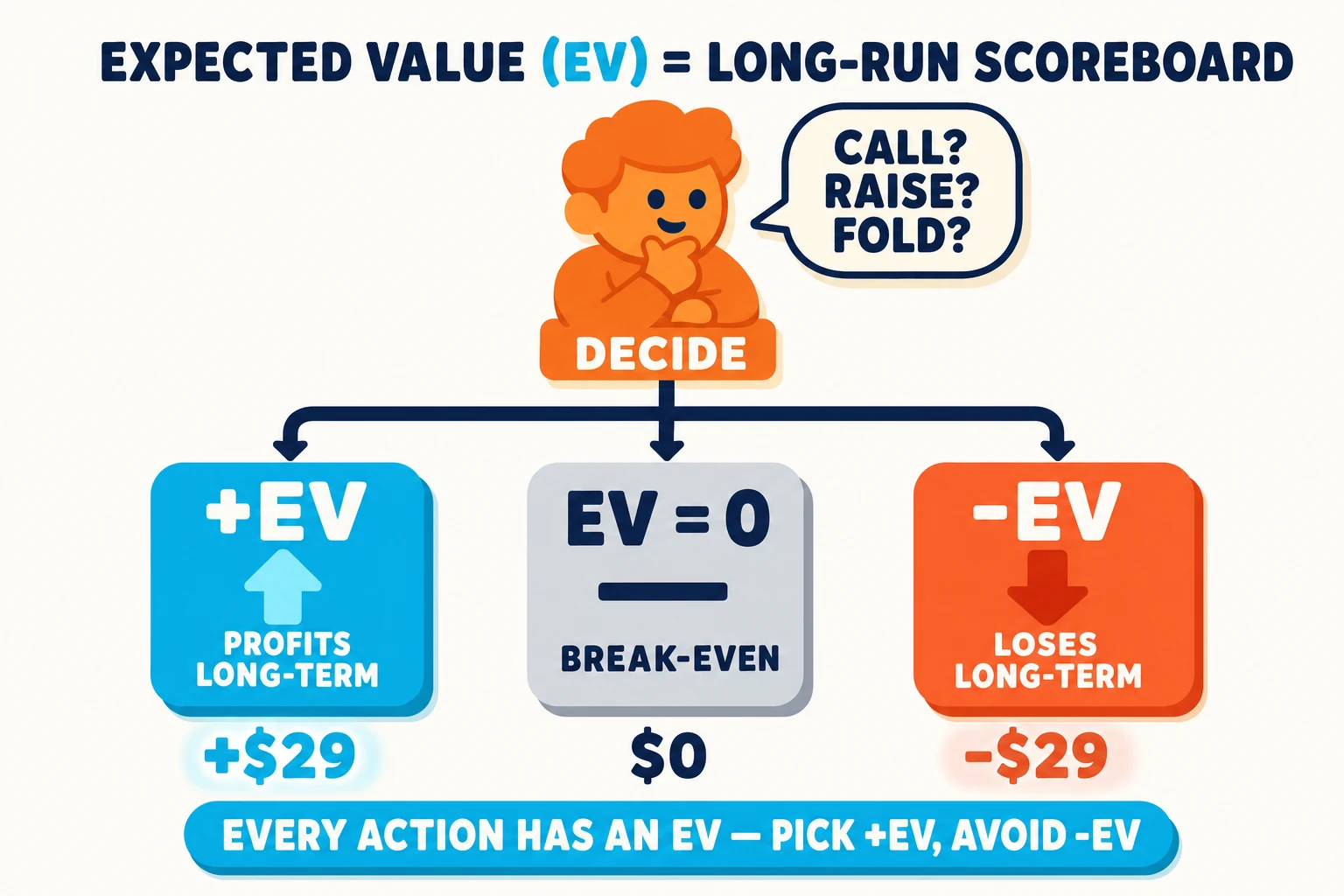
Expected value (EV) measures the average money you expect to win or lose from a specific action over the long run. A play that returns more than zero on average is +EV; less than zero is -EV; zero is breakeven. Folding has 0 EV; you risk no further money after folding.

Practice this in Poker Skill. Each action in a spot has an expected value, and the Daily Puzzle, a new decision every day, grades every option it offers, the ones you pass on as well as the one you pick.
Get the free appExpected value (EV)
What EV means for your decisions
Expected value (EV) measures the average money you expect to win or lose from a specific action over the long run. A play that returns more than zero on average is +EV; less than zero is −EV; zero is break-even. Folding has 0 EV; you risk no further money once your cards are in the muck.
A few related terms: equity is your probability of winning the pot. Pot odds are the immediate price to call. Implied odds are the future money you can win if your hand improves. Fold equity is the chance villain folds to your bet.
EV is the scoreboard for thousands of hands at a time. A single hand’s outcome doesn’t tell you whether the decision was right; the EV does.
Calculating EV: the basic formula
The core formula is: EV = (%W × $W) - (%L × $R)
Where:
- %W = your win probability (equity)
- $W = amount you win when you succeed (the pot before your call, including the opponent’s bet)
- %L = 1 - %W
- $R = amount you risk by making the call or bet
Quick steps to apply it at the table:
- Estimate %W (use an equity calculator off-table, or assign a range and estimate equity).
- Calculate $W (current pot + opponent’s bet if you call) and $R (what you must put in).
- Plug values into the formula. If EV > 0, the action is +EV.
Concrete check: if a shove requires about 33% equity to break even, and your hand’s equity versus the opponent’s range is 43%, calling is +EV.
Applying EV across the hand (preflop to river)
Preflop: build opening and calling ranges that are +EV given stack sizes and opponent tendencies. A tight preflop raise that folds out better hands can be +EV even if it wins fewer showdowns.
Postflop: weigh your current equity against the pot and expected future bets. A marginal flop call can be +EV if implied odds or later value bets justify it. Conversely, calling repeatedly into large pots with little equity will erode EV.
Always ask how future streets change the amounts won ($W), the risked amount ($R), and your win probability (%W).
Pot odds and implied odds: comparing odds to EV
Pot odds compare the cost to call now with the current pot size to give a break-even equity percentage. Implied odds add expected future bets you can win if your draw hits. Use both: if your estimated equity exceeds the pot-odds break-even point or is justified by implied odds, the call is likely +EV.
Range-based thinking matters: compare your hand’s equity against the opponent’s likely range, not just a single hand.
Value betting and bet sizing to maximize EV
Bet sizing changes the EV equation by altering $W and $R and by changing opponents’ folding frequencies (which affects realized wins). Evaluate sizings by how they shift these three EV inputs.
- Small bets: extract thin value from worse hands and keep opponent calling ranges wide.
- Larger bets: increase fold equity, protect against draws, and charge opponents more to chase.
Poker Skill teaches both sizes in its betting capstone, the smaller bet for top pair on K-10-7 so worse hands stay in and the larger bet for top set on Q-9-7 so the draws pay. Choose sizes that maximize the net EV of your line given opponent tendencies.
Practical limits, range uncertainty, and game theory
You never know exact holdings, so assign opponent ranges and compute a weighted EV across that range. Overestimating folding frequencies or implied odds can turn a theoretical +EV play into a losing one.
EV evaluates strategies; combine it with range-based and game-theory thinking to develop lines that are both profitable and hard to exploit. For the difference between this number and your share of the pot right now, see equity vs EV.
Measuring EV over time: bb/100 and session review
Win rate is measured in big blinds per 100 hands, written bb/100, so one number compares any session against another. A couple of big blinds per 100 looks like nothing on one hand and is real money across thousands of them. After a session, pick out the spots that keep losing chips and work out what the higher-EV line would have been.
Quick checklist
- Use the EV formula on every contested decision.
- Always compare your hand equity to pot odds and consider implied odds.
- Assign opponent ranges and calculate weighted EVs, not single-hand EVs.
- Choose bet sizes that improve the net EV of your line (value vs protection).
- Think long term: small +EV edges compound across many hands.
- Track your win rate in bb/100 and review the spots that keep costing you.