


Play the Board
When your best five-card hand is the five community cards and neither hole card improves it. If others are also playing the board, the pot splits.
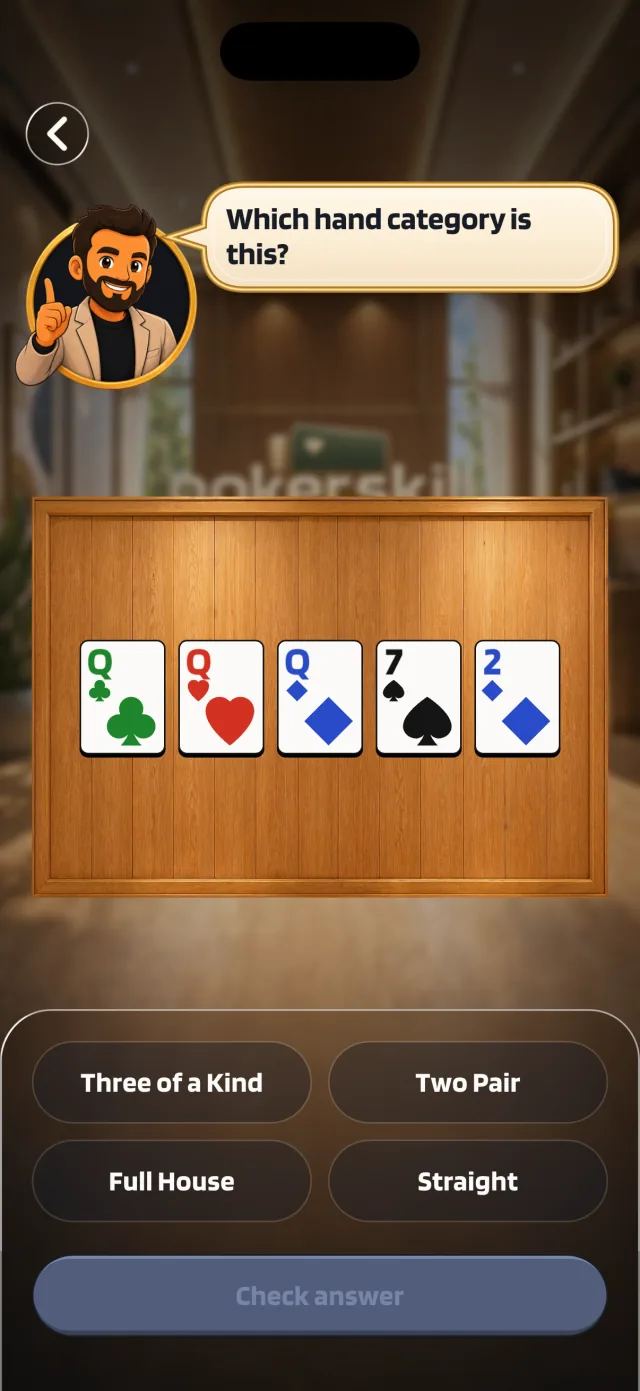
Practice this in Poker Skill. The Play the Board lesson asks who plays the board on Q-Q-Q-9-9, where three hands tie on the board and only the one holding a queen makes quads and wins.
Get the free appPlay the Board (No-Limit Texas Hold’em)
Definition: “Playing the Board” “Playing the board” means your best five-card hand uses only the five community cards. Your two private cards, called hole cards, add no value to that hand. When every remaining player’s best hand is the board, all players share the same final hand and split the pot. If any player can use at least one hole card to make a better five-card hand than the board, that player can win the pot outright.
The Board: Flop, Turn, River The five community cards are dealt in three stages: flop, turn, and river. The flop shows three face-up cards, the turn adds a fourth face-up card, and the river shows the fifth face-up card. Every player combines those five community cards with their two hole cards to make the best possible five-card poker hand. Sometimes the five community cards themselves form the strongest hand, such as a straight, flush, or full house, so players whose hole cards don’t improve cannot beat anyone.
How to Recognize You’re Playing the Board Quick checks to see whether your hole cards matter:
- Compare your hole cards to the final board; if neither hole card improves the five-card board, you are playing it.
- Ask whether a single hole card can create a better five-card combination than the board; if not, you have no edge.
- Consider opponents: could someone hold a hole card that improves the board? If yes, they can beat the shared hand.
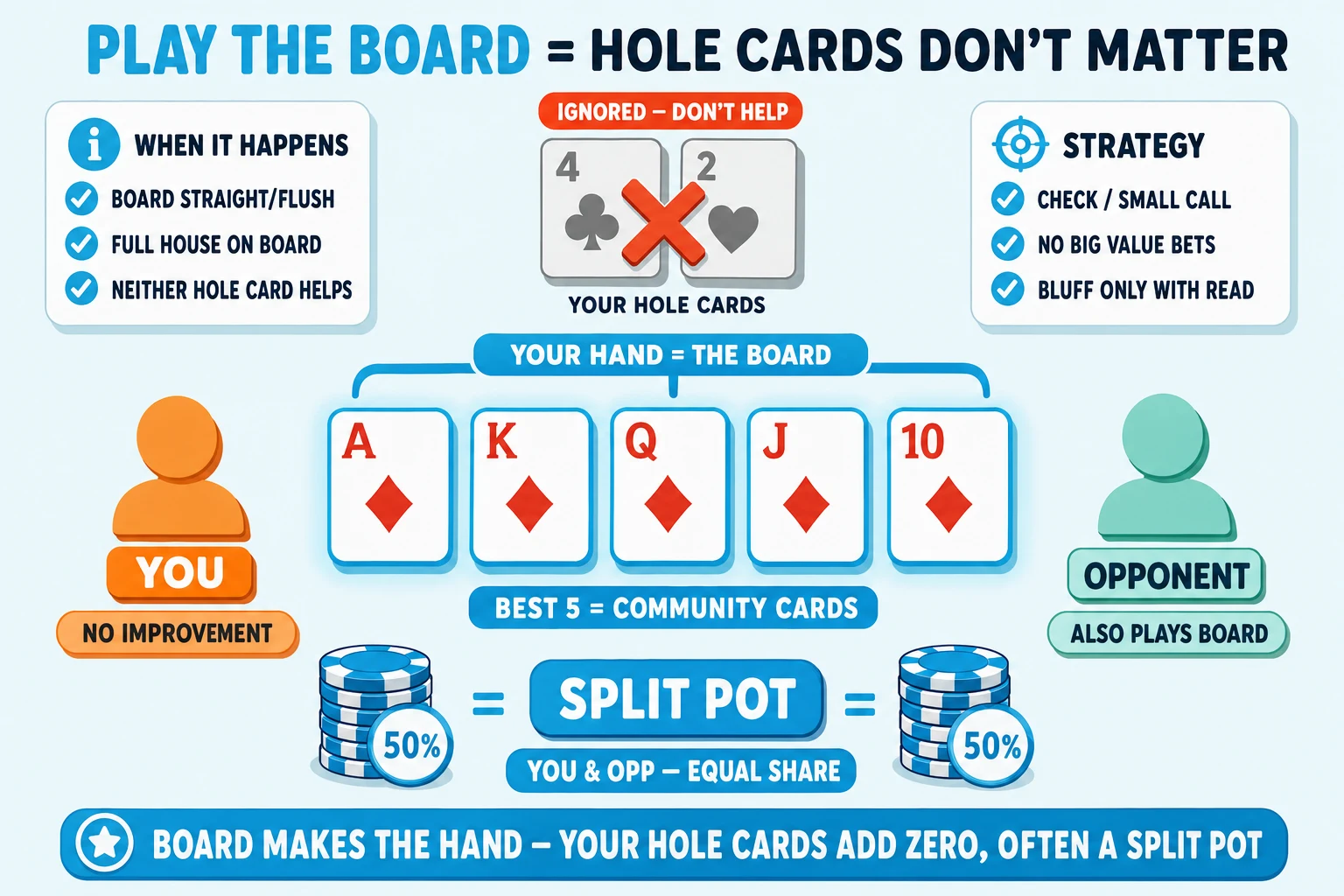
Example: if the board is A♦ K♦ Q♦ J♦ 10♦ (a royal flush on board), any player without a hole card that changes the five-card makeup is simply playing the board and cannot beat anyone else.
Betting and Strategic Consequences When you are only playing the board, you cannot win more than an equal share of the pot against other players also on the board. That reality should guide your betting decisions:
- Avoid large value bets; betting for value assumes you hold a better hand than your opponents.
- Bluffing to steal the pot is possible but risky and should rely on a strong read that opponents will fold better hole-card hands.
- Control the pot size by checking or calling small bets rather than committing large amounts with no chance to improve.
- Watch for opponents who could hold the single hole card needed to improve the board and win the pot outright.
Worked Example: Board That Makes a Full House Board: 3♠ 3♥ 3♣ 2♦ 2♠ - the five community cards form a full house.
- If no player holds a 3 or a 2 in their hole cards, every remaining player’s best five-card hand is that full house and the pot is split evenly.
- If a player holds a 3 in their hole cards, they can improve to four of a kind and would win the pot outright.
- If a player’s hole cards change the five-card combination to something stronger than the board, they take the pot; otherwise the board is shared.
Quick checklist
- Before betting at showdown, check whether either hole card improves the five-card board.
- Avoid large bluffs or big value bets when you are only playing the board unless you have solid reads that opponents will fold.
- Control pot size with checks and small calls, and watch for opponents who could beat the board with a single hole card.