


Playability
Playability is how easily a hand can realize its equity across future streets — clear decisions, strong draws, disguised hands, and resilient showdown value all raise it. Two hands with the same raw equity can play very differently, which is why a 38% suited connector can defend more cleanly than a 38% offsuit broadway.
Practice this in Poker Skill. Against an under-the-gun open, the Big Blind: Call or Fold lesson calls with suited jack-ten because it can make straights and flushes, and folds 9-8 offsuit as too hard to play out of position.
Get the free appPlayability: how easily a hand realizes its equity across future streets
Playability in plain English
Playability is how easily a hand can keep realizing its equity across future streets because it makes clear decisions, has strong draws, lands disguised value, or carries resilient showdown strength. A playable hand keeps finding paths forward — call, semi-bluff, raise, or fold — without painting itself into a corner. A hand with poor playability has the equity on paper but spends most flops getting bet off, paying off second-best, or guessing.
Three quick reads on what makes a hand playable:
- Clear decisions. The hand knows what it is on most flops: top pair good kicker, strong draw, or fold. It rarely sits stuck guessing about who is ahead.
- Forward motion. It flops at least one credible continue on most boards — a draw, a pair-plus-backdoor, or a piece big enough to bet for value.
- Disguise and showdown. When it improves, the result is hard for the opponent to read; when it does not, it can still see showdown often enough to collect its share.
Related terms
- Raw equity
- Equity realization
- Position
- Implied odds
- Reverse implied odds
- Combo draw
- Suited
- Connected board
Playability vs raw equity, realization, and position
These four ideas live in the same pot but answer different questions. Playability is the property of a hand. Realization is the score that property earns.
| Concept | What it tells you | What it does NOT tell you |
|---|---|---|
| Raw equity | Your % share of the pot at showdown if cards just run out | Whether you can keep playing |
| Playability | How easily a specific hand keeps making clear, forward-moving decisions | The exact percentage you will realize |
| Equity realization | The fraction of raw equity you actually convert into EV | Whether the hand was playable to begin with |
| Position | Whether you act last on every post-flop street | Anything about the cards in your hand |
The shortest version: raw equity asks “who wins at showdown?” Playability asks “can this hand still be playing the pot when showdown arrives?” Realization is the number those two answers add up to.
What raises and lowers playability
A handful of features do most of the work. They multiply with each other rather than add.
- Suitedness. Same-suit hole cards add flush draws, backdoor flush draws, and combo-draw flops. Every extra path to a credible continue raises playability.
- Connectedness. Closely connected cards make straights and double gutters; wide-gapped cards leave the hand with one or two ways to improve. 8♠9♠ has many friendly flops; Q♣4♥ has very few.
- Position. Acting last is the single biggest playability lever. In position you can check behind for a free card, control pot size, and react to action. Out of position the same hand commits to a plan with less information.
- Domination risk. Offsuit hands like K9o, Q9o, and A9o look fine on the equity calculator but get dominated by the same opponent’s natural value range. When the kicker plays, it usually plays second-best. That is the reverse implied odds side of playability.
- Stack depth. Deep stacks reward hands that can make big disguised holdings: suited connectors, small pairs, suited aces. Short stacks reward hands that flop top pair on dry boards and want to commit.
- Range fit. A hand whose strength matches the average flop your range hits well plays cleanly inside that range. A hand that misses the boards your range hits hardest spends extra streets out of position to its own line.
The same hand can be playable in one seat and unplayable in another. K9o on the button plays into ranges weak enough that K-high or top pair often holds up. K9o in the big blind plays into ranges that naturally have it dominated.
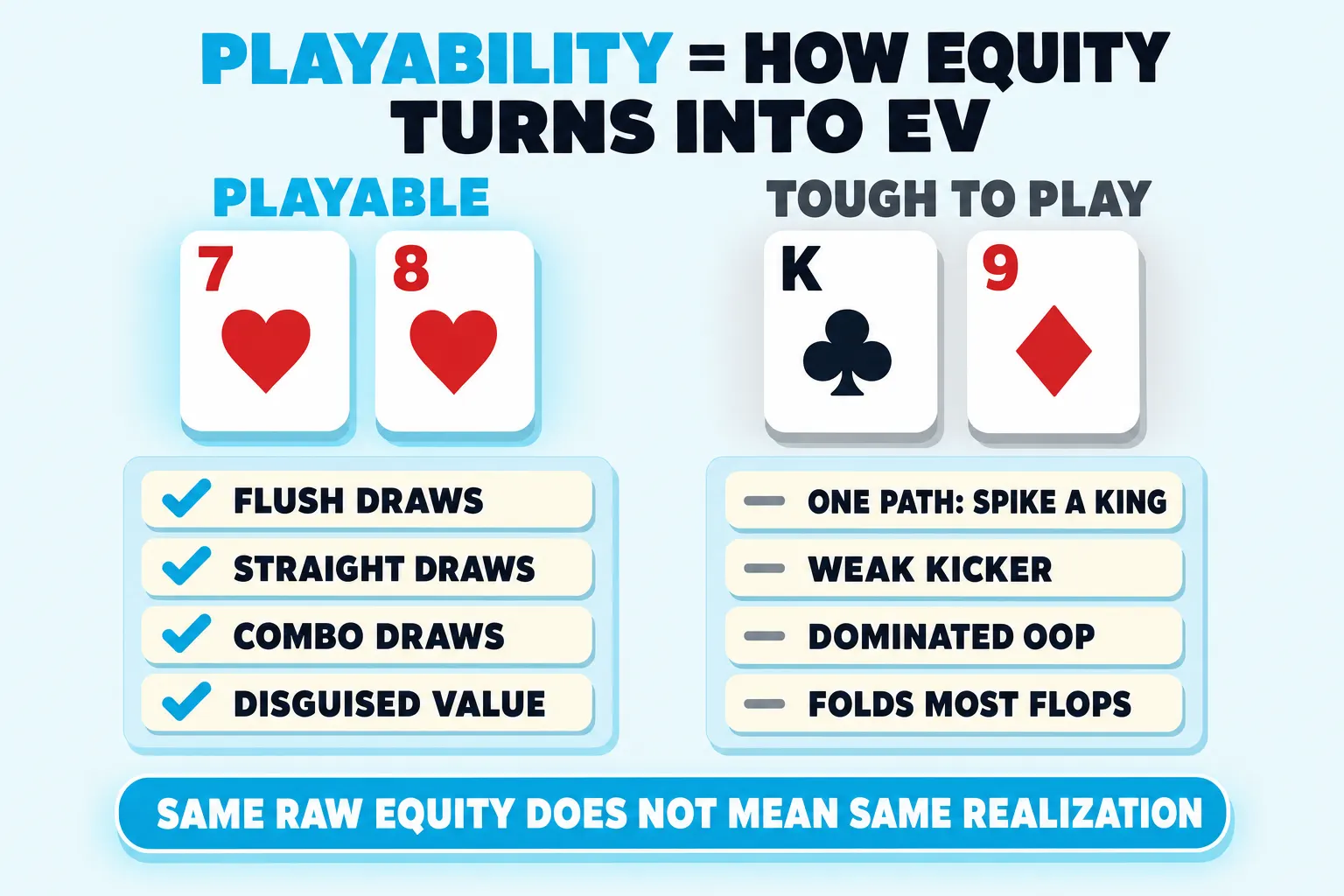
Example: 7♥8♥ vs K♣9♦ defending the big blind
Same seat, same opponent, same price, very different playability stories.
Setup: 6-max NLHE cash, 100bb effective. The button opens to 2.5bb, the small blind folds, you defend in the big blind versus a typical button opening range.
Hand A: 7♥8♥ — suited, connected, out of position.
- Raw equity versus a typical button opening range is roughly 38–40% (illustrative; exact numbers depend on the range you load).
- Playability is high. The hand flops at least one credible continue on a wide slice of boards: pair, gutshot, open-ender, flush draw, or a backdoor combo. On a connected board it often turns into a combo draw, which lets it call, check-raise, or barrel for credible reasons.
- When 7♥8♥ improves, the result is disguised. A button range full of broadways and offsuit aces does not naturally read 7-high for top two. The implied odds on the times it hits cushion the times it misses and folds.
Hand B: K♣9♦ — offsuit, weakly connected, out of position.
- Raw equity against the same button range is in a similar neighborhood, often 38–42%.
- Playability is poor. The hand has one primary path forward: spike a king. Most of the time it spikes a king against a kicker that beats nine, which is the worst version of a top pair. The rest of the time it makes king-high or weak nine-pair and gets bet off most flops.
- The same suit-and-connectedness that gave 7♥8♥ ten different friendly flops gives K♣9♦ maybe two: K-high flops with a manageable kicker, or 9-high flops with a king overcard. Every other flop is a fold candidate.
- Reverse implied odds bite hardest on the flops the hand does “hit.” Top pair weak kicker out of position is a textbook under-realizer.
The lesson is not that K♣9♦ is weaker than 7♥8♥. K9o is the stronger hand on the equity calculator and the stronger hand at showdown when both make a pair. The point is that playability decides which hand keeps the share that the raw number promises. 7♥8♥ over-realizes; K♣9♦ under-realizes. Two near-identical equities, two very different defends.
A close cousin shows up with suited vs offsuit broadways. KQs out of position plays much cleaner than KQo because the suit opens up flush draws on coordinated boards, the connectedness adds straight draws, and the times KQs misses still leave backdoor equity to barrel with. KQo without those paths spends more streets either folded or paying off dominated.
Common mistakes when judging playability
1) Treating equity charts as playability charts
Two hands with the same equity number can have very different post-flop lives. The chart says “K9o is 41% versus the button range.” It does not say K9o flops top pair weak kicker into the button’s natural value range. Playability is the gap between those two facts.
2) Calling out of position with hands that need position
Many borderline defends are fine in position and bad out of position because position is half the playability budget. A hand that flops a marginal made hand on the button can check back, take a free card, and price its own continue. The same hand in the big blind faces a c-bet and decides blind. Folding the equity is the cost of being first to act with a hand that needs to react.
3) Confusing strong-looking hole cards with playability
Off-suit broadways like Q♣J♠ look strong cold. They are roughly average for playability: top pair on roughly one in three flops, weak kickers on the other broadway flops, and rarely a draw stronger than a gutshot. They play meaningfully better than QJo across textures only when there is real range advantage or position to lean on.
4) Forgetting that playability is range-dependent
A hand that under-plays in one range can over-play in another. A small pair is a poor defending hand against a tight UTG raise (it sets-or-folds and rarely gets paid) and a fine call against a button open (sets get paid against a wider range, and the times it misses can fold cheaply against a narrower c-bet frequency). Playability lives at the intersection of your hand and the action in front of you, not the hand in isolation.
FAQ
What is the simplest definition of playability?
Playability is how easily a hand realizes its equity across future streets. A playable hand keeps making clear decisions: call, raise, semi-bluff, fold. A hand with poor playability has the equity but spends most flops getting bet off, paying off, or guessing.
Why does a 38% suited connector defend better than a 38% offsuit broadway?
Because raw equity is silent on which one keeps the share. A suited connector flops draws, combo draws, and disguised straights that let it continue under pressure. An offsuit broadway flops top-pair-weak-kicker into the opener’s natural value range and either folds the equity or pays off dominated. Same number on the calculator, very different post-flop lives.
Is playability the same as equity realization?
They are related but not the same. Playability is the property of the hand: how many credible continues it has on the average flop, how disguised its value gets, how often it has a clear decision. Equity realization is the score: the fraction of raw equity that property converts into EV. A playable hand realizes more of its equity; an unplayable hand realizes less.
How does position affect playability?
Position is the single biggest playability lever. The same hand routinely realizes 10–20% more of its raw equity in position than out of position, because acting last lets you take free cards, control pot size, and react to action. Out of position the same hand commits to a plan with less information, which makes the easier playability problems harder and the hard ones unmanageable.