


Raw Equity
Raw equity is your hand's bare showdown-equity percentage against an opponent's hand or range, calculated as if the cards just run out. It ignores position, future betting, fold equity, and realization, which is exactly why it can mislead in any pot that isn't already all-in.

Practice this in Poker Skill. The Big Blind vs UTG Open lesson looks past raw equity, folding offsuit A8 as a hand that realizes its equity poorly out of position while suited A4 calls for its wheel and flush potential.
Get the free appRaw equity: the showdown number before any adjustments
Raw equity in plain English
Raw equity is your hand’s bare percentage chance to win the pot at showdown if the remaining cards just run out, with no more bets, no more folds, and no decisions to make. It is the number an equity calculator returns when you punch in two hands or a hand and a range, and it is the input that the more expensive ideas, equity realization and all-in equity, are built on top of.
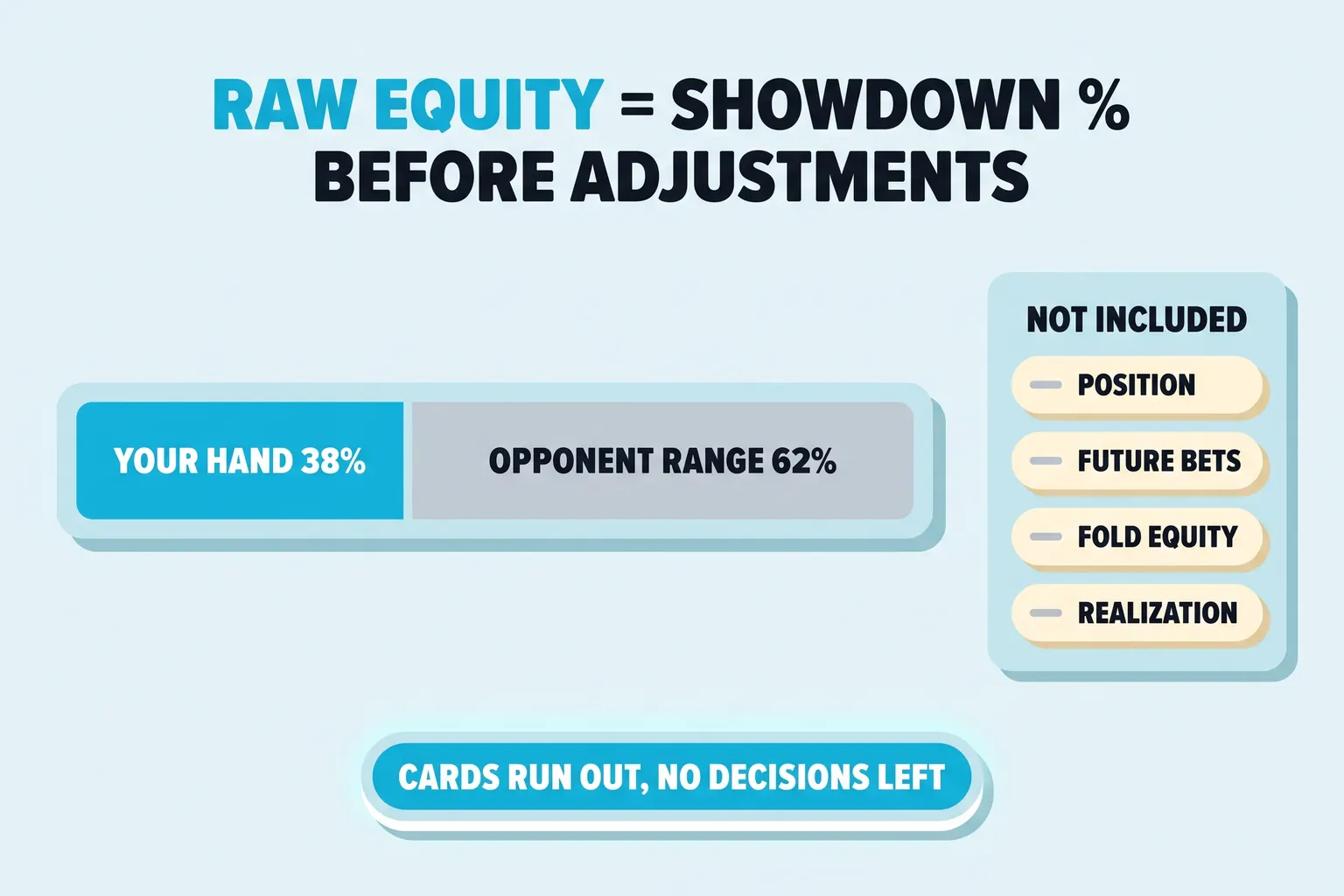
A useful mental shortcut:
- Raw equity treats the hand as if it were already at showdown. It does not know whether you have to call a turn barrel to get there.
- It is the same number whether you are in or out of position. Position only matters once decisions get added back in.
- “Hot-and-cold equity” is the same idea. The label means both hands stay live to the river: neither folds, neither bets, neither sees a card the other one didn’t.
Related terms
- Equity
- Equity realization
- All-in equity
- Pot odds
- Fold equity
- Implied odds
- Reverse implied odds
- Expected value
- Position
Raw equity vs the other equity-flavored ideas
These eight concepts share a vocabulary and get mixed up constantly. They answer different questions about the same pot.
| Concept | What it tells you | What it does NOT tell you |
|---|---|---|
| Raw equity | Your % share of the pot if cards just run out, no betting, no folds | Whether you actually reach showdown |
| Equity | The umbrella term — your win probability at any moment | Which flavor (raw, realized, all-in) the speaker means |
| All-in equity | Your % share once both stacks are committed and only the runout is left | Anything outside an all-in spot |
| Equity realization | The fraction of your raw equity you actually convert to EV when betting continues | The price tag on this exact decision |
| Pot odds | The minimum equity you need right now to call this bet at break-even | What happens on later streets |
| Fold equity | The portion of EV that comes from making the opponent fold | How your hand does if they call |
| Implied odds | Future chips you expect to win when you improve | The cost of paying off when you make second-best |
| Reverse implied odds | Future chips you expect to lose when you improve to a worse hand | The upside on the cleaner runouts |
| Expected value | The chip outcome of a decision averaged over many runs | Which input — equity, realization, fold equity — drove the result |
The shortest version: raw equity is the showdown probability before any of the realization-side ideas get applied. All-in equity is what raw equity becomes once both stacks are in and the realization factor jumps to 100% by definition. Realized equity is what raw equity becomes once you account for folds, position, and future betting.
Why raw equity can mislead in non-all-in pots
The number is honest about what it measures. The mistake is treating it as the answer to a question it does not answer.
In an all-in pot, raw equity and realized equity are the same number. Nothing can leak between now and showdown: no folds, no missed second-barrels, no bluffs to peel off. The cards run out and one player ships the pot.
In a non-all-in pot, three things stand between your raw-equity share and the chips actually moving toward you:
- You can fold before showdown. Every flop you check-fold and every turn barrel you give up to is a slice of raw equity that the opponent collects without contesting.
- The opponent can charge you to keep going. Even when the math says to call, paying off bets to hit your draw eats into the realized number — and missing the draw and folding the river hands the rest back.
- You can improve to a worse hand. Reverse implied odds eat raw equity from the other direction. The hand that looked like it had the best of it at the moment of the flop turns into the hand that pays off a full pot.
A hand can have enough raw equity to call a single bet by pot odds and still be a losing call once realization is priced in. The textbook trap reads “I have 35% versus his range, pot odds are 30%, so this is a call.” Raw equity priced the bet in front of you correctly. It did not price the next two streets, the next two folds, or the next time you make second-best and pay off.
The rule of thumb: in any spot where there are still streets to come, treat raw equity as the input to your decision, not the answer. Adjust it down for hands that under-realize (offsuit, weakly connected, out of position, low SPR with a marginal made hand) and adjust it up for hands that over-realize (suited, connected, in position, deep stacks with implied odds).
Example: 78s versus AKo, the same raw equity, very different realized value
Consider a stat that surprises beginners every time: a small suited connector and a strong offsuit broadway hand have nearly identical raw equity in many spots. What separates them is everything that lives outside the raw number.
Setup: 6-max NLHE cash, 100bb effective. The button opens to 2.5bb, the small blind folds, you defend in the big blind versus a typical button opening range.
Hand A: 7♥8♥ — suited, connected, out of position.
- Raw equity versus a typical button opening range is roughly 38–40% (illustrative; the exact number depends on the range you load).
- Realized value runs higher than raw on most flops the hand plays. 78s flops some piece of the board often — pair, gutshot, open-ender, flush draw, backdoor combo draws — so it has credible ways to call a c-bet, semi-bluff a turn, or hit a disguised straight or flush that the button’s range pays off.
- The hand over-realizes its raw equity in most defends because it can keep playing.
Hand B: A♣K♦ — strong unpaired broadway, out of position.
- Raw equity against the same button range is also roughly 38–42%, in the same neighborhood as 78s.
- Realized value is messier than raw suggests. AKo flops top pair on roughly one in three flops; the rest of the time it is ace-high or king-high with limited paths forward. Defending is closer to a 3-bet candidate than a flat — flatting AKo out of position runs into c-bets that fold out the live ace-high half of the equity, and reverse implied odds when the king pairs into a queen-high flop with a worse kicker.
- AKo can under-realize its raw share, depending on action and runout, when defended flat out of position.
The lesson is not that AKo is “weaker than” 78s. AKo is the stronger hand at showdown. The point is that raw equity is silent on which one keeps the share that the number promises. 78s is one of the cleaner over-realizers in the big-blind defending range; AKo is one of the more common candidates for under-realization when played passively out of position. Two hands with the same raw equity, two very different decisions.
A draw makes the gap even louder. A bare gutshot has roughly 8–9% raw equity to hit on the next card and roughly 16–17% to hit by the river. The realized number on a multi-street pot is often lower, because folds before you get there or hitting and getting outdrawn both shave the share. A combo draw like a flush draw plus a gutshot has both higher raw equity and a much higher realization factor, because every street offers a credible continue.
Common mistakes with raw equity
1) Confusing raw equity with EV
Raw equity is one input to expected value, not EV itself. EV is what comes out the other side once realization, fold equity, position, and future betting decisions get applied. Hands with identical raw equity can have very different EV in the same spot.
2) Using raw equity to price a non-all-in call
The classic leak. Pot odds say you need 30%. Raw equity says you have 35%. Call. Then fold the flop unimproved, give up the turn unimproved, or pay off third pair on the river. The 35% raw share does not survive the way the hand actually plays. Realized equity was closer to 22%, and the call was negative the whole time. Raw equity is the right input for an all-in call. It is not the right input for a flat that has more streets to come.
3) Reading raw equity as a guarantee
Raw equity is a long-run average over runouts. A hand with 60% raw equity loses 40 times in 100. The number describes the distribution, not any one hand. Treating it as a promise is how a +EV decision gets blamed for a single bad run.
4) Comparing raw equity across positions
Two hands with the same raw equity but different positions are not the same defend. Acting last lets you take free cards, control pot size, and react. Acting first forces commitment with less information. Position is invisible to a raw-equity calculator; it is one of the biggest realization levers at the table.
FAQ
What is the simplest definition of raw equity?
Raw equity is the percentage chance your hand wins the pot at showdown if the remaining cards run out, without any further betting or folding. If you have 40% raw equity in a pot, you would win 40% of all the runouts where neither player ever folds or makes a new decision. It is the input that EV math starts from.
Is raw equity the same as all-in equity?
They reduce to the same number in any spot where there are no decisions left. All-in equity is the version of raw equity that gets to be realized at 100%, because once both stacks are in there is nothing left for either player to do except watch the cards. Outside an all-in spot, raw equity is still raw equity, but it has to survive realization before it pays.
How is raw equity different from realized equity?
Raw equity is the showdown-percentage in a vacuum. Realized equity is the fraction of that percentage you actually convert into expected value when betting continues. A hand with 35% raw equity that only realizes 75% of it ends up with the value of a 26% hand for EV purposes. Realization is shaped by position, suitedness, connectedness, stack depth, range advantage, and how strong or marginal the hand is on the average flop.
Why is raw equity called “hot-and-cold” sometimes?
“Hot-and-cold” is the older calculator label for the same idea: deal both hands all the way to the river with no betting, see who wins, repeat. The label captured that nothing can move between the two hands — no bluffs, no folds, no decisions. The modern term is raw equity (or showdown equity, or pure equity), and the math behind it is the same.