


Full House
A Full House is five cards: three of one rank plus two of another. In Hold'em you combine your two private hole cards (your two personal cards) with the five community cards (the board) to form the best five-card hand. A Full House beats straights and flushes but loses to four of a kind or any straight flush.
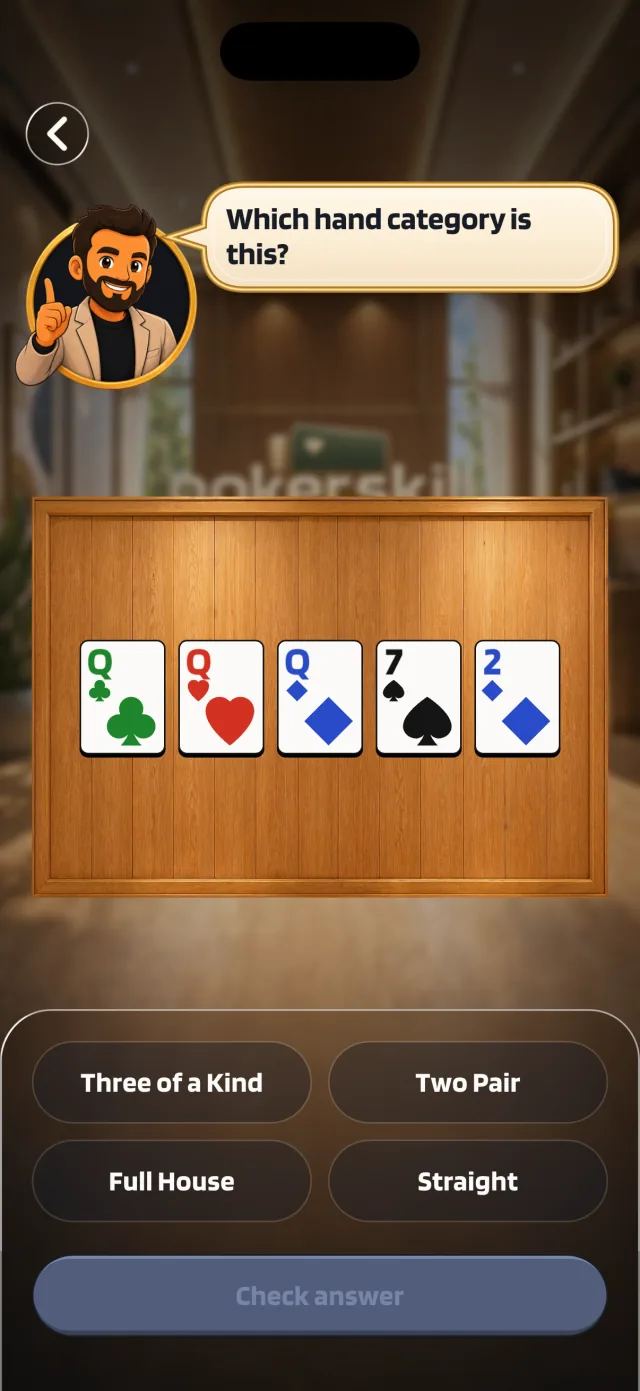
Practice this in Poker Skill. The Full House & Four of a Kind lesson asks you to name K♣ K♥ K♠ 2♦ 2♥ from four answers, and only kings full of twos is right: a full house is named by its trips first, so “twos full of kings” has the order backwards.
Get the free appFull House (No-Limit Texas Hold’em)
Definition and composition
A Full House is five cards: three of one rank plus two of another. In Hold’em you combine your two private hole cards (your two personal cards) with the five community cards (the board) to form the best five-card hand. A Full House beats straights and flushes but loses to four of a kind or any straight flush.
You will also hear this hand called a boat. The two words mean the same thing, and the nickname has its own entry at boat.
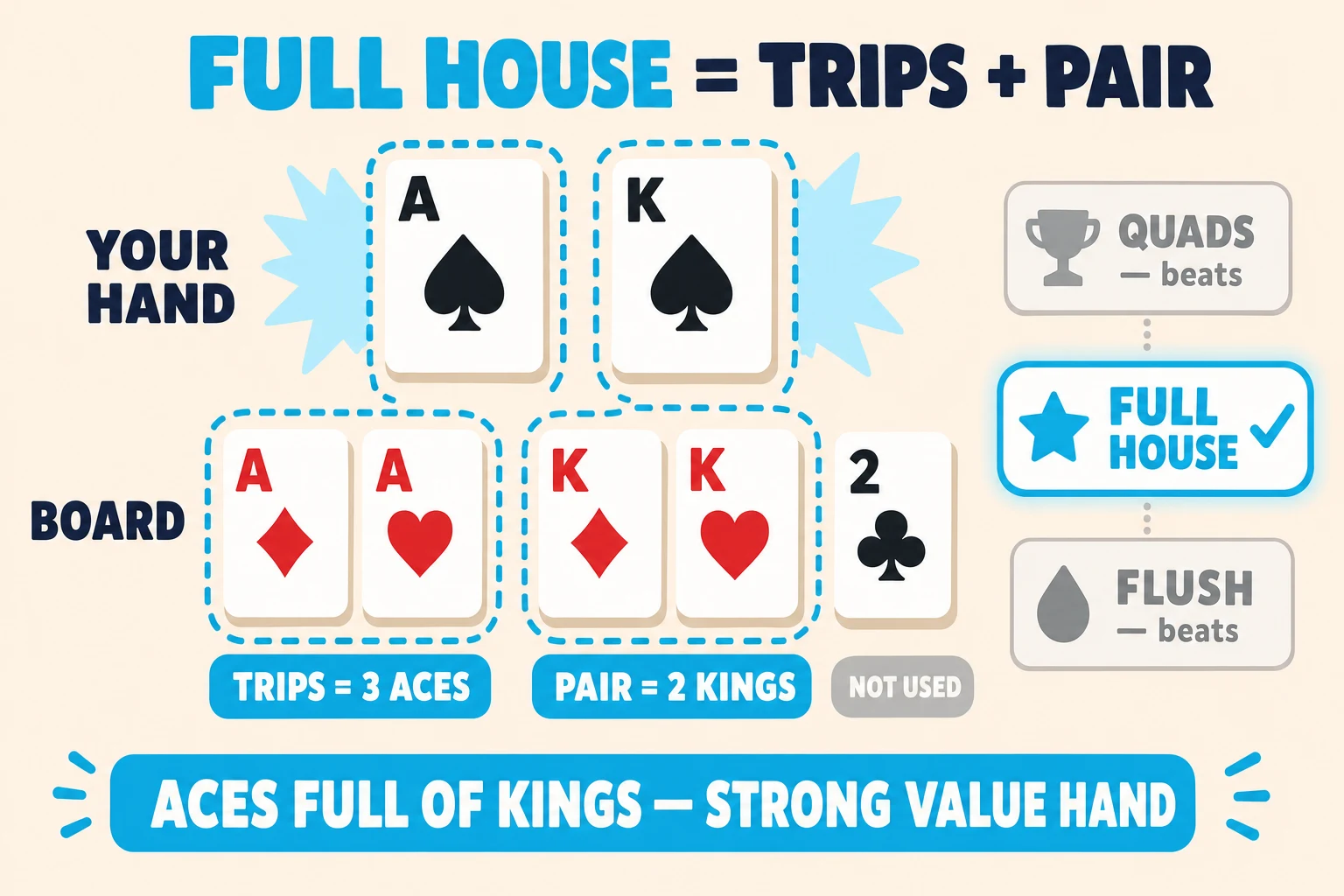
Example: You hold A♠K♠ and the board is A♦ A♥ K♦ K♥ 2♣. Your best five-card hand is A A A K K, a Full House (aces full of kings).
For the full order of hands, odds, and tie-break examples, see the poker hand rankings chart. For every other term on this site, browse the poker terms list.
Does a full house beat a straight?
Yes, comfortably. A straight is five cards in sequence. A full house is three of a kind plus a pair, and the rankings place it above both the straight and the flush.
So if you have a full house and your opponent turns over a straight or a flush, you win the pot.
What beats a full house?
Only three hands: four of a kind, a straight flush, and a royal flush. Nothing else in the deck is above it.
That is the whole list. Two pair, three of a kind, a straight, and a flush all lose to a full house. The one thing left to check at the table is whether the board could hand somebody a bigger full house than yours, which is a separate question from what beats a full house at all. For which full house wins when two collide, and the odds of making one, see full house rules and ties.
How Full Houses form in Hold’em
Full Houses commonly form when the board pairs or when a player’s hole cards pair a board card.
- Using both hole cards: With a pocket pair, 8♣8♦ and a board J♠8♠J♦7♣, you make 8 8 8 J J.
- Using one hole card: With A♣Q♣ and board A♦A♥K♦K♠7♠, you make A A A K K.
- Board-made trips or pairs: When the board pairs or contains trips, multiple players can make Full Houses. For example, a flop K♦K♠2♥ followed by the turn K♣ puts trips on the board: the player holding the last king has quads, and any pocket pair or any deuce makes a Full House.
Full Houses most often complete on the turn or river, as those streets add the paired or trip cards you need.
Relative strength and frequency
A Full House ranks above a flush and a straight and below four of a kind. Across seven cards it comes up about 2.6% of the time, less often than a flush or a straight. Full Houses are rarer than two pair or trips, so they usually carry substantial equity versus typical calling hands. Their rarity and strength often justify applying pressure to extract chips.
Betting and value-extraction strategies
With a Full House, aim to extract value while protecting against outs, the cards that can still beat you.
- Bet for value and deny free cards that could give opponents quads or higher Full Houses.
- Size bets to keep worse hands calling; build the pot without pricing them out.
- Slow-play selectively. On dry boards and versus passive players, checks or small bets can induce calls later. Versus aggressive or draw-heavy players, prefer larger bets to charge draws.
Example: With A A A K K on a river that completes flushes and straights, a sizable bet can get paid by those hands, and none of them beats a Full House.
One more sizing rule comes from the Zeebo theorem: no player folds a full house at any bet size, so bet big when you beat one and never bluff a player who probably holds one.
Reading the board and opponent considerations
Always read the board texture. If the board pairs twice, contains four cards of a suit, or is highly connected, the risk of quads or a straight flush increases.
Consider opponent ranges, the hands they could plausibly hold given the earlier action. Early-position aggression may indicate pocket pairs that can convert to quads or beat your Full House. Use betting patterns, timing, and history to choose between extracting maximum value and playing cautiously.
Example: On Q♦ Q♥ 9♣ 9♠ 2♦, holding A♥ 9♦ makes 9 9 9 Q Q, nines full of queens. Beware: an opponent holding any queen has Q Q Q 9 9, queens full of nines, a higher Full House likely to raise. Full houses carry no kicker, so your ace does not help: against Q♠ 5♣ on this board, the matchup in Poker Skill’s Capstone - Winners in Context lesson, A♥ 9♦ loses to a hand whose five never plays.
Compare all ten poker hand rankings, best to worst to see where a full house sits.
Every full house matchup, answered one by one, sits in what beats what in poker.
Quick checklist
- Confirm your best five-card Full House before committing chips.
- Check the board for higher combinations: quads or straight flushes.
- Size bets to balance value extraction and protection against draws.
- Adjust lines based on opponent tendencies and revealed ranges.