


Quads
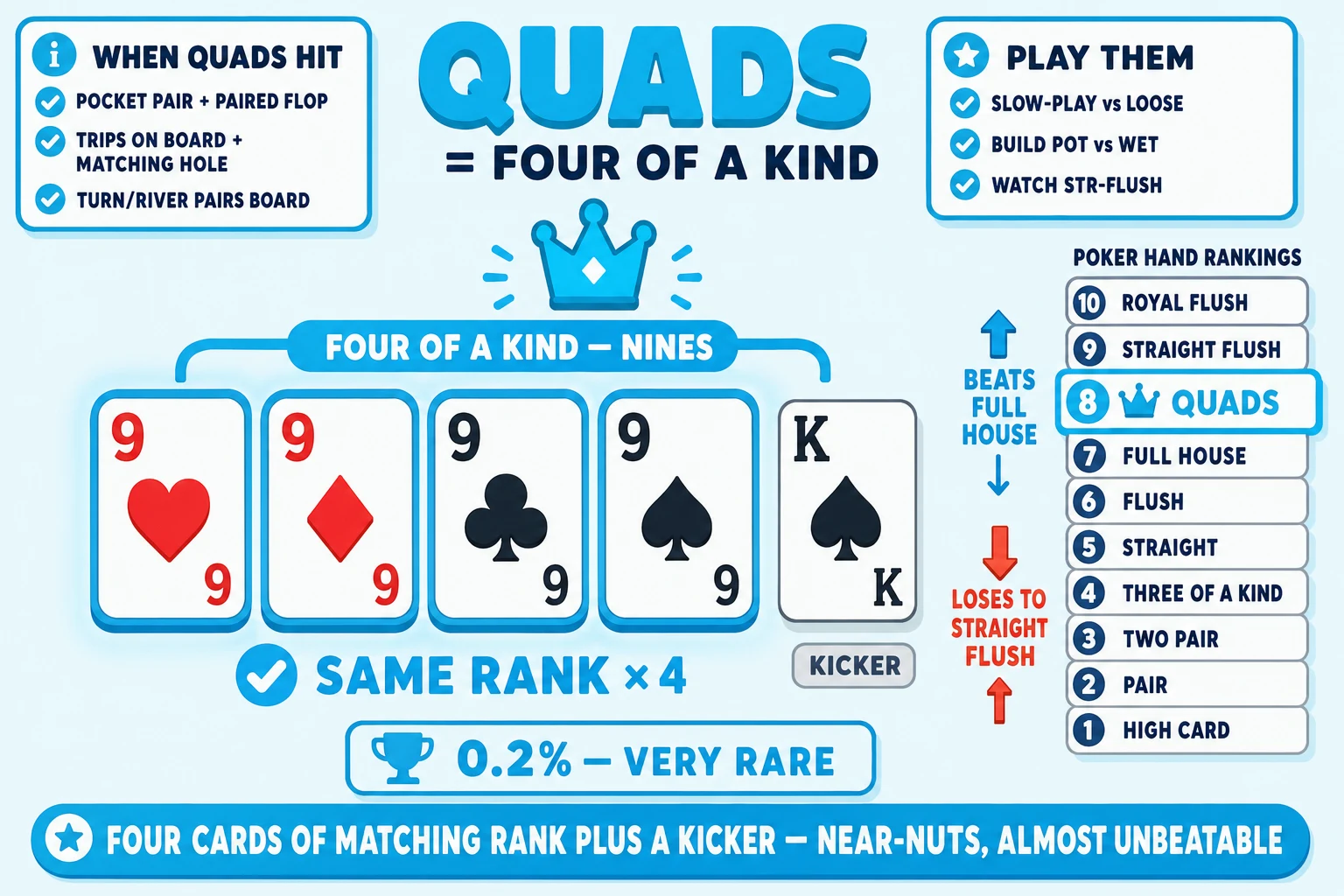
Quads, or Four of a Kind, are four cards of the same rank plus a fifth unrelated card called the kicker. The kicker is the extra card that breaks ties when players share the four matching ranks. Example: you hold A♠ A♥ and the board is A♦ A♣ K♣ - you have four aces with a king kicker.
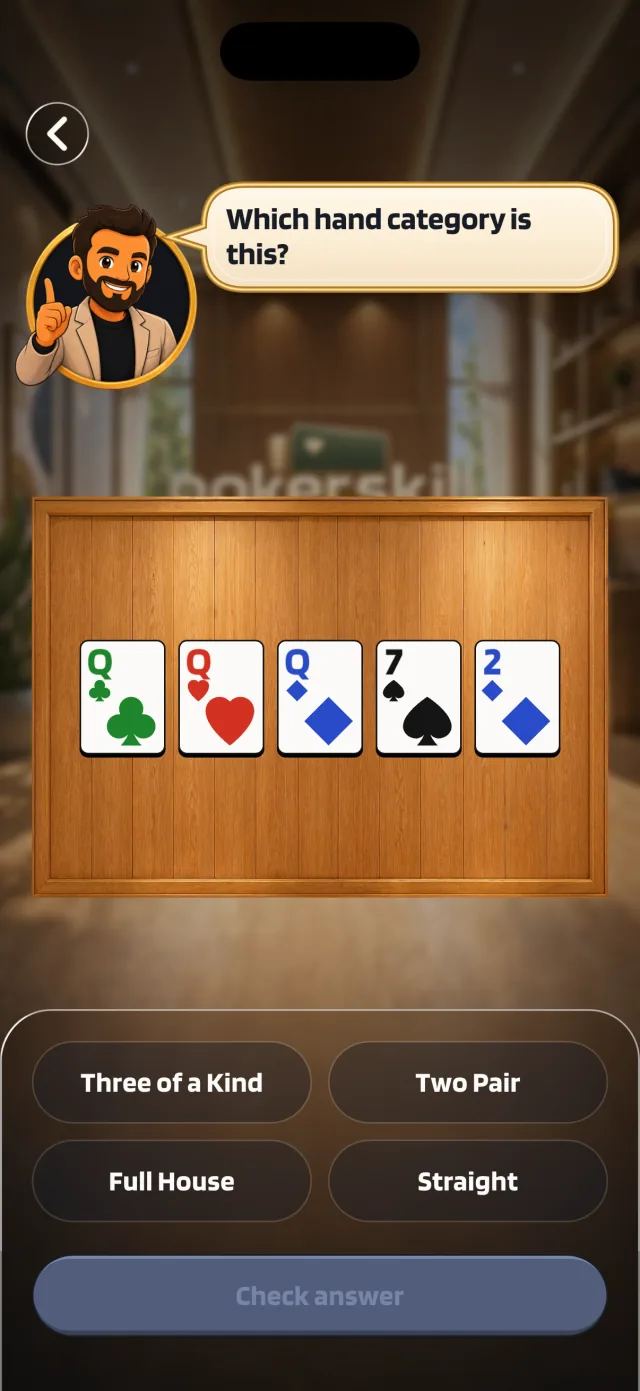
Practice this in Poker Skill. Picking the quads out of four hands on 7♥ 7♦ 7♠ K♣ 2♦ is a question in the Full House & Four of a Kind lesson, and only a hand holding the 7♣ has them, while K♦ K♠ or 2♥ 2♣ just fill up.
Get the free appQuads (Four of a Kind) in No-Limit Texas Hold’em
What quads are and where they rank
Quads, or Four of a Kind, are four cards of the same rank plus a fifth unrelated card called the kicker. The kicker is the extra card that breaks ties when players share the four matching ranks. Example: you hold A♠ A♥ and the board is A♦ A♣ K♣ - you have four aces with a king kicker.
In the standard hand hierarchy, quads sit below a straight flush and above a full house. That makes quads nearly unbeatable except against a straight flush or a higher four of a kind.
For the full order of hands, odds, and tie-break examples, see the poker hand rankings chart.
How often quads occur and key board patterns
Quads are rare. The chance your final five-card hand is four of a kind, measured from the pre-flop stage, is about 0.2%. Flopping quads is much rarer: about 0.024% of all hands dealt, or roughly 1 in 4,165. Holding a pocket pair, the chance that the flop brings the other two cards of your rank is about 1 in 408. Example: you hold 7♣ 7♦ and the flop comes 7♠ 7♥ 2♦ - you flop quads.
Certain board textures increase quads possibilities. A three-of-a-kind flop (e.g., 6♦ 6♣ 6♥) or a paired board plus a matching hole card makes quads much more likely and should change how you read ranges.
Basic strategic approaches with quads
Slow-play - checking or making small bets to disguise strength - often extracts more value from full houses and strong pairs. Slow-play means intentionally playing passively to induce larger calls or bluffs.
Practical decision steps:
- Assess the board: quads rarely need protection, so on a draw-heavy board the reason to bet is the value from hands that call.
- Evaluate opponents: bet larger versus calling stations; check to induce aggressive players.
- Watch for higher quads: on paired boards, confirm whether your quads are the top four-of-a-kind.
Example: you hold Q♠ Q♥ on Q♦ Q♣ K♠. Against a loose caller, bet the flop and keep betting; against an aggressive player, a check can let them bet into you.
Reading opponents and sizing bets for maximum value
Size bets to keep strong villains in the pot. Small-to-medium bets often keep full houses and big pairs calling; huge overbets tend to force folds. On a dry board with quads, medium bets build the pot while allowing call-downs.
Watch betting patterns: frequent small calls and a large turn raise often signal a full house or improving set. If an opponent slow-plays, they may hold the second-best hand; exploit that by checking to induce or by sizing bets for calls.
Choose trapping (checking) when opponents will bet for you; choose building (betting/raising) when free cards or draw-heavy textures threaten your value.
Common pitfalls and edge cases to watch for
- Don’t assume an automatic win: under-betting or over-slowing can leave value on the table.
- Beware rare outranks: on heavily paired boards a higher four of a kind or a straight flush can beat you.
- Be careful when quads are entirely on the board (e.g., 5♦ 5♣ 5♥ 5♠ K♣). Then every player holds at least the board’s four fives with a king kicker, and only an ace in hand plays higher.
For the short list of hands that can still beat four of a kind, four aces included, see what beats what in poker.
Quick checklist
- Confirm whether quads use hole cards or are entirely on the board.
- Choose a value plan: slow-play versus controlled aggression based on opponents and board texture.
- Size bets to extract calls from full houses and other strong hands.
- Stay aware of rare outranks (straight flush, higher quads) before committing chips.