


Quartered
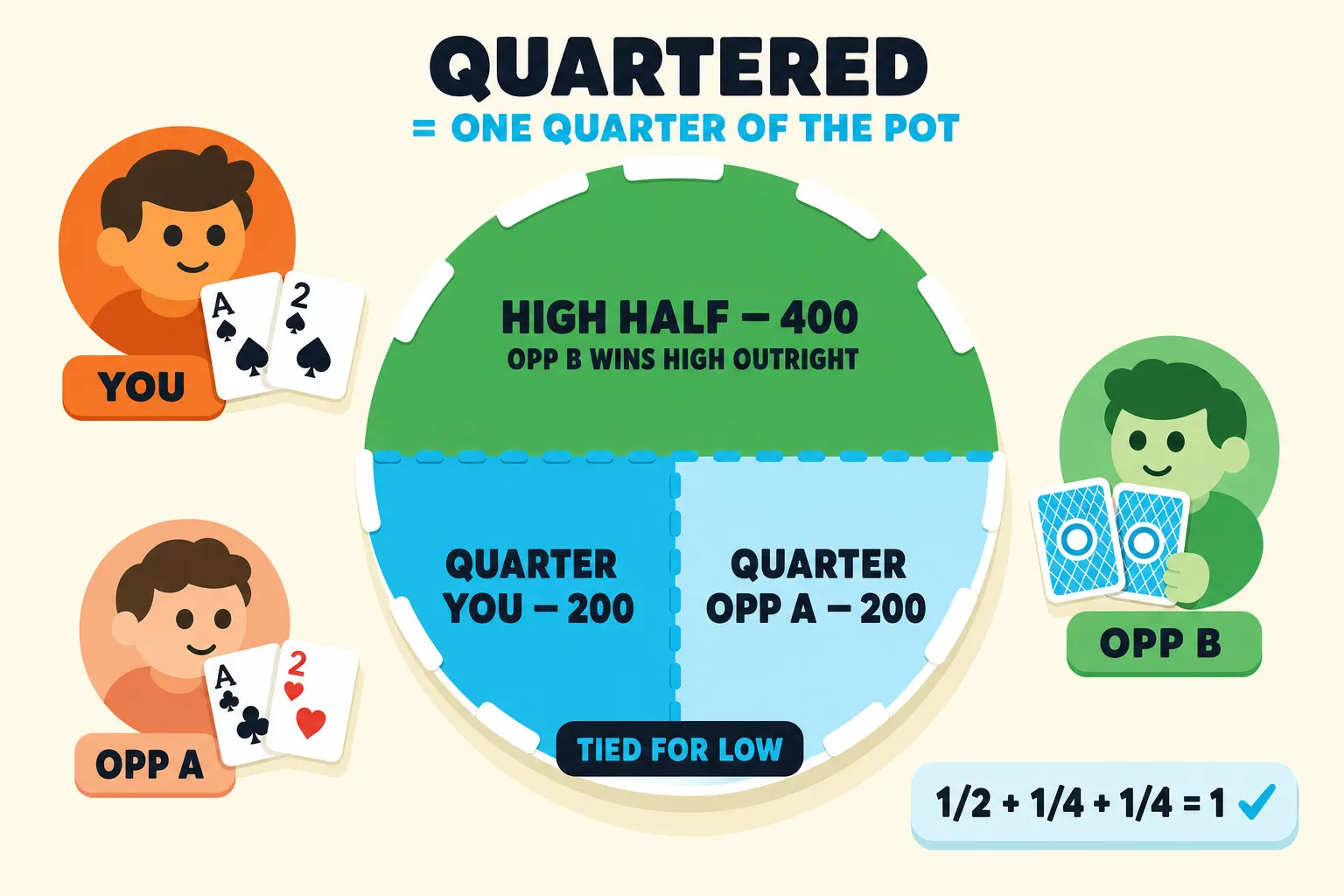
Quartered means you collect only one quarter of the pot at showdown. It almost always happens in split-pot games like Omaha Hi-Lo and Big O: the pot splits in half between the best high hand and the best qualifying low, and you tie someone for one of those halves. Two players sharing the low each take a quarter, while the high winner takes the other half outright.
Quartered: collecting one quarter of the pot at showdown
What “quartered” means
You get quartered when one of the two halves of a split pot is itself shared between two players, so your share of the whole pot ends up at one quarter. It is the standard outcome when you tie someone for the low half in a hi-lo split game. The other half (the high) goes to a single winner outright. Two quarter-shares plus one half equals the pot. That is the math, and the word “quartered” is what players say when they are on the wrong end of it.
Quartered vs split, chop, and tie
These four words name nearby ideas and get mixed up. The clean way to keep them separate:
| Term | What it names | Typical share |
|---|---|---|
| Tie | The reason a pot splits: equal best hands at showdown | Cause, not a share |
| Split pot | The rule that a tied pot is divided equally | 1/2 each in a heads-up tie |
| Chop pot | The verb players use at the table for dividing it | Same shares as split |
| Quartered | Receiving one quarter of the pot, usually from tying for one half of a hi-lo split | 1/4 |
The simplest way to remember it: a chop or split is the whole pot getting divided. Quartered is when one half of an already-halved pot gets divided again, and you are on the tied side. Same showdown, smaller share.
Where you’ll see quartering at the table
Quartering is mostly a hi-lo split game thing. The two surfaces it shows up on:
- Omaha Hi-Lo (Eight-or-Better). The pot splits between the best high hand and the best qualifying low (five unmatched cards eight or below). Two players holding A-2 with no counterfeit on the board tie for the nut low and each take a quarter. A third player with the best high takes the other half whole.
- Big O (five-card hi-lo). Same hi-lo split structure as Omaha 8, with five hole cards instead of four. More players reach showdown with a low, more low ties happen, more quartering happens. Big O tables casually pass the phrase “quartered” around like Hold’em tables pass “cooler.”
In No-Limit Texas Hold’em, true quartering is rare. Hold’em is a high-only game with no low half to tie for. The closest Hold’em analogue is a three-way tie at showdown where everyone takes a third of the pot, which is just a wider split, not quartering. If you only play NLHE, you will hear the word in commentary and from friends who play mixed games. The math still pays off knowing once you sit down for a hi-lo round.
Poker Skill teaches only Hold’em, where a split is a whole-pot tie, and that is the case its Winners & Splits lesson drills, with no low half to share.
How quartering interacts with main pots and side pots
Hi-lo quartering and side pots compose the way you would expect: each pot is split high/low first, and ties on either side of either pot are quartered separately. That means a single hand can produce a quartered main pot, an outright side-pot win, and a fold-out scoop somewhere else, all at once. The rule is: each pot is awarded high/low, and each half of each pot is divided among the players tied for that half.
You don’t need to track this on the fly. The dealer does. The point is that “I got quartered” can mean a quarter of one specific pot, not a quarter of the total chips on the table. Worth saying out loud, since players often round the number in their head and end up annoyed at the wrong amount.
Example: getting quartered for the low
Pot-Limit Omaha 8-or-Better, 6-max cash, 100bb effective, blinds 1/2.
You open the cutoff to 6 with A♠ 2♠ 9♥ 10♦ — a strong hand because A-2 plays the nut low and the spades plus the connector add high-side equity. The button calls, and the big blind calls. Three to the flop with 18 in the pot.
- Flop: 7♣ 5♦ 4♥. Board has three low cards and a one-card straight to the wheel. You bet 14, button calls, big blind calls. Pot 60.
- Turn: K♠. You check, big blind bets 35, button calls, you call. Pot 165.
- River: 3♦. The board now reads 7-5-4-K-3, all five low cards eight or below. The wheel (5-4-3-2-A) is on the board for any player holding A-2. Big blind bets 80 into 165, button raises pot, you call.
Showdown.
- Big blind shows K♥ K♣ Q♥ J♥ — top set on the turn, kings still strong. Best high hand: K-K-7-5-4. No qualifying low (kings can’t make a low).
- Button shows A♣ 2♣ 9♣ 10♣ — exact same low as you, A-2 for the wheel. They also play A-2 for the high straight.
- You show A♠ 2♠ 9♥ 10♦. Same wheel low.
The pot of about 580 is split high/low. The high half (290) goes to the big blind’s set of kings outright. The low half (290) is shared by you and the button, who both made the wheel. You each take 145.
You and the button got quartered. The big blind took half the pot. You collected one quarter of the chips you were chasing — about 145 from a pot of 580 — and you put a meaningful slice of your stack in to do it. That’s the price of going to showdown with a low you aren’t going to win outright.
The recognition skill: when the river is friendly to your low, ask whether anyone else can have the same low. Holding A-2 in Omaha 8 with a low-friendly board is not a free quarter; it is a likely quarter. The hand is still playable. Just price it as half of a half, not as a half.
Common mistakes
1) Treating “quartered” like a normal split
A normal split is 50/50. Quartered is 25/75 of the relevant half. Players who calculate pot odds as if every showdown win is half the pot consistently overpay rivers in hi-lo games. Price a non-nut low like a hand that can win a quarter, not a hand that can win half.
2) Drawing to a low that ties easily
A-2 is the nut low when nobody else has A-2. With four hi-lo players still in on a low-friendly board, A-2 is shared often. The second-nut low (A-3 when somebody else has A-2) is even worse: you don’t tie for the half, you lose it outright while still putting in chips. Big O punishes second-best lows hardest because of the extra hole card.
3) Forgetting that the high half is still being contested
Getting quartered for the low while a third player wins the high outright is the standard shape. If you are only paying attention to your low, you can miss that the player betting hardest is doing it on the high side and is going to take half the pot whether you win, lose, or tie the low.
4) Saying “I got quartered” when you got a third or a sixth
Three-way ties on one half of a hi-lo split give each tied player a sixth, not a quarter. Four-way ties give an eighth. The word “quartered” specifically means one quarter, which is one half divided in two. If you are unsure of the share, ask the dealer to count it; the math is clean once you see the chips.
Quartered checklist
- “Quartered” means one quarter of the pot, almost always from tying for half of a hi-lo split.
- It is a hi-lo concept (Omaha 8, Big O, stud 8). True quartering is rare in NLHE.
- A non-nut low that ties is the default way it happens; the high half is awarded separately.
- Each pot (main and side) is split high/low before any tied half is divided.
- Price drawing hands as a quarter share, not a half share, when a tie for one half is likely.
FAQ
What does “getting quartered” mean in poker?
Getting quartered means you collect one quarter of the pot at showdown. It happens almost exclusively in hi-lo split games such as Omaha Hi-Lo and Big O, where the pot is divided into a high half and a low half. If you tie another player for one of those halves, the two of you each take a quarter of the whole pot, and the other half goes to whoever wins it outright.
Can you get quartered in No-Limit Hold’em?
Not in the strict sense. NLHE is a high-only game, so there is no low half of the pot to tie for. You can split a pot three ways at NLHE showdown and end up with a third, but that is a wider chop, not a quarter. You will hear the word “quartered” in mixed-game settings (Omaha 8, Big O, stud 8) where the hi-lo split makes the math show up.
How is quartered different from a split pot?
A split pot divides the whole pot equally among tied players. Quartering happens when only one half of a pot is divided again because two players tied for that half. Split is the rule; quartered is what your share is called when you are on the tied side of one half of a hi-lo split.
Does quartering apply to side pots?
Yes. Each pot is awarded separately. A main pot and a side pot are each split high/low in a hi-lo game, and each half of each pot is divided among the players tied for it. You can be quartered in the main pot and not in the side pot, or vice versa.
Why do players hate getting quartered?
Because it usually happens with a hand they expected to win half the pot — the nut low — and the result is a quarter share that often barely covers the river call. The chips you put in to get there don’t shrink, but the share you collect does. Pricing the call as a quarter rather than a half is the practical fix.