


Rainbow Board
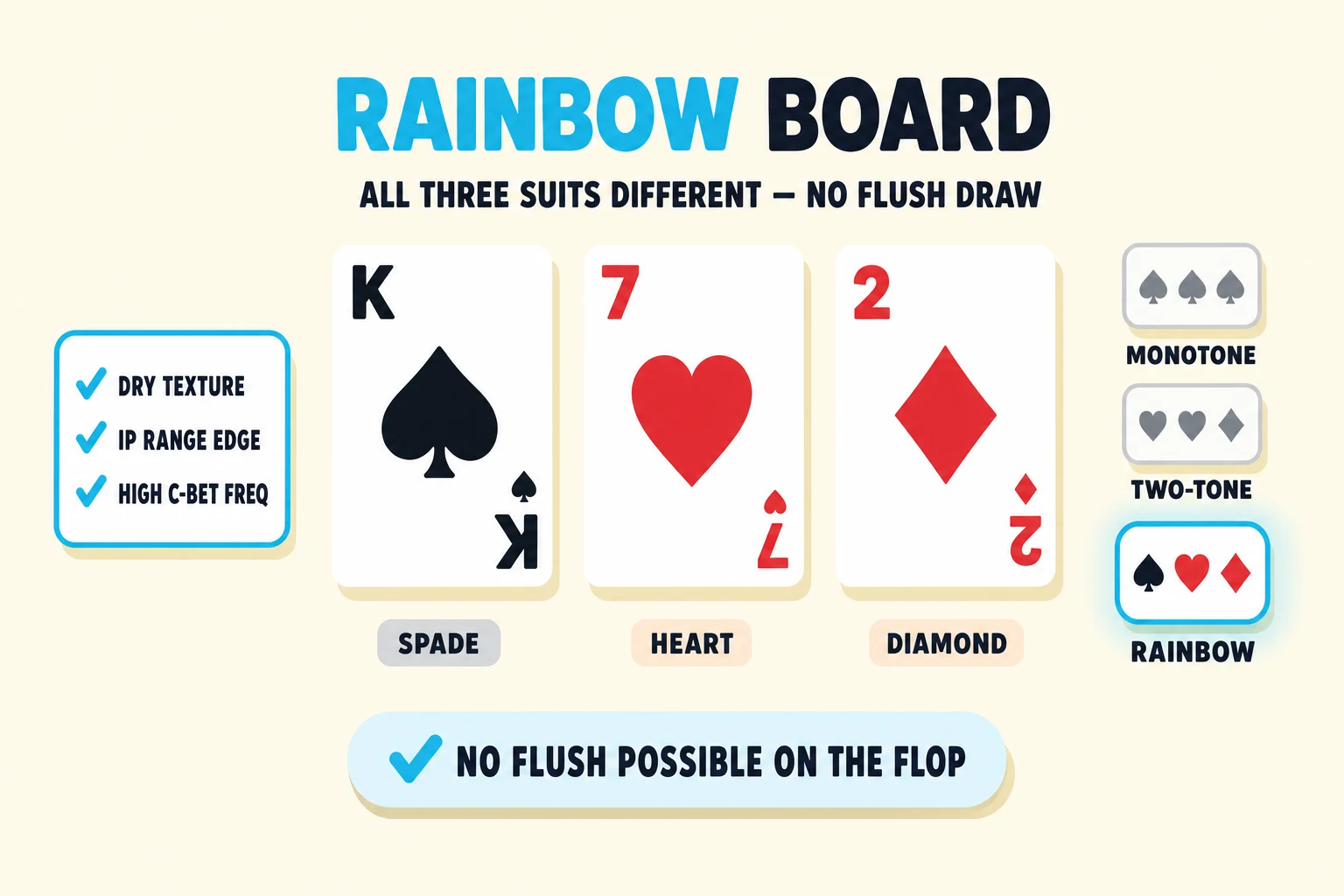
A rainbow board is a flop where all three community cards are different suits, like K♠ 7♥ 2♦. With three suits showing, no flush is possible on the flop and no flush draw is live for either player yet. Rainbow flops are the driest texture for suit purposes, which usually favors the preflop raiser and supports a high c-bet frequency. The runout still matters: a runner-runner flush stays possible but rare, and the turn card decides whether the texture stays static or wakes up with a backdoor flush draw.
Practice this in Poker Skill. One of its first strategy lessons deals this same K-7-2 flop after you raise on the button and miss, and a small bet still wins it more often than a check because the board misses the caller.
Get the free appRainbow Board
What a rainbow board is
A rainbow board is a flop where all three community cards are different suits, for example K♠ 7♥ 2♦. With three suits showing, no flush is possible on the flop and no flush draw is live for either player yet. Rainbow flops are the driest flop texture for suit purposes. Coordination still matters separately: a connected rainbow flop like 9♠ 8♥ 7♦ has straight draws even though no flush draw can exist, while a disconnected rainbow flop like K♠ 7♥ 2♦ has neither.
Related terms
- Dry board — the common low-action version of a rainbow flop.
- Monotone board — the opposite suit texture: all three flop cards share one suit.
- Wet board — the broader family of dynamic, draw-heavy textures.
- Flush draw — the draw rainbow flops do not create on the flop.
- Continuation bet — the small, frequent bet rainbow flops often support.
- Flop — the first street where rainbow, two-tone, and monotone labels apply.
Rainbow vs two-tone vs monotone flops
The three classes describe how the suits land on the flop, independently of the ranks.
| Texture | Suit pattern | Flush draws on flop | Postflop tone |
|---|---|---|---|
| Rainbow | three different suits | none | static, IP-friendly |
| Two-tone | two same + one different | one flush draw live | dynamic, sizing trade-offs |
| Monotone | all three same suit | flushes already made | volatile, BB-friendly |
Rainbow is the only texture where neither player can be on a flush draw on the flop. Two-tone introduces one flush draw and creates abrupt equity shifts when the turn brings the third suited card. Monotone is the most volatile because flushes already exist on the flop and ranges intersect tightly. The rainbow / two-tone / monotone label is independent of pairing and connectivity: a rainbow flop can still be paired (K♠ K♥ 2♦) or wet (J♠ T♥ 9♦).
How rainbow texture changes hand strength and ranges
The defining feature of a rainbow flop is what’s missing rather than what’s there: no flush draw. That removes a large class of speculative hands from the defending player’s continuing range and shrinks the equity-swing potential of later streets.
Practical effects:
- The preflop raiser usually keeps the range advantage. Wide raising ranges contain more ace-high, broadway, and pocket-pair combos that pick up at least a backdoor draw or showdown value on a dry rainbow flop. Defending ranges miss harder.
- IP can c-bet more often. With the BB’s range thin on draws, small bets fold out air without overcommitting medium hands.
- Equity stays sticky. A hand that’s strong on a rainbow flop usually stays strong on the turn, because the runout can introduce only a backdoor flush draw, not a made flush.
- Pairing matters more than suits. A paired rainbow flop (7♠ 7♥ 2♦) still triggers all the trips and full-house concerns of any paired board.
- Rank coordination still drives sizing. A rainbow K-7-2 plays very differently from a rainbow 9-8-7, even though both have no flush component.
Example: c-betting K♠ 7♥ 2♦ from the cutoff
You open 2.5bb from the cutoff with A♣ Q♣. The big blind defends. Pot is 5.5bb. The flop comes K♠ 7♥ 2♦.
- Range read: your cutoff opening range hits this flop harder than the BB’s defending range. You hold most kings, queens-up, and pocket pairs above 7. The big blind’s defending range, with small connectors, suited gappers, weak broadways, and small pairs, connects much less reliably with K-7-2.
- Plan: a small c-bet, around one-third pot or a min-bet, runs at high frequency on this texture. The bet folds out missed gappers and small unpaired hands while keeping the pot small with your A-high.
- Why small, not big: this flop has zero flush draw and only a low backdoor straight draw class (5-6, 6-8, 5-8). Charging draws is not the priority here. Denying showdown value to A-high and J-high is.
- Turn read: most non-K, non-A turn cards are fine to barrel a second street if called. An ace gives you top pair and lets you bet for thin value. A turn that brings two suited cards wakes up a backdoor flush draw and slightly tightens the value of further bluffs.
- Stop line: if the BB check-raises the flop on a dry rainbow texture, expect a polarized response: sets, two-pair (K7), or the occasional pure bluff. Folding A-high cleanly is correct most of the time.
Common mistakes on rainbow flops
- Skipping the c-bet. Rainbow flops are exactly where the preflop raiser’s range advantage is most decisive. Failing to bet hands the BB a free turn card on a board that connects with their range too poorly to defend.
- Sizing too big without a reason. Large c-bets on dry rainbow flops fold out the BB’s air without extracting more from medium hands. A min-bet or one-third pot wins the same pot most of the time and saves chips when called.
- Treating every rainbow as bone-dry. A connected rainbow flop like 9♠ 8♥ 7♦ has open-ended straight draws, gutshots, and three flopped straights. The “no flush” feature does not erase the rank coordination.
- Auto-firing the turn. After a flop c-bet and a call, the turn card decides the next move. If the turn brings two suited cards, the BB now has flush draws that didn’t exist on the flop, and a second barrel needs more equity behind it.
Common questions
Is a rainbow flop the same as a dry flop? No. Rainbow describes suits only: three different ones. Dry usually means rainbow plus disconnected ranks (think 7♣ 4♦ 2♠). A connected rainbow flop like 8♠ 7♥ 6♦ is rainbow but very wet because of the straight draws.
Can a flush draw exist on a rainbow flop? Not on the flop itself. The earliest a flush draw becomes live on a rainbow flop is the turn, and only if the turn card matches one of the flop suits. That’s called a backdoor flush draw, and it needs both the turn and the river to come the same suit to complete.
Should I always c-bet a rainbow flop? Close to it on dry, high-card rainbow flops where your opening range crushes the defender’s continuing range. Less so on low or connected rainbow flops, where the defender’s range catches up with pairs, gutshots, and open-enders. Adjust frequency by rank coordination, not just by suit.
Quick checklist
- A rainbow flop has all three flop cards in different suits and no flush draw on the flop.
- Lean into c-bets at high frequency on dry, high-card rainbow flops with small to medium sizing.
- Slow down on connected or low rainbow flops where the defender’s range reconnects with straight equity.
- Re-evaluate on the turn: a second suited card creates a backdoor flush draw that didn’t exist on the flop.
- Track pairing and connectivity separately from suits. Rainbow does not mean safe.