


Monotone Board
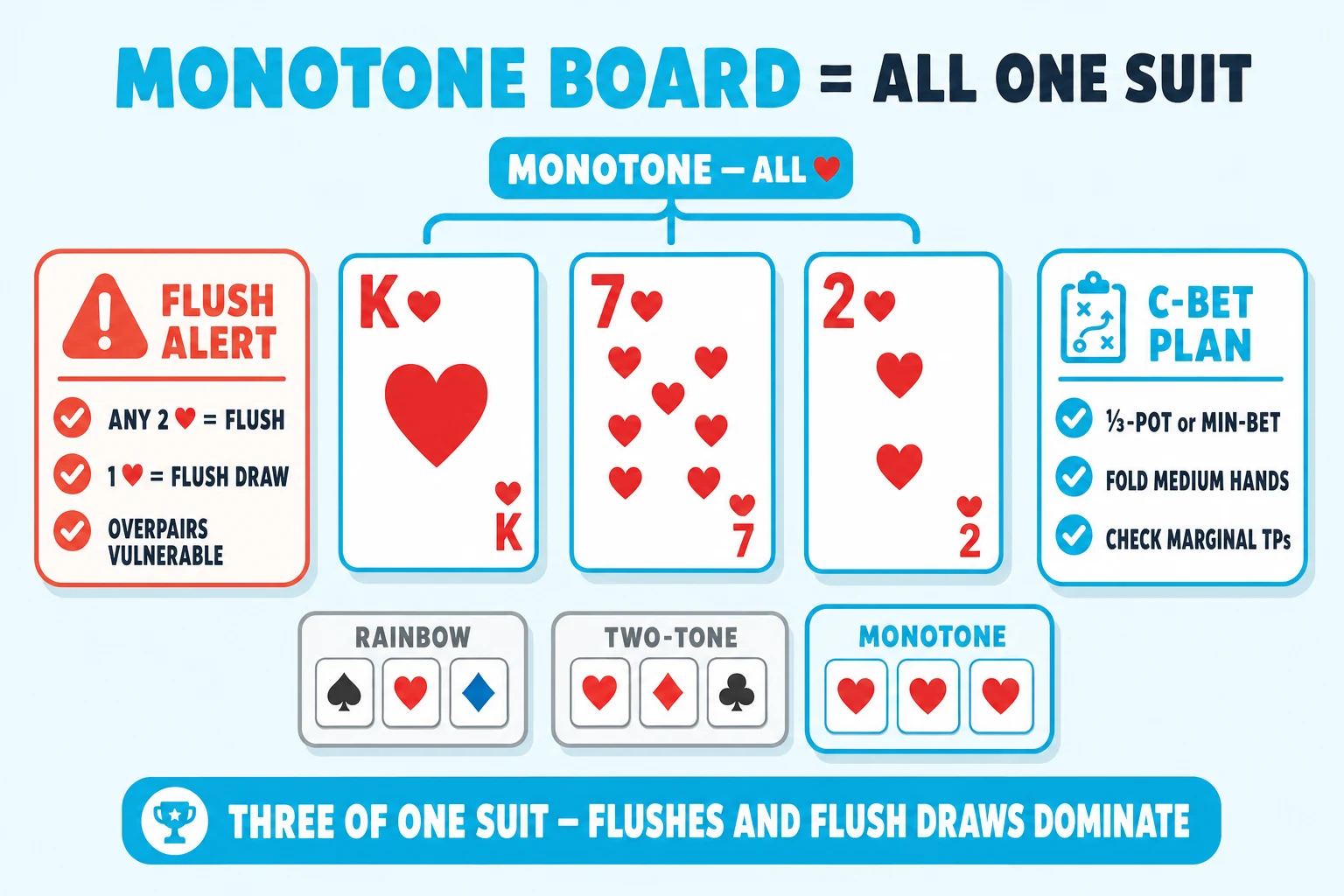
A monotone flop shows three community cards of the same suit (e.g., K♥ 7♥ 2♥). It sharply increases the number of made flushes and flush draws on the board. Equity is your hand's chance to win, and it shifts quickly on these textures. Recognize a monotone flop immediately and adjust your postflop plan for suit dynamics. If you don't, you'll overvalue hands and mis-size bets into opponents holding or chasing flushes.
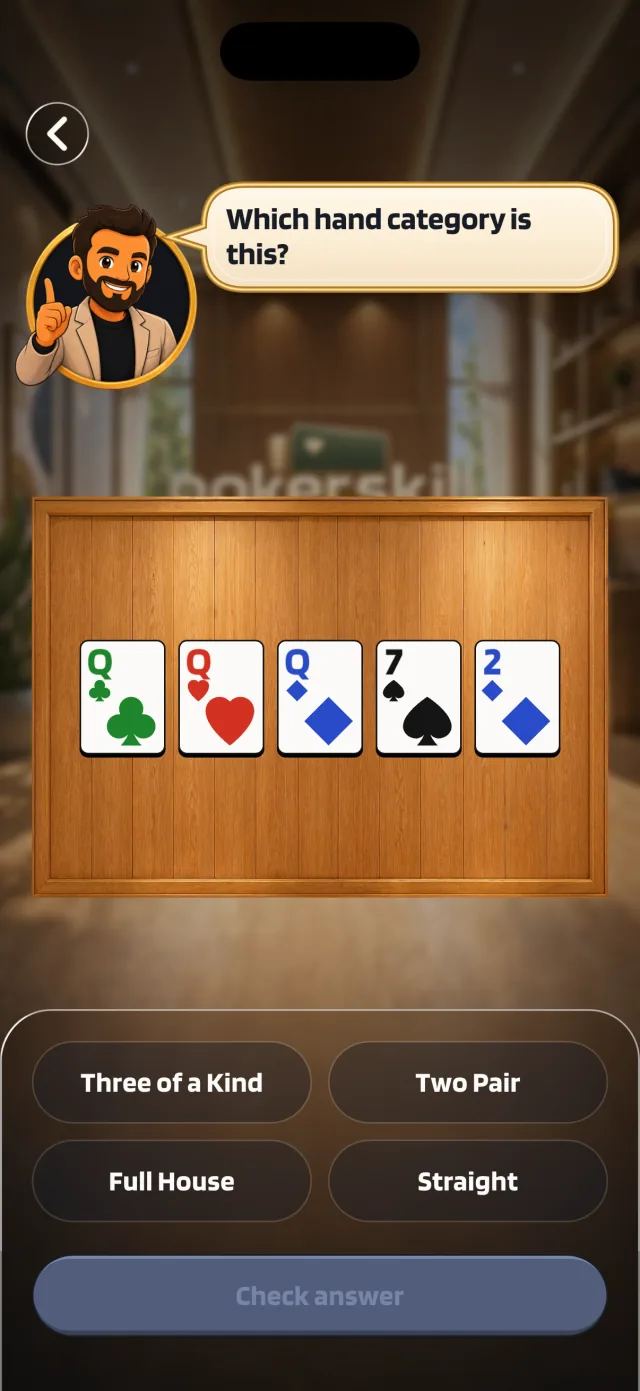
Practice this in Poker Skill. Reading a monotone flop starts with the nut draw, and on A♦ 7♦ 2♦ in the Nut Flushes & Monotone Boards lesson, K♦ 9♣ holds it with a single diamond, since the ace is already on the board.
Get the free appMonotone Board
What a monotone board is and why it matters
A monotone flop shows three community cards of the same suit (e.g., K♥ 7♥ 2♥). It sharply increases the number of made flushes and flush draws players can hold. Equity is your hand’s chance to win, and it shifts quickly on these textures. Recognize a monotone flop immediately and adjust your postflop plan for suit dynamics. If you don’t, you’ll overvalue hands and mis-size bets into opponents holding or chasing flushes.
How monotone boards change hand strength and equity
Made flushes and flush draws become the central factors in postflop play on monotone boards. A♥ Q♥ on K♥ 7♥ 2♥ is the nut flush and dominates most ranges, while A♥ J♣ holds the nut flush draw there. Those hands frequently win large pots.
By contrast, many hands that normally look strong lose relative value. Overpairs, single top-pair hands and several two-pair combos can be behind to a flush or a turned flush. Marginal holdings you’d thin value-bet on a rainbow flop are often better checked or folded on monotone textures.
IP vs BB range dynamics on monotone flops
In-position (IP) raisers (the player who opened preflop and acts last postflop) often see their continuing range depolarize. Many of the IP’s typical postflop holdings, like overpairs and single pairs, become more vulnerable to flushes.
The big blind (BB), who defended preflop, tends to have a more polarized range on these boards. The BB sometimes holds made flushes and often holds hands with large flush equity, such as suited connectors or suited broadways. That polarization lets the BB credibly represent both nut flushes and heavy drawing hands, which changes whether the IP should bet or check.
Continuation bets on monotone flops
A light c-bet, one made without a strong hand, needs folds, and a monotone flop connects with many of the caller’s hands: every made flush and every hand holding one card of the suit has a reason to continue.
- Be selective with light c-bets. The more ways a flop can connect with the caller’s range, the less often one takes the pot.
- Check hands with little to no equity. On a board this wet, pass on the light c-bet when the hand has nothing to fall back on if called.
- Weigh the whole spot. Your hand’s strength, the number of opponents and how they play all count alongside the suits.
Example: You open-raise from the cutoff with A♠ Q♣ and see 9♥ 6♥ 2♥ on the flop. With ace-high and no heart, a c-bet here is a light one, and every big blind hand holding a heart has a reason to call it.
Postflop value-betting, bluffing and practical adjustments
Reduce thin value bets and favor pot control with medium pairs and weak top-pair hands. Check these holdings to balance your range and avoid building big pots when you’re likely behind. With Q♥ J♠ on A♦ J♦ 2♦, Poker Skill’s answer is a check with middle pair, because the three diamonds fit too many of the caller’s hands. Bet strongly with nut flushes and big draws, but limit bluff frequency. Ranges interact tightly on monotone boards, making bluffs easier to call.
Factor in board rank and connectivity. Lower, more connected monotone flops (e.g., 7♥ 6♥ 5♥) justify even fewer c-bets because they enable straight-plus-flush combinations and give plenty of equity to defending ranges.
Quick checklist
- Identify monotone flops immediately and reassess hand equity.
- Be selective with light c-bets, and check hands with little to no equity.
- Check medium and weak made hands rather than thin value-betting.
- Beware overpairs and other hands that look strong but are vulnerable to flushes.
- Expect the BB’s range to be more polarized; adjust bluff and value lines accordingly.