


Mixed Strategy
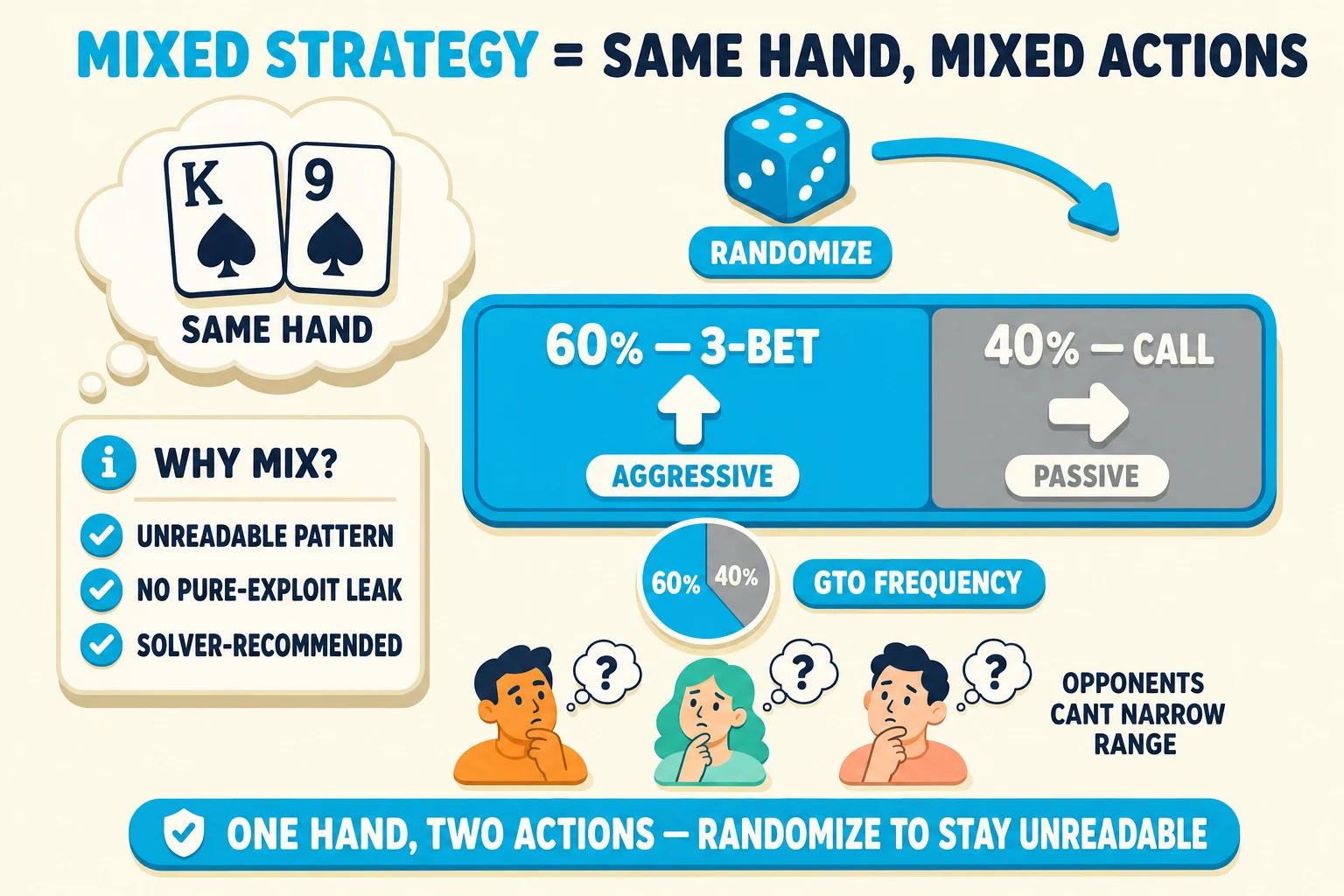
A mixed strategy means deliberately varying your actions-fold, call, or raise-with specific hands. In poker, a "range" is the set of hands an opponent could hold; mixing stops them from assigning precise ranges to your actions. If you always 3-bet the same hands and fold everything else, skilled opponents will exploit you. Mixing keeps your range ambiguous and raises your expected value against observant players.
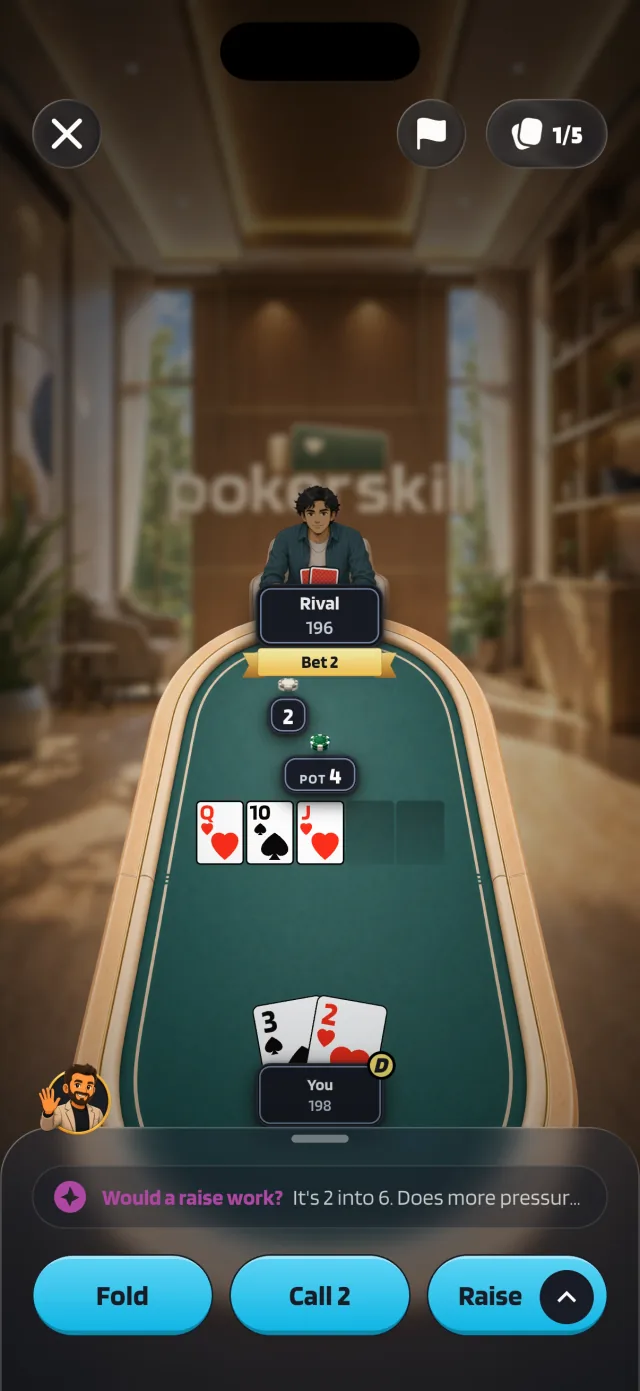
Practice this in Poker Skill. In Practice vs AI, where you play full hands against AI opponents, Coach Max, the coach at the table, can point out a spot where more than one play works and say which one he takes most often.
Get the free appMixed Strategy in No-Limit Texas Hold’em
Define mixed strategy and why it matters
A mixed strategy means deliberately varying your actions-fold, call, or raise-with specific hands. In poker, a “range” is the set of hands an opponent could hold; mixing stops them from assigning precise ranges to your actions. If you always 3-bet the same hands and fold everything else, skilled opponents will exploit you. Mixing keeps your range ambiguous and raises your expected value against observant players.
Where mixed strategies commonly arise (pre-flop)
Pre-flop is the most common place to mix because many hands sit on a profitability threshold. Defending the Big Blind often requires a mix of folds, calls, and aggressive actions based on opener position and raise size.
Example: facing a 3x raise from the Cutoff (one seat before the Button), you might:
- Fold the weakest offsuit hands.
- Call with medium-strength hands like K9o or JTs some of the time.
- Occasionally 3-bet with suited connectors (e.g., 87s) and suited A-x (e.g., A5s) to apply pressure and use blockers. (A blocker is a card in your hand that reduces the chance an opponent holds a particular strong hand.)
Mix borderline hands instead of always folding or always calling. That prevents opponents from exploiting a predictable, binary defense.
Poker Skill’s Big Blind: Call or Fold lesson teaches the unmixed version of this defense against an under-the-gun open, where every hand has a single right answer.
How solvers and frequencies guide mixing
Solvers compute near-optimal strategies and list which hands are pure actions and which should be mixed at set frequencies. They won’t prescribe one “correct” play for every spot but reveal balanced patterns across ranges. Use solver frequencies as practical guidelines rather than rigid rules. Adjust those frequencies for stack depth, table dynamics, and blocker effects-these factors change an action’s marginal profitability.
Post-flop mixing: bet sizes, bluffs, and value hands
Post-flop mixing means varying bet sizes and mixing bluffs among value hands so opponents can’t read you by sizing alone. Value hands are ones you bet expecting to be best; bluffs are bets meant to make better hands fold. On a dry Ace-high board, use both small and large bets. Sometimes bet medium-strength Aces for value; other times use the same sizing as a thin bluff to mimic that value line. On coordinated boards, mix smaller and larger bluffs with backdoor draws to keep your range protected. Advanced players use multiple sizes and balanced value-to-bluff ratios to avoid exploitable sizing patterns.
Practical steps to implement mixed strategies at the table
- Identify borderline hands (e.g., K9o, A5s, 87s) and decide which actions you’ll mix and roughly how often.
- Start with a small set of mixed patterns: defend the BB with calls and occasional 3-bets; vs. CO/HJ opens, 3-bet some suited connectors and call others.
- Practice these patterns in rewindable sessions-hand reviews or online play-until they feel natural.
- Adjust on the fly for stack depth, opponent tendencies, and blocker effects; don’t follow a pattern rigidly.
Quick checklist
- Vary actions with threshold hands instead of always repeating one line.
- Use solver guidance to learn which hands are pure and which should be mixed.
- Mix pre-flop defense between fold, call, and 3-bet in appropriate spots.
- Incorporate bluffs into multiple post-flop bet sizes to protect ranges.
- Adjust mixes for stack depth, blockers, and opponent adjustments.
- Practice specific mixed lines until you can execute them without overthinking.