


Mixed Frequency
Mixed frequency is the percentage split a strategy uses when the same hand or range class takes more than one action. If a hand calls 60% of the time and folds 40%, those numbers are the mixed frequencies. The frequency is the percentage; the mixed strategy is the plan that contains it.
Mixed frequency: the percentage split inside a mixed strategy
What mixed frequency means
Mixed frequency is the percentage split a strategy uses when the same hand or range class takes more than one action. If a study tool says A♠5♠ in a particular spot calls 60% of the time and folds 40%, those two numbers are the mixed frequencies for that hand. Frequency is the how often. The mixed strategy is the broader plan that combines those weighted options into one balanced approach. You can think of frequency as the dial; the strategy is the device the dial sits on.
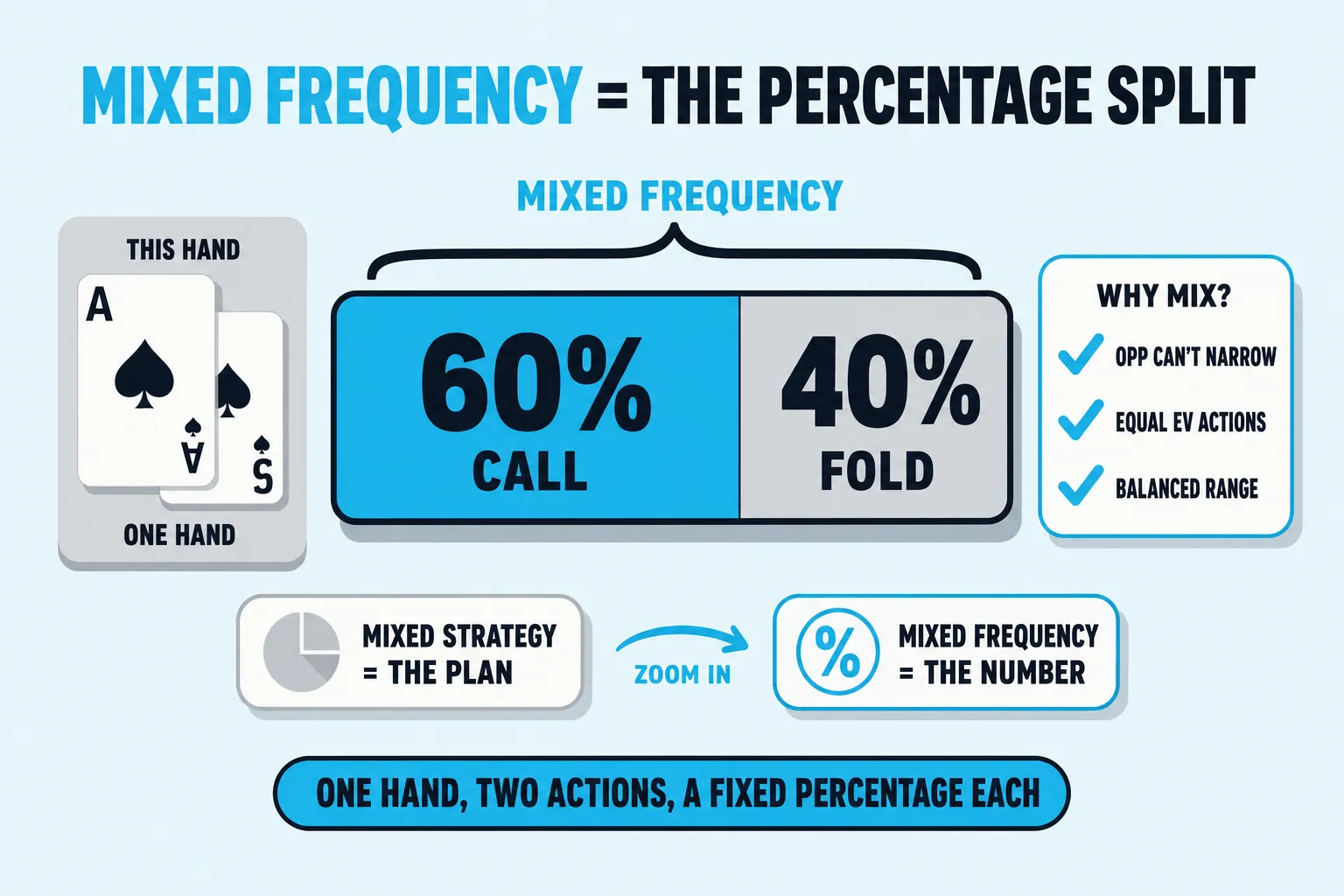
A simple mental shortcut:
- A pure action is one number (100% call, 100% fold, 100% raise).
- A mixed action is two or more numbers that add to 100% (60% call, 40% fold, for example).
- The numbers themselves, the 60 and the 40, are the mixed frequencies.
The point is not the precision. The point is that one hand has more than one EV-equivalent action available, and the strategy assigns each action a share rather than picking a single winner.
Related terms
Mixed frequency vs. mixed strategy
Players often hear the two phrases as the same thing. They aren’t. One is the plan; the other is the number inside the plan.
| Concept | What it is | What it tells you | Example |
|---|---|---|---|
| Mixed strategy | A plan that randomizes between two or more actions for the same hand | Which actions the strategy considers playable | ”Call sometimes, fold the rest” |
| Mixed frequency | The percentage assigned to each of those actions | How often each action gets used | ”Call 60%, fold 40%“ |
| Pure strategy | A plan that picks one action with the same hand every time | The single action | ”Always call” |
The same hand, played 100 times in the same spot, can have a mixed strategy of {call, fold} but a mixed frequency of {60, 40}. Change the frequencies to {30, 70} and the strategy is still {call, fold}; only the numbers moved.
This is also why solver output looks the way it does. A solver doesn’t list pure actions; it lists frequencies. “Call 0.612, fold 0.388” is the tool saying the EV of calling and folding are close enough that the equilibrium splits the hand between them.
When mixed frequencies show up
Mixed frequencies cluster around spots where two actions have nearly equal EV. The most common ones are:
- Big-blind defense versus an open from the cutoff or button. Hands at the bottom of the calling range often mix between call and fold.
- River bluff-catchers where the hand beats some of villain’s bluffs and loses to all of villain’s value. Calling and folding can split the hand at frequencies set by villain’s value-to-bluff ratio.
- Flop continuation bets with marginal hands on connected boards. The same hand may bet small at one frequency and check at another.
- Turn barrels with weak made hands and weak draws. Equilibrium will often mix bet and check rather than commit either way.
- Shove-or-fold spots at short stacks, where the closeness of the equity threshold pushes a hand into a mixed jam.
A useful tell: any spot a player calls “a coin flip” usually has a mixed frequency hiding underneath. The math isn’t tossing a coin; it’s telling you which coin and how it’s weighted.
Mixed frequencies show up less often when:
- The action is obvious (premium hand on a dry board, trash hand against a deep call).
- Villain’s strategy is far from balanced and one pure action exploits them by a wide margin.
- Stack depths or board textures collapse multiple actions into one EV-leader.
Poker Skill’s turn lessons, such as Good Barrel Cards, give each hand one answer, bet or check, based on whose card the turn is.
Example: a river bluff at 50%
The cleanest place to see frequencies in action is the river, where the math is least muddy. No more cards are coming and no equity is left to realize. Suppose pot is $100 and you bet $50 with a missed draw. The break-even fold percentage for the bluff is bet ÷ (pot + bet), or $50 ÷ ($100 + $50) = 33.3%.
If villain folds more than 33% of their continuing range, the bluff has positive expected value. If villain folds less than 33%, the same bluff has negative expected value. Equilibrium answers a different question: out of all the hands you reach the river with, what share should be bluffing at this size so villain can’t punish either decision?
Imagine a betting range of seven and a half combos at the river. Five are value bets that beat villain’s calling hands. To stay balanced at half-pot, the strategy wants roughly two and a half bluff combos in the betting frequency, because a half-pot bet asks villain to be right 25% of the time, and 5 value : 2.5 bluff hits that ratio.
You don’t have a half-combo of bluffs. So the strategy picks one candidate, say A♠5♠ on a board where the ace is dead, and assigns it a 50% bluff frequency. That number, the 50, is the mixed frequency on that one hand. It bluffs half the time and gives up the other half. Across the whole bluff candidate group, a few hands at 50% sum to the right total bluff weight without any single hand having to bluff every time.
The 50 is not magic. Move villain’s calling range and the number moves with it. The frequency is doing one job: keeping the betting range’s value-to-bluff ratio at the level that makes villain’s call versus fold close to a wash.
Common mistakes
1) Memorizing the percentage instead of the pattern
Equilibrium tools are often near-indifferent between similar bet sizes. A hand that mixes 40/60 between two sizes does not have to be played 40/60 to the decimal point at the table; it needs to be played roughly half-and-half, with the bigger size getting the slight edge. Reading “this hand mixes” and remembering “small bet wins on connected boards” is more useful in the moment than reading “37.4% small / 62.6% big” and trying to hit those numbers from memory.
2) Treating the frequency as a fixed rule
The frequency is the equilibrium answer against an equilibrium opponent. Real opponents deviate. If villain over-folds river, your bluff frequency on that one hand should rise, sometimes all the way to a pure bluff. If villain over-calls, the same hand drops toward a pure check. The frequency tells you the balanced default; your read tells you when to leave it.
3) Skipping the randomization and just guessing
If a hand is supposed to call 60% and fold 40%, picking on feel (“I called the last one, so I’ll fold this one”) collapses into a pattern villain can read. A simple randomizer (clock second hand, the colour of a hidden card, an online tool) is enough to keep your long-run frequencies near the targets without any solver precision in the moment.
4) Forgetting that the frequency lives inside a range
A mixed frequency attaches to a single hand, but the strategy’s balance is enforced across the whole range. Bluffing one hand at 50% and another bluff candidate at 0% can produce the same range-level bluff weight as bluffing both at 25%. The frequency on any one combo is one input into the range; missing that link is what turns “I mixed” into “I just made an arbitrary call.”
FAQ
Why does a Nash equilibrium ever recommend mixing instead of one pure action?
A hand only mixes at equilibrium when more than one action has the same EV against the opponent’s best response. That is the indifference principle: if calling and folding have the same long-run EV, the strategy can split the hand between them and still be unexploitable. If one action were strictly better, equilibrium would always pick it. Mixing is what equilibrium does precisely when the alternatives tie.
Are mixed frequencies the same as the minimum defense frequency?
No, though both are percentages. The minimum defense frequency is a range-level number, the share of your continuing range that has to keep going to stop villain’s bluffs from getting through automatically. A mixed frequency is a hand-level number, the share of the time one specific hand takes one action versus another. The two interact: when a range needs to defend at, say, 67%, the hands at the bottom of the defending range often mix between call and fold to land the total exactly on 67% without any single hand calling forever.
Do I need a solver to play with mixed frequencies?
No, but a solver makes the frequencies visible. Without one, you can still play mixed by recognising the spots (close decisions, river bluff-catchers, big-blind defense) and assigning rough splits like 50/50 or 70/30 to your borderline hands, then using a randomizer to honour those splits at the table. A solver lets you check those rough splits against an equilibrium answer and find the spots where your intuition is off by more than rounding.