


Poker solver
A poker solver is a Nash-equilibrium calculator that takes ranges, stack depth, and bet sizes as inputs and outputs a mixed-frequency strategy for both players. It's a study tool, not a table tool — the value is in understanding why it does what it does, not in memorizing the chart.
Practice this in Poker Skill. The AI opponents in Practice vs AI play an equilibrium approximation, a Showdown AI strategy built with counterfactual regret minimization for the heads-up and three-player games the app deals.
Get the free appSolver: an unexploitable-strategy calculator in plain English
What a solver actually computes
A solver is a piece of software that takes a poker spot, the ranges both players bring to it, the stack depth and the bet sizes you want it to consider, and returns a strategy that is as close to a Nash equilibrium as the inputs allow. In poker shorthand it’s a GTO calculator. In plainer language: you describe the spot, the solver searches for the play neither side could improve on, and it hands back a hand-by-hand recipe of what to do and how often.
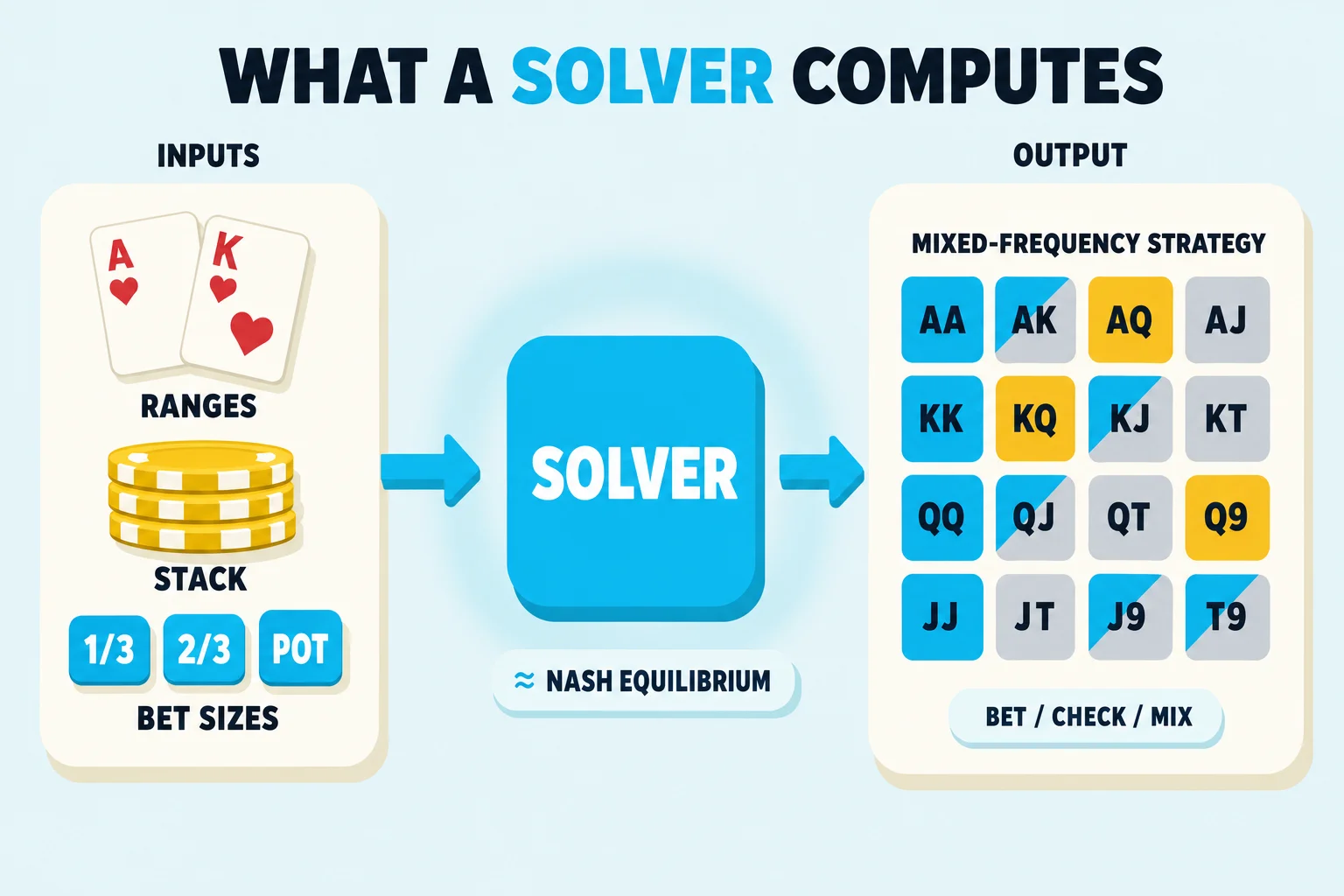
The output is a grid rather than one answer per hand: each combo gets some mix of actions (bet small 22%, bet big 28%, check 49%, overbet 1%), and the percentages reflect what an opponent who already knew your strategy could do nothing about.
A useful mental shortcut for the input/output:
- A solve is one specific run with specific assumptions (ranges, sizes, stack).
- A solver is the engine that runs the solve.
- The output is a strategy table: for each hand in each range, what action and at what frequency.
- Change any assumption (different opening range, different bet-size tree, different stack depth) and you get a different solve. The solver isn’t lying; the question changed.
Related terms:
Solvers vs GTO vs mixed strategies
These three terms travel together and get used interchangeably in conversation, which causes confusion. They’re related but distinct.
| Term | What it is | Where it lives |
|---|---|---|
| GTO | A property of a strategy: unexploitable against perfect counterplay | A concept, not a file |
| Solver | A tool that searches for strategies with that property | Software like PIOSolver, GTO+, MonkerSolver |
| Mixed strategy | A form the strategy takes: same hand, multiple actions, fixed frequencies | The output the solver produces |
The relationship: GTO is the destination. The solver is the vehicle. Mixed strategies are the road shape, the reason the trip looks like “bet 30%, check 70%” instead of “bet, period.”
There’s a wrinkle worth knowing: full No-Limit Hold’em has not been solved. Heads-up Limit Hold’em has been, by a research project running on a 200-machine cluster, while heads-up No-Limit and 6-max are still approximated. What modern solvers compute is an ε-Nash equilibrium for the abstraction you give them: close enough to be a useful study baseline, but still conditional on the ranges, bet sizes and stack depth you entered.
When solver work actually matters
Solver study earns its time when:
- You already understand fundamentals. Ranges, position, pot odds, equity, board texture. A solver can show you the answer; it cannot teach you the question.
- You want to plug a specific leak. “I keep losing money in single-raised pots from the big blind on low-card flops” is a solver-shaped problem. “I want to get better at poker” is not.
- You want to study patterns across hands and boards. The biggest win from a solver is the structure behind the lines: which hand groups bet, which check, which mix and why. Most strong players read solver output the way a chess player reads opening theory: the grid is the map, the lesson is what’s repeated and what’s the exception.
- You’re a regular against tough fields. When opponents are also studying, leaks shrink and equilibrium baselines start to matter. The closer your opponents play to the solver, the more the solver line is the actual highest-EV play.
Solver study earns its time less when:
- You’re at the table mid-hand. Solvers don’t run in real time at human tables. The point of the study is to internalize structure, not to recall a percentage.
- Your pool is soft. Most live and small-stakes online pools have predictable leaks: calling stations don’t fold rivers, nits don’t 3-bet light. An exploitative deviation often beats the solver line by a wide margin against those players. Use the solver to know the baseline; deviate from it on purpose.
- You haven’t built fundamentals yet. A beginner who memorizes a chart without the reasons will play it even when the table says otherwise.
Example: what a solve actually outputs
Imagine you set up a flop spot in PIOSolver: you’ve raised from the cutoff, the big blind has called, the flop is 8♠ 5♥ 2♣, both stacks are 100 BB deep, and you’ve allowed the solver to choose between three c-bet sizes (1/3 pot, 2/3 pot, pot) or check.
You run the solve. After several minutes, the solver gives you a hand grid colored by action. A typical-looking output, simplified:
| Hand | Check | Bet 1/3 | Bet 2/3 | Bet pot |
|---|---|---|---|---|
| AA | 12% | 88% | 0% | 0% |
| KK | 18% | 82% | 0% | 0% |
| 88 | 0% | 30% | 60% | 10% |
| 65s | 5% | 25% | 60% | 10% |
| K♥3♥ | 0% | 30% | 50% | 20% |
| ATo | 95% | 5% | 0% | 0% |
The numbers are illustrative; your real run depends on the ranges and bet tree you fed in. The shape is what every solve looks like. Some hands take one action almost always (overpairs mostly take the small bet and check only now and then, weak unpaired hands check). Some hands mix between sizes (sets bet for value across all sizes, with the bigger sizes pulling more weight). Some hands appear as bluffs: the K♥3♥ has a backdoor flush draw, a backdoor straight draw and an overcard, making it a structural bluff candidate rather than a “feel” bluff.
Two things to read from output like this:
- The frequencies describe the strategy as a whole. Across a long sample, the solver wants AA to check 12% of the time and bet small 88%, but in any one hand you make a single choice, and the randomization decision is yours.
- Simplify without losing the idea. You can round away a branch the solver seldom takes, as long as your plan keeps the main strategic ideas; which hands the solver picks for each action, and why, matters more than the exact percentage.
This is why a beginner who treats a solver chart as a recipe gets worse, not better. The chart is the answer to one specific question. Without internalizing the structure (why KK mixes more than AA, why some bluff combos make the cut and others don’t), you can copy the output and still play badly.
Common mistakes
1) Treating solver output as a universal answer
A solver answers one well-defined question: “given these ranges and these bet sizes at this stack depth, what’s the equilibrium?” Change any input and the answer changes. Treating the chart as truth-in-itself rather than truth-conditional-on-inputs is the most common beginner mistake. The right phrasing is “the solver said this under these assumptions.”
2) Memorizing the chart instead of the why
Solvers don’t explain themselves. A grid that says “open 14% UTG” with a specific hand list rots in your memory unless you can answer why: which boards your range will hit hardest, what 3-bet sizing makes your range indifferent, why one hand opens and a similar-looking one folds. If you can’t reconstruct the answer from first principles, the chart is throwaway the moment the spot drifts.
3) Copying mixed frequencies as fixed actions
A solver might say “bluff 28% of the time and give up 72%.” Some players read that as “bluff a lot” and bluff almost every time the spot comes up. The output says something narrower: bluff more than 28% of the time and you hand your opponent a leak to attack. The way to honor a frequency is with randomization, not with personality.
4) Studying solver work before fundamentals are in place
A solver assumes you already understand what a range is, what equity means, what board texture changes about the spot and why position matters. Without that scaffolding, the output is shapes on a screen. The fastest path to wasted study time is opening PIOSolver before the basics are stable.
FAQ
Has poker been “solved” by solvers?
Heads-up Limit Hold’em was. The Cepheus project at the University of Alberta finished the solve in 2015 using a 200-machine cluster and a counterfactual-regret-minimization algorithm. Heads-up No-Limit Hold’em has been beaten by AI (Libratus, 2017) but not formally solved; the game tree is too vast, on the order of more situations than there are atoms in the observable universe. Six-max No-Limit and full-ring are nowhere near. What you get from any commercial solver is an ε-Nash equilibrium for a specific abstraction, useful for study but not the literal end of the road.
Do I need a solver to study GTO?
No. The core ideas (balanced ranges, mixed frequencies, value-to-bluff ratios at given bet sizes, the indifference principle behind mixed strategies) are well-covered in books and translate cleanly into table heuristics. A solver lets you check those heuristics against real equilibrium output and find the spots where your intuition is wrong. Most strong players start with the conceptual scaffolding and add solver work after fundamentals stabilize. The reverse path tends to produce players who can recite charts and lose chips.
What’s the difference between a solver and a tool like GTO Wizard?
A solver is the engine that runs new solves on demand from your inputs (PIOSolver, GTO+, MonkerSolver). GTO Wizard offers a library of pre-solved spots, much faster to use and with no hardware setup, and it also runs custom solves in the browser, where you set the ranges, stack depths and bet sizes and can node-lock a player’s strategy. Both have a place. Beginners and improvers usually start with pre-solved libraries because the friction is lower; players who want to study custom spots, lock specific opponent behaviors at a node and explore what changes when assumptions change run custom solves.