


Plus Notation
The plus sign in range shorthand meaning 'this hand and every higher one.' TT+ covers TT through AA; AQ+ covers AQ and AK. Compact preflop range notation.
Plus Notation
Definition: what “plus” means for hand ranges
The plus sign (+) in No-Limit Texas Hold’em denotes “at or above” a ranking among starting hands. A hand range is the set of starting hands you or an opponent might hold. A plus after a hand groups that hand and every higher-ranking hand under standard poker ordering. For pocket pairs, X+ includes that pair and every higher pair. For non-pairs, X+ includes the named combination and any stronger starting hands, such as higher pocket pairs. Pre-flop ranges refer only to starting hands; community cards are not yet in play.
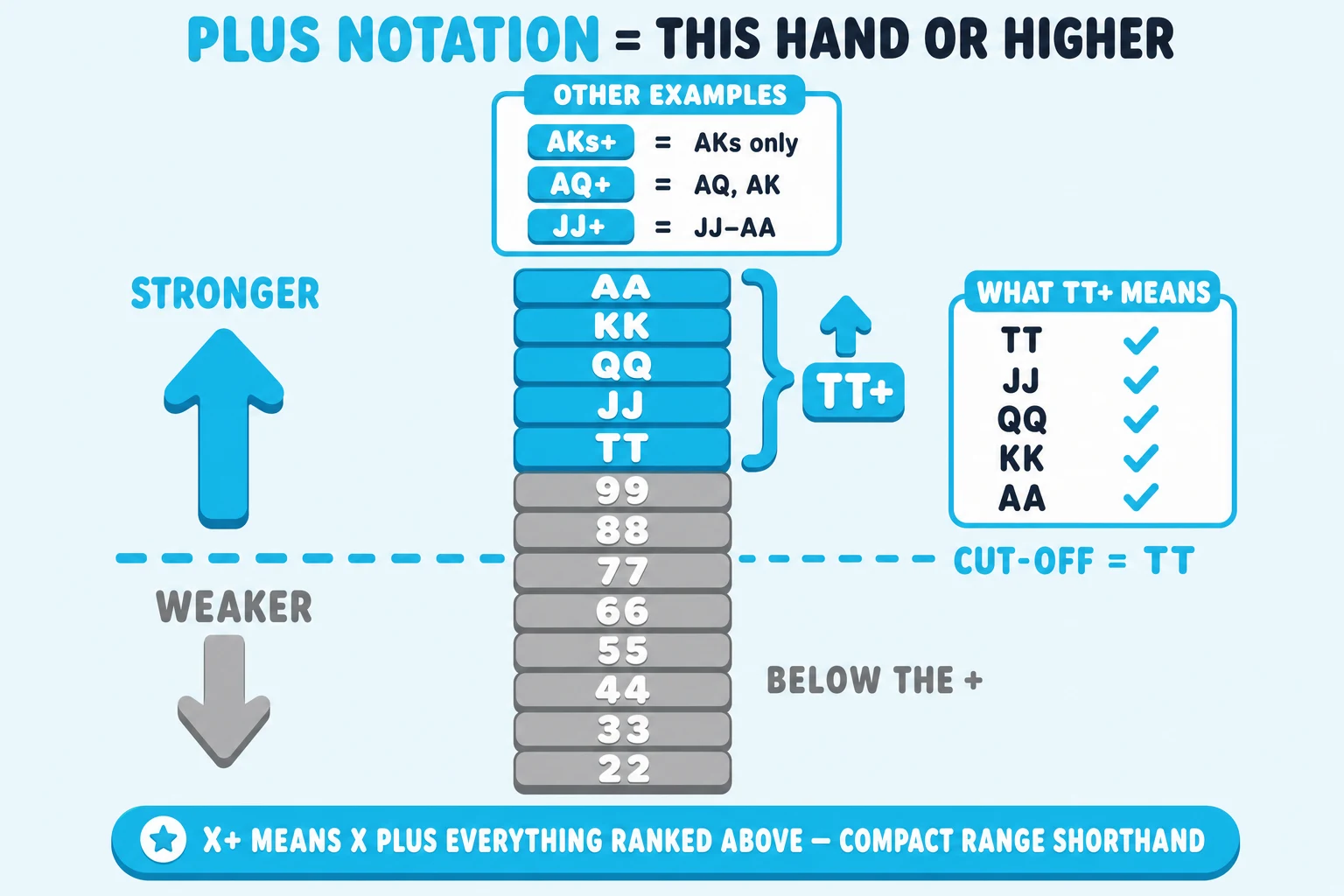
Concrete examples: J-J+ and A-K+
- J-J+ (read “pocket jacks or better”): means J-J, Q-Q, K-K, and A-A. Writing J-J+ as a raise range includes all those pocket pairs.
- A-K+ (read “Ace-King or better”): usually denotes A-K plus any stronger starting hands under standard pre-flop ranking, for example pocket A-A. In practice, players treat A-K+ as a premium holding and play it aggressively.
These notations let players shorthand collections of hands when discussing pre-flop actions like raising, calling, or 3-betting. (3-bet = a re-raise - the third bet in a betting sequence.)
Why players use plus notation
- Speed: It compactly expresses “this hand and everything better” without listing every hand.
- Clear cutoffs: Plus notation sets a precise threshold when constructing or discussing ranges.
- Consistency: Players communicate agreed boundaries for aggression or folding without long lists.
Using plus notation for pre-flop decisions
Plus ranges directly inform pre-flop choices: whether to open-raise, call, or 3-bet. For example, saying you 3-bet J-J+ against a late-position open means you’ll 3-bet any pocket jacks or higher. Likewise, A-K+ is typically treated as a premium and played aggressively pre-flop, because it dominates many other starting hands.
Poker Skill’s Big Blind vs Button Open lesson works at this kind of threshold without the shorthand, 3-betting pocket queens and kings, suited ace-king and suited ace-jack against the button’s wide open.
How to write and apply a plus range (quick steps)
- Pick a cutoff hand (for example, J-J or A-K).
- Append ”+” to indicate “and everything ranked above it” (for example, J-J+).
- State your interpretation aloud or in notes (for example, “J-J+ = J-J, Q-Q, K-K, A-A”) so everyone shares the same meaning.
Role in advanced play and study
Using plus notation precisely is core to higher-level play and game-theory work. It defines boundaries for aggressive and value-oriented actions. That standardization speeds analysis: coaches and players can tweak cutoffs and instantly see how ranges shift.
Quick checklist
- When you write a plus range, explicitly list which hands you include.
- Use plus notation to build and communicate concise pre-flop ranges.
- Apply plus ranges when deciding raise, call, or 3-bet thresholds.
- Use plus notation to mark boundaries for aggressive or value plays.