


Baseline Strategy
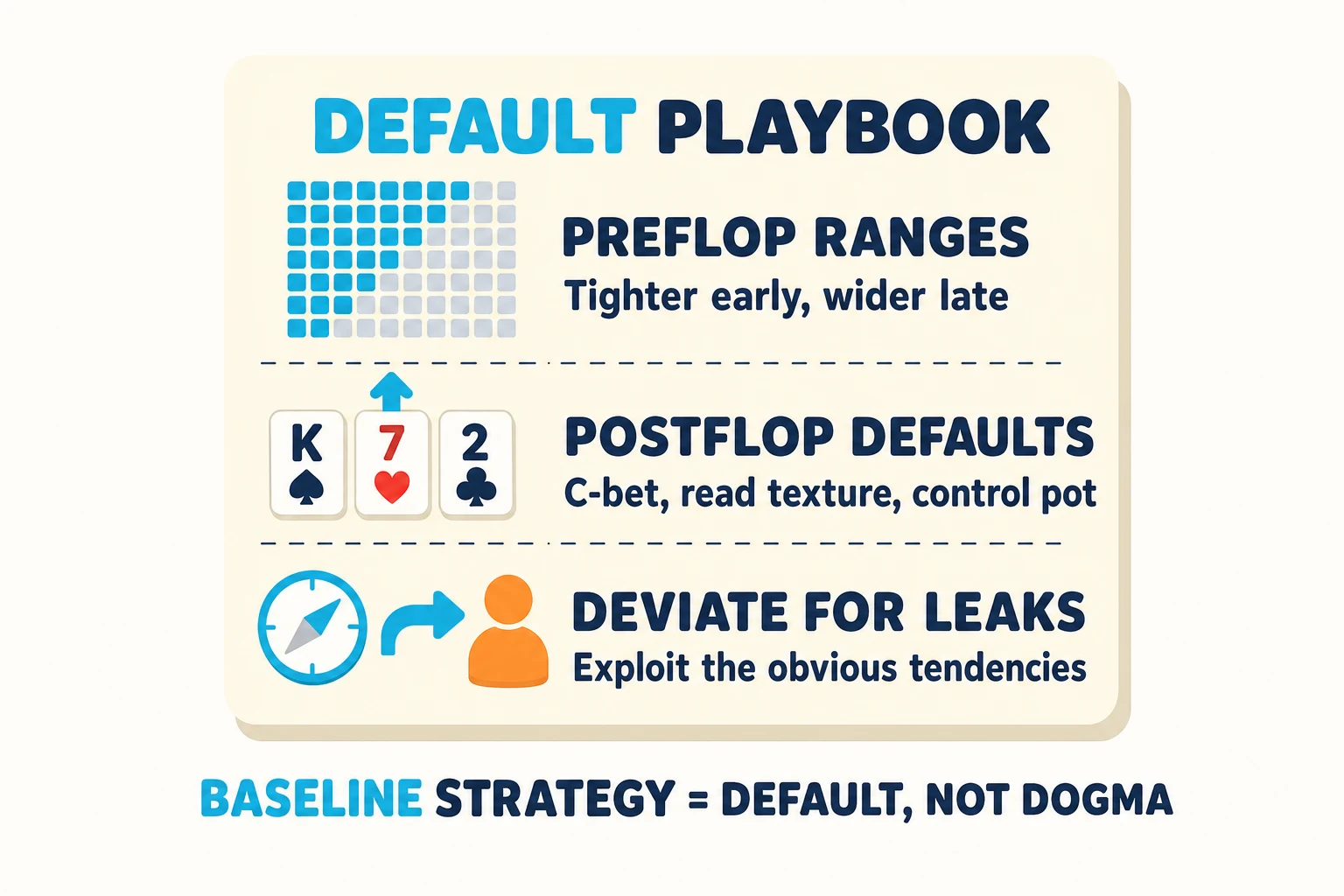
Your default playbook for No-Limit Hold'em: tight early-position ranges, wider late, raise rather than limp, and a postflop plan that follows position and board texture. The starting point you only deviate from when an opponent gives you a reason.

Practice this in Poker Skill. Seat by seat, this is what the preflop lessons teach, from raise-or-fold spots under the gun to button opens, and the preflop capstone sums it up as tight early, wider late.
Get the free appBaseline strategy
A baseline strategy is the simple, principled default you fall back on in No-Limit Hold’em: a preflop opening chart, a postflop plan that follows position and board texture, and a habit of raising rather than limping. The point isn’t to play the same way every hand. The point is to have a sound default so that the only choices you have to think hard about are the ones you have a reason to deviate on.
What a baseline strategy is and why it matters
A baseline is not a rulebook. It is a default that keeps your game sound under pressure. Following one keeps tilt-driven decisions out of tough spots, gathers consistent data on opponents (which is what makes exploits possible later), and turns preflop edges into postflop value more often. Treat it like a safety net: follow it until you have a specific reason to deviate.
Preflop hand selection and position
Position is the seat order you act in. Acting after opponents is a structural edge. Adjust your hand selection by seat:
- Early position (tight): play only the strongest hands. A baseline range from UTG looks like AA-99, AKs, AQs, AJs, ATs, AJo, KQs.
- Middle position: add selective broadways and suited connectors.
- Late position (looser): on the cutoff and button, widen to include more suited connectors and small pairs. Acting last gives you control of pot size and postflop decisions.
Think in ranges, the set of hands an opponent could hold, rather than single hands. That mindset is what makes the rest of the postflop game possible. Avoid limp-calling. Limping is calling the big blind preflop instead of raising. Open-raising seizes initiative, simplifies postflop, and isolates weaker players.
Preflop betting tactics and stack-depth adjustments
Raise to build pots with strong hands and take initiative. Passive limps tell the table what you don’t have, and aggressive opponents will run you over.
- Short stacks: favor shove-or-fold decisions with hands that have strong raw equity. Big pairs and strong aces play better as shoves than as marginal raises at low effective depth.
- Deep stacks: prioritize hands that flop well: suited connectors and higher pairs. You have room to maneuver, so playability matters more than raw strength.
Adjust opens and defends by stack depth and game type. Tournaments and cash games have different shove thresholds; ICM (the tournament payout structure’s effect on decisions) is a real lever in the late stages.
Postflop fundamentals: continuation bets, textures, and range reading
A continuation bet (C-bet) is a flop bet by the player who raised preflop. Use it when you have initiative, but read board texture (how coordinated the flop is) and opponent tendencies first. Dry boards, with few draws, favor C-bets more than coordinated flops that give opponents many draws to call with.
Assign opponent ranges from their preflop actions and refine those ranges with their turn and river behavior. A wide caller from the cutoff often holds medium-strength hands and draws on most boards; price your bets accordingly. Control pot size with position and hand strength, and avoid overcommitting with marginal holdings out of position.
From baseline to advanced: GTO baseline and exploitative adaptation
Start with Game-Theory-Optimal (GTO) charts as a neutral baseline for preflop and the most common postflop spots. Those defaults keep your ranges balanced, which means opponents cannot exploit you for free.
Then watch for clear tendencies, the kinds of leaks recreational players telegraph quickly: chronic limping, calling too wide, overfolding to flop bets. Deviate from GTO to attack those: raise more often into limpers, value-bet thinner against calling stations, bluff more into players who fold the river. Balance baseline adherence with real-time reads as you go.
Checklist
- Open-raise rather than limp from most positions.
- Tighten early-position ranges and widen them on the cutoff and button.
- Size bets in line with initiative, stack depth, and board texture.
- Use C-bets selectively. Read ranges, not single hands.
- Default to GTO-informed ranges, then deviate to attack clear opponent leaks.
- Review hands regularly to check that your deviations actually pay.