


Minimum Defense Frequency (MDF)
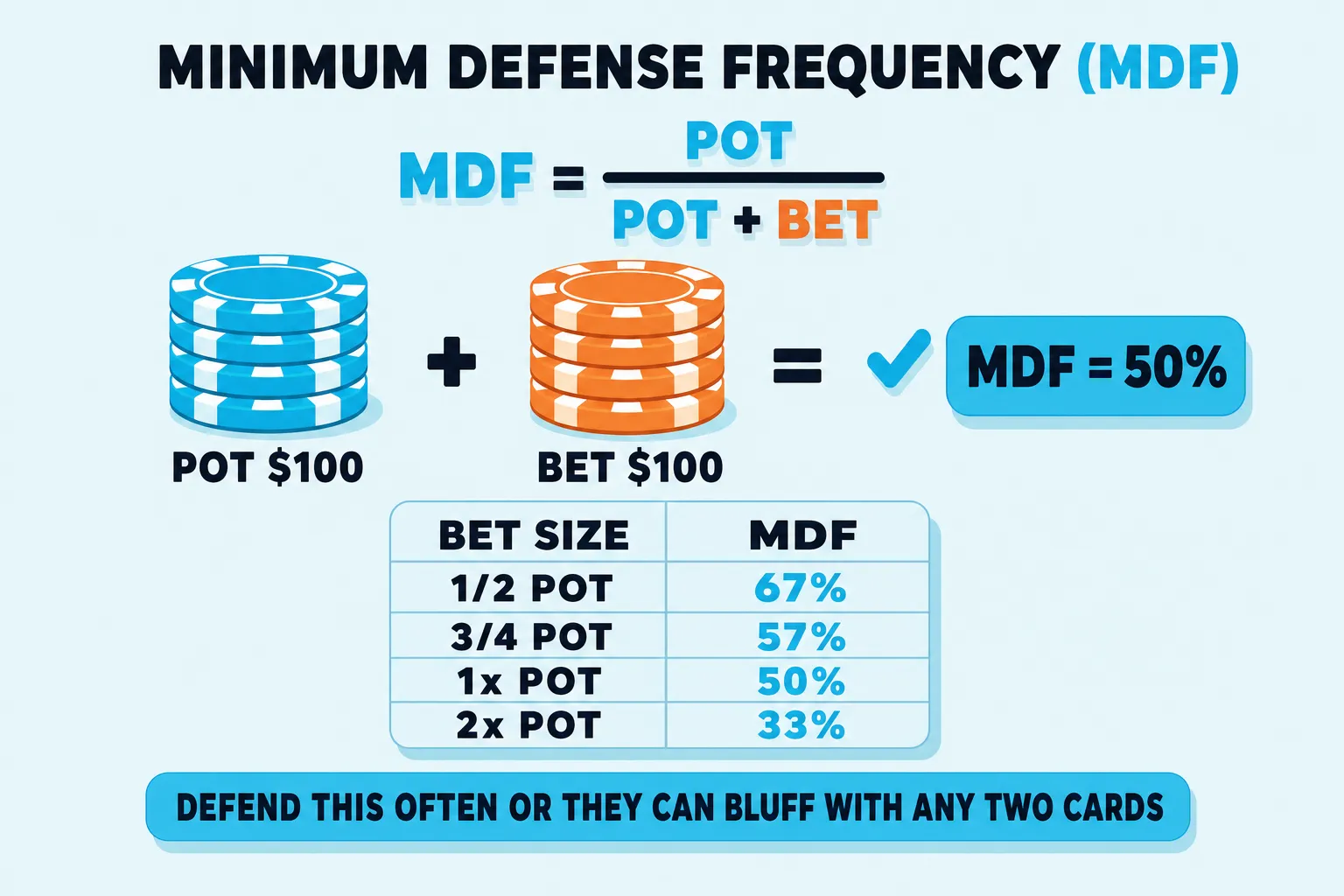
Minimum defense frequency (MDF) is the share of your range you must continue with — call or raise — to keep an opponent from profitably bluffing any two cards. It is the defender's mirror of the bettor's break-even fold percentage. The formula is pot ÷ (pot + bet), so MDF falls as the bet grows. Use it as a river benchmark and a sanity check; use it carefully on the flop and turn.

Practice this in Poker Skill. The folds in the Check-Fold lesson are the bottom of the range: an ace with no pair and no draw beside it, or two overcards with no straight or flush draw, like Q♥ 9♥ on 8♦ 3♦ 2♠.
Get the free appMinimum defense frequency (MDF): how often you must call to stop bluffs
What MDF means
Minimum defense frequency, usually shortened to MDF, is the share of your range you must continue with — call or raise — when facing a bet so that an opponent cannot profit by bluffing any two cards. It’s a defender-side benchmark drawn from the same algebra that gives the bettor a break-even bluff number. If the bettor needs you to fold X% to break even on a bluff, MDF is just 1 − X%.
MDF, alpha, and the break-even fold percentage
Three names, one piece of math. Use the one that matches the seat you’re in.
- Alpha — the fold percentage a bluff needs to break even.
alpha = bet / (pot + bet). - MDF — the rate the defender must continue.
MDF = pot / (pot + bet). - The two always sum to 1, which is why the break-even fold percentage is alpha by another name. Same formula, different chair.
A useful mental shortcut:
- The bettor asks: “How often does the defender need to fold for my zero-equity bluff to print?” (alpha)
- The defender asks: “How often do I need to keep going so the bettor can’t bluff me with anything?” (MDF)
Related terms
MDF by bet size
MDF is fully determined by the bet size relative to the pot. Memorize this table; the in-game math gets faster every time you face a familiar size.
| Bet size | Alpha (bettor needs folds) | MDF (defender must continue) | Bluff-to-value at this size |
|---|---|---|---|
| 1/2 pot | 33.3% | 66.7% | 1 : 3 |
| 3/4 pot | 42.9% | 57.1% | 3 : 7 |
| Pot | 50.0% | 50.0% | 1 : 2 |
| 1.5x pot | 60.0% | 40.0% | 3 : 5 |
| 2x pot | 66.7% | 33.3% | 2 : 3 |
Two patterns drop out of the table:
- As the bet grows, MDF falls. A 2x-pot overbet only forces you to continue 33% of the time; a half-pot bet forces you to continue 67%. Big bets shrink the defending range you owe.
- Bigger bets need more bluffs in the bettor’s range. That’s the bluff-to-value ratio column. At pot, a balanced bettor needs one bluff for every two value bets; at 2x pot, two bluffs for every three value bets. The two columns are linked because they describe the same equilibrium from opposite seats.
From the bettor’s seat, the alpha column says a smaller bet needs fewer folds to work, and Poker Skill has you bet A♣ 9♠ small on 3♠ 7♦ 3♦ because the caller misses that flop most of the time.
When MDF matters most
MDF earns its keep on the river. There are no more cards to come, no equity to realize, and the bettor’s bluffs are by definition zero-equity hands. The math reduces cleanly: continue at MDF and you can’t be exploited by bluff frequency at this size.
MDF matters less, and is often misleading, on the flop and turn:
- “Bluffs” still have equity to improve, so the bettor doesn’t always lose the pot when called.
- Future streets still matter: you may face another barrel, realize equity, or have raise options. That is different from a final river call-or-fold decision.
- Board texture and range composition swamp the raw percentage. A weak-king-high on a board where your range is mostly trash often folds even if MDF says “defend more.”
A textbook caution: in a BB-vs-UTG single-raised pot facing a 1/3-pot c-bet, raw MDF says the BB should defend roughly 75%. The actual equilibrium defense on a dry, ace-high flop is closer to 42%, because most of the BB’s range has too little equity against UTG’s c-betting range to call profitably. The MDF number is the river benchmark; the flop reality is filtered through equity, pot odds, and equity denial.
Treat MDF as a river anchor and a flop sanity check. Don’t treat it as a flop strategy.
Worked example
A clean river spot first. Pot is $100, villain bets $100 (pot-sized) on the river. Your hand is a bluff catcher — it beats every bluff in villain’s range and loses to every value hand.
- Alpha =
100 / (100 + 100)= 50%. Villain’s bluff needs you to fold half the time to break even. - MDF =
1 − 0.50= 50%. You must continue with at least half of your range that reaches this river to keep villain from bluffing profitably with any two cards.
If your river range here is 20 combos, that’s 10 combos you defend. Pick the 10 best — the ones with the most equity against villain’s value range, the ones that block their value combos, the ones that don’t block their bluffs. Fold the rest. The number tells you “how many”; your hand-reading tells you “which.”
A second spot, on the blind defense side. The button opens to 2.5bb in a 1bb/0.5bb blind structure, risking 2.5bb to win the 1.5bb already posted by the blinds.
- Alpha =
2.5 / (2.5 + 1.5)= 62.5%. A button steal with any two cards needs the blinds to fold 62.5% to break even. - MDF =
1 − 0.625= 37.5%. The blinds together must continue about 38% of the time to stop that open from printing with any two cards.
In practice, that defense is split between the SB and BB, and the BB often carries more of it because it closes the action and gets a better price. Use raw MDF as the floor; let position, rake, stack depth, and your preflop chart shape the actual hands.
Common mistakes
1) Defending trash to “hit the number”
MDF tells you the share of your range to defend. It does not tell you which hands. Calling 7-3 offsuit on a board where you have no equity isn’t a defense; it’s a -EV donation labeled with a percentage. Continue with the most playable, most equity-rich hands first; let the bottom of your range fold.
2) Treating MDF as a flop strategy
The percentage assumes that calling is the only way to extract value from villain’s bluffs and that the bettor loses the whole pot when called. Neither holds on the flop or turn. On earlier streets, real GTO defending ranges often sit well below raw MDF because equity, future streets, and check-raise threats reshape the calculation. River first, earlier streets with care.
3) Confusing MDF with bluff-to-value ratio
Both come out of the same bet/pot relationship, but they’re different objects. MDF is the defender’s continuing frequency. The bluff-to-value ratio is the bettor’s mix of bluffs to value. They link through the indifference principle: the bettor picks the mix that makes your bluff catcher indifferent; MDF describes the share you defend at that equilibrium. Same equilibrium, two different numbers — don’t substitute one for the other.
4) Ignoring that MDF assumes a balanced bettor
MDF protects you against an unknown opponent who could be bluffing optimally. Against a known under-bluffer who only ever bets value on the river, the MDF answer is wrong: you should over-fold and surrender the pot, because their share of bluffs is below what your call’s price needs, bet ÷ (pot + 2 × bet), which is 1 in 3 against a pot-sized bet. Against a maniac who over-bluffs, you should over-defend past MDF. The percentage is the GTO floor against an unknown player; reads move the answer.
FAQ
What is the formula for minimum defense frequency?
MDF = pot / (pot + bet). Plug in the pot before the bet and the bet size; the result is the share of your range that must continue by calling or raising. The mirror formula is alpha = bet / (pot + bet), the fold rate a zero-equity bluff needs to break even. The two always sum to 1.
Should I always defend at MDF?
No. MDF is the unexploitable floor against an unknown opponent who might be bluffing perfectly. In real games, three things shift the answer: your hand’s equity vs villain’s betting range, the street (river is clean, flop and turn are messy), and reads on whether villain is over- or under-bluffing this size. Treat MDF as the baseline; deviate when you have a reason.
Does MDF apply preflop?
Yes, in the same algebra: a steal-vs-blinds calculation gives an alpha and an MDF. Combined blind defense versus a 3bb button open lays alpha around 67%; the blinds together must continue ~33% of the time to stop a fully exploitative open. In practice modern preflop charts defend the BB much more aggressively than raw MDF demands, because position post-flop and closing the action both add value to defending. The MDF number is the worst-case floor, not the recommended strategy.