


Break-Even Fold Percentage
The break-even fold percentage is the minimum rate an opponent must fold for a bet or raise to be immediately profitable. It measures pure fold equity - the chance your opponent folds to your action - and ignores playability factors like later-street equity or showdown value. This metric matters for bluffs and semi-bluffs; a semi-bluff is betting with a drawing hand that can improve later. Use it to turn a read into a clear, testable decision.
Practice this in Poker Skill. Estimating how often the caller folds is what the bluffing lesson trains: 4♥ 8♣ has nothing on Q♠ 3♣ 2♣, but the flop missed the caller too, so you bet to take the pot now.
Get the free appBreak-Even Fold Percentage (No-Limit Texas Hold’em)
What the break-even fold percentage means
The break-even fold percentage is the minimum rate an opponent must fold for a bet or raise to be immediately profitable. It measures pure fold equity - the chance your opponent folds to your action - and ignores playability factors like later-street equity or showdown value. This metric matters for bluffs and semi-bluffs; a semi-bluff is betting with a drawing hand that can improve later. Use it to turn a read into a clear, testable decision.
For the full bluff-frequency table, MDF mirror, and worked river examples, read Optimal bluffing frequency: the formula and when it lies.
How to calculate it
The formula is simple:
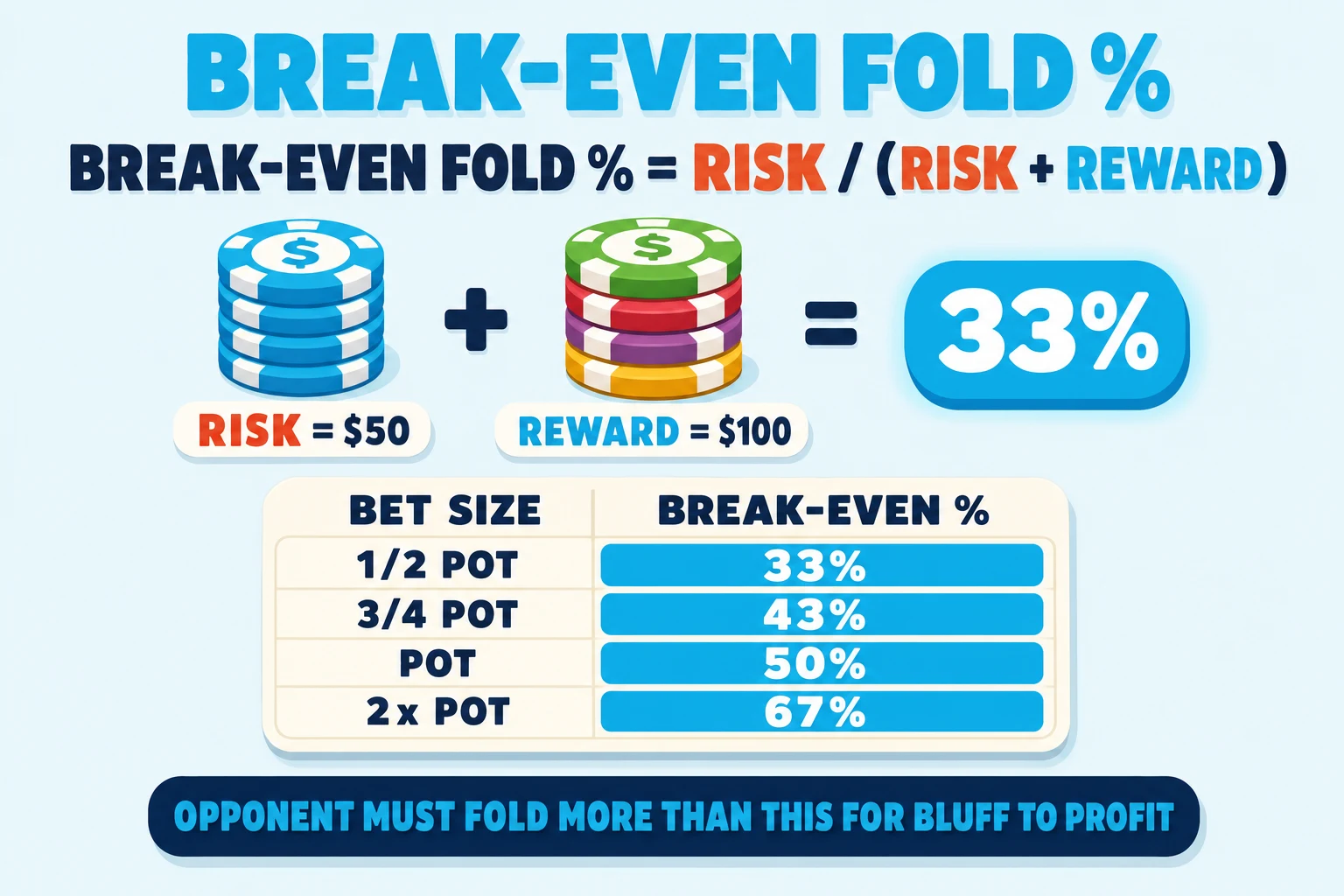
Break-Even Fold % = Risk / (Risk + Reward)
- Risk = the amount you are betting.
- Reward = the pot size before your bet.
Step-by-step:
- Note the pot size before your bet (Reward).
- Note the amount you will put in (Risk).
- Compute Risk / (Risk + Reward) and convert to a percentage.
Example: Pot $100, you bet $50.
- Risk = $50, Reward = $100.
- Break-Even Fold % = 50 / (50 + 100) = 50 / 150 ≈ 33%. Interpretation: your opponent must fold more than 33% of the time for that bluff to be immediately profitable.
Another quick example: Pot $150, you shove $150 (bet the pot).
- Risk = $150, Reward = $150.
- Break-Even Fold % = 150 / 300 = 50%.
Standard bet sizes and their break-even thresholds
Memorize these anchors for fast decisions at the table:
- Half-pot bet (0.5x): break-even ≈ 33%.
- Three-quarters pot (0.75x): break-even ≈ 43%.
- Full-pot bet (1x): break-even = 50%.
- Double-pot bet (2x): break-even ≈ 67%.
If you expect an opponent to fold more often than the threshold for your chosen size, the bluff is immediately profitable from a fold-equity perspective.
Practical use: when to bluff and when not to
Turn the math into action with this checklist:
- Estimate how often the opponent folds to this size on this street.
- Calculate the break-even fold % for your planned bet.
- Compare the two: if estimated fold rate > break-even, bluff (ignoring other factors); if lower, don’t bluff only for fold equity.
Size bluffs so the required fold frequency matches realistic opponent tendencies. For example, against a caller who folds 30% to half-pot bets, a half-pot bluff (33% break-even) is marginal; a 3/4-pot bet (43% break-even) is too large unless you expect more folds or have extra equity for later streets. Remember this calculation ignores future playability and showdown value. Semi-bluffs combine fold equity with actual outs, which often changes the decision.
Defending and strategic implications
For defenders, the break-even fold percentage links directly to pot odds and minimum defense frequency (MDF). MDF is the share of the time you must continue (call or raise) to avoid being exploited by bluffs. If a bet requires the opponent to fold less often than your calling frequency, you are defending optimally.
Use break-even anchors to decide when calling is mandatory versus folding. Integrate range considerations and future-play factors, such as whether you can extract value later, to refine calls and bluffs.
Quick checklist
- Compute Break-Even Fold % = Risk / (Risk + Reward) before or during decisions.
- Compare the threshold to your read of the opponent’s fold frequency.
- Choose bet sizes that make profitable bluffs realistic, and remember the concept ignores future playability and showdown equity.