


Min-Raise
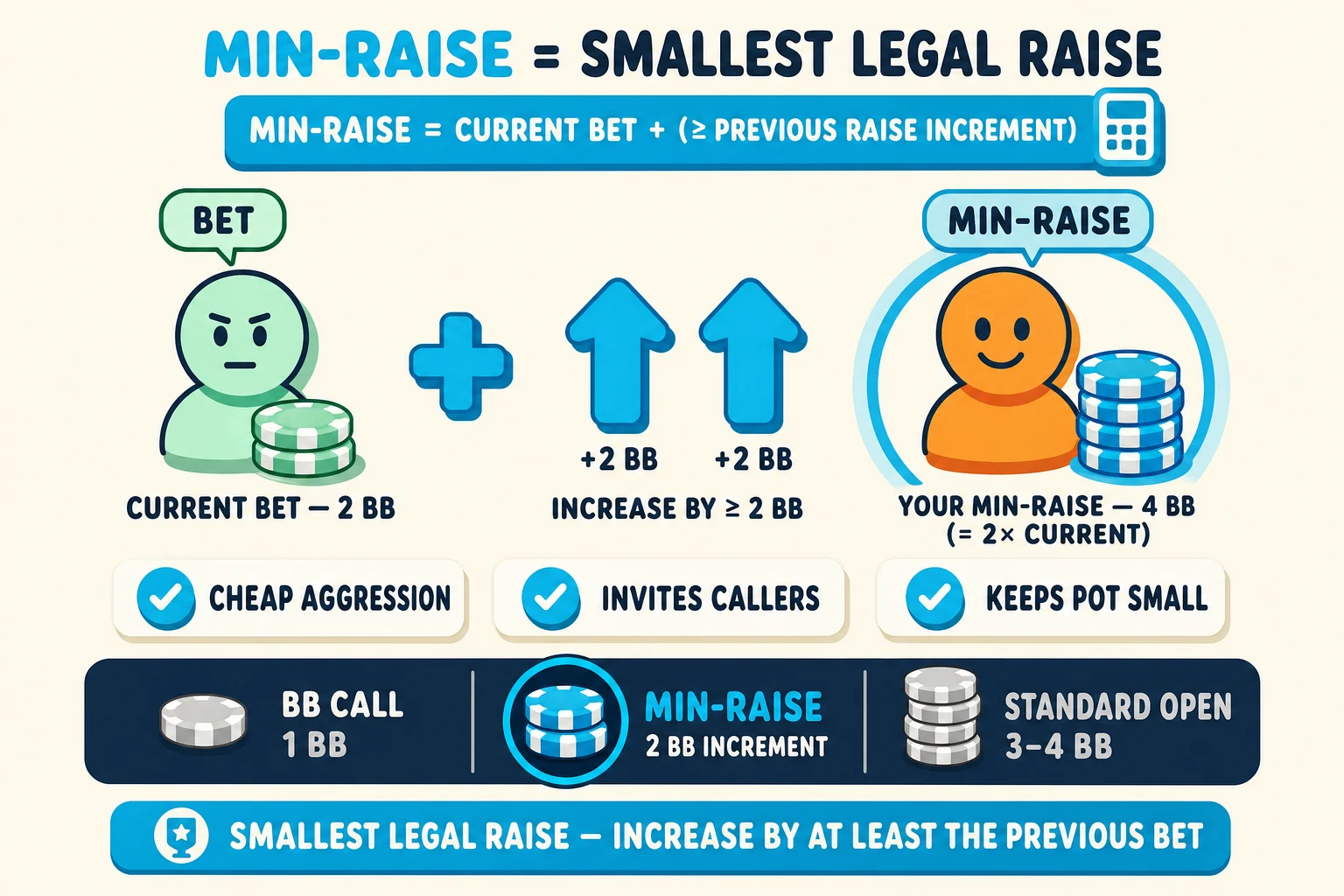
A min-raise is the smallest legal increase over the current bet in a betting round. For example, with a 100-chip big blind, the min-raise is to 200 chips (an increase of 100). This rule applies pre-flop and on post-flop streets-any raise sets the minimum increment opponents must at least match. Players use min-raises to initiate or escalate action while keeping chips committed low.

Practice this in Poker Skill. The Raise Mechanics & Reopening lesson puts chip counts on this rule, starting from a 300 bet where the smallest legal raise is to 600.
Get the free appMin-Raise
What a Min-Raise Is
A min-raise is the smallest legal increase over the current bet in a betting round. For example, with a 100-chip big blind, the min-raise is to 200 chips (an increase of 100). This rule applies pre-flop and on post-flop streets-any raise sets the minimum increment opponents must at least match. Players use min-raises to initiate or escalate action while keeping chips committed low.
Primary Purposes of Min-Raising
- Enticing action: Small raises invite more callers. If you hold a strong or deceptive hand, such as a set (three of a kind), a min-raise builds the pot by encouraging calls rather than folds.
- Minimizing risk: A min-raise lets you be aggressive while limiting chips at risk. Opening to the min pre-flop with KQ offsuit keeps your investment small if you face a big re-raise.
- Applying pressure: Min-raises support a Raise/Fold approach-raise to try to take the pot pre-flop, then fold to heavy resistance. Use this to steal blinds or force marginal hands off the pot without planning deep post-flop play.
Position and Stack-Depth Effects
Position and stack depth determine when and how you min-raise.
- Early position: Players min-raise with a tighter range. Use min-raises with strong hands to avoid bloating pots you’ll play out of position.
- Late position: Players min-raise more liberally for blind steals and exploitation. From the button, a min-raise widens your opening range because you have post-flop position.
- Stack depth: With shallow stacks, decide between a min-raise and a shove (all-in). With deeper stacks, min-raises become common opens, but tighten hand selection because 3-bets or all-ins pose real threats.
Reading Opponents and Table Dynamics
Adjust min-raise frequency based on opponent tendencies and table dynamics.
- Versus over-folders: If defenders fold too often to small raises, min-raises become highly profitable for stealing blinds.
- Versus active 3-bettors or callers: If opponents frequently 3-bet or call small raises, min-raising loses value; tighten your range or mix in larger sizes.
- Game evolution: As games get tougher, larger open sizes may become standard. Even then, the min-raise remains a core tool to balance aggression and limit risk when inviting action.
How Min-Raises Fit with Other Strategies
The min-raise integrates cleanly with broader strategic frameworks.
- Raise/Fold: Min-raises enable controlled aggression and fast, clear decisions.
- Three-betting dynamics: Frequent min-raises attract more 3-bets and isolations; be ready to tighten or three-bet back with a polarized range.
- Blind-stealing and pre-flop sizing: Mix min-raises with larger opens to vary your range and avoid predictability. Mixing sizes keeps opponents uncertain about your hand strength.
Checklist
- Verify effective stack depths before choosing a min-raise versus a shove.
- Adjust min-raise frequency based on opponents’ blind-defense and 3-bet tendencies.
- Use position to widen or tighten your min-raise range appropriately.
- Combine min-raises with other sizes to balance your range and avoid predictability.
Short, targeted min-raises are a simple, powerful tool when you account for position, stacks, and opponent habits.