


Check-Fold
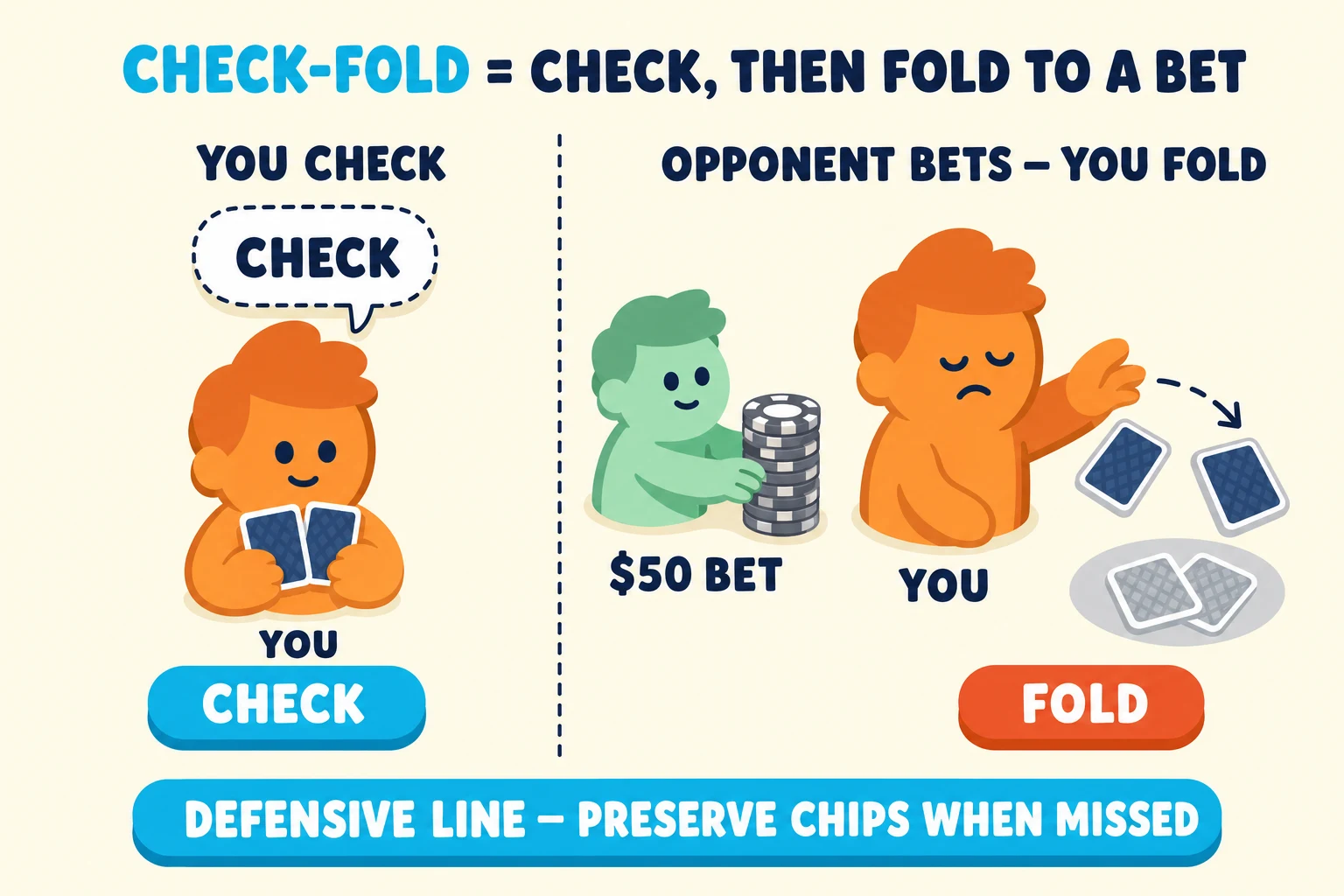
Check-fold is a conservative post-flop line: you check, then fold if facing a bet. A "check" means you decline to put chips into the pot on your turn. A "fold" means you discard your hand and give up the pot to a bet. The full sequence: check, and fold to any bet rather than call or raise.
Practice this in Poker Skill. Five of the ten spots in the Check-Fold lesson are calls, with two pair, middle pair or top pair.
Get the free appCheck-Fold in No-Limit Texas Hold’em
What check-fold means
Check-fold is a conservative post-flop line: you check, then fold if facing a bet. A “check” means you decline to put chips into the pot on your turn. A “fold” means you discard your hand and give up the pot to a bet. The full sequence: check, and fold to any bet rather than call or raise.
Use check-fold when your hand misses the flop or the board texture makes continuing unprofitable. You only stay if the action checks through; fold to aggression. Example: you called preflop with K♦9♠ and the flop comes A♣7♦2♥. You missed. You check; when the button bets, fold instead of investing more chips in a low-equity spot.
When to use a check-fold line
Common situations where check-fold is the sensible default:
- After missing the flop with a marginal holding. Example: You hold Q♥10♦, flop is K♠8♣3♦. You likely check-fold versus a bet.
- On coordinated or unfavorable boards that reduce your equity. A coordinated board (connected or two-suited) gives opponents many draws and made hands, lowering your chances. Example: you hold A♠7♣ and the flop is J♠10♠9♦. The board is highly connected; check-fold is often prudent.
- When out of position or facing an aggressive opponent. Acting before opponents makes post-flop decisions harder and more expensive.
Quick checklist before deciding: Did I improve? Has the board likely hit my opponent? Am I out of position or facing a bully? If you did not improve, the board likely hit your opponent and you are out of position or facing a bully, choose check-fold.
Why check-fold is a defensive tool
Check-fold protects your stack in No-Limit play, where bet sizes can escalate quickly. Folding early minimizes losses with weak or marginal hands. It also avoids complex, low-equity decisions. Calling or raising on dangerous boards forces you into difficult turns and rivers with little chance to win; check-fold keeps you out of those high-variance spots.
Practical decision steps:
- Estimate your equity, your chance to win if the hand goes to showdown.
- Gauge opponent tendencies and pot size.
- If equity is low and risk is high, check-fold to preserve chips.
Risks and limitations of overusing check-fold
A predictable check-fold pattern is exploitable. Opponents who spot it will bluff more and pick up pots cheaply. Over-reliance also removes chances to realize equity by check-calling with decent draws or to apply pressure with a check-raise. Good players mix lines: sometimes check-call with draws, sometimes check-raise to push back. Do the same.
Practical online considerations
Most online sites offer a check/fold button for quick action and to avoid accidental commitments. Use it only when you genuinely intend to fold to any bet. Even online, don’t auto-pilot: glance at the board texture and opponent history before selecting check/fold. The button is a convenience, not a replacement for basic reads and board assessment.
Quick checklist
- Use check-fold when you miss the flop or face an unfavorable board texture.
- Prefer check-fold out of position or versus strong, aggressive opponents to limit losses.
- Avoid predictable overuse; mix in check-calls and check-raises occasionally.
- Consider the online check/fold button only when you truly intend to fold to a bet.
FAQ
Can you fold after you check?
You only face a fold decision if someone bets after your check. If everyone checks, the betting round ends, the hand continues to the next street, or to showdown on the river, and there is nothing to fold. Check-fold means planning to fold to a bet that has not happened yet.
Is it ever right to fold instead of checking?
Never. Checking is free, so folding when no bet is in front of you gives up your chance at the pot for nothing. Fold only when you are facing a bet you are unwilling to call.