


Big O
Big O is a five-card Omaha variant, almost always played as pot-limit hi-lo with an eight-or-better qualifier. You receive five hole cards and must use exactly two of them plus exactly three board cards to make each five-card hand. The pot is split between the best high hand and the best qualifying low (five unmatched cards eight or below); if no low qualifies, the high hand wins everything. Big O looks like Pot-Limit Omaha with one extra card, and plays nothing like it: equities run very close, multi-way pots are the default, and the game punishes anything other than nut-leaning hands.
Big O: the Five-Card Omaha Variant
What Big O is and how the rules work
Big O is a five-card Omaha variant, almost always played as pot-limit hi-lo with an eight-or-better qualifier. You receive five hole cards before the flop, and the betting rounds match Hold’em: a preflop round, a three-card flop, a turn, and a river. Each raise is capped at the size of the pot. At showdown you build your best high hand using exactly two hole cards plus exactly three community cards, and your best low hand the same way. The two pairs of hole cards do not have to be the same, so you can play A-2 for the low and a different two cards for the high. A qualifying low is five unmatched cards ranked eight or lower; if no player makes one, the entire pot goes to the best high hand. The best low is 5-4-3-2-A, which is also a five-high straight on the high side.
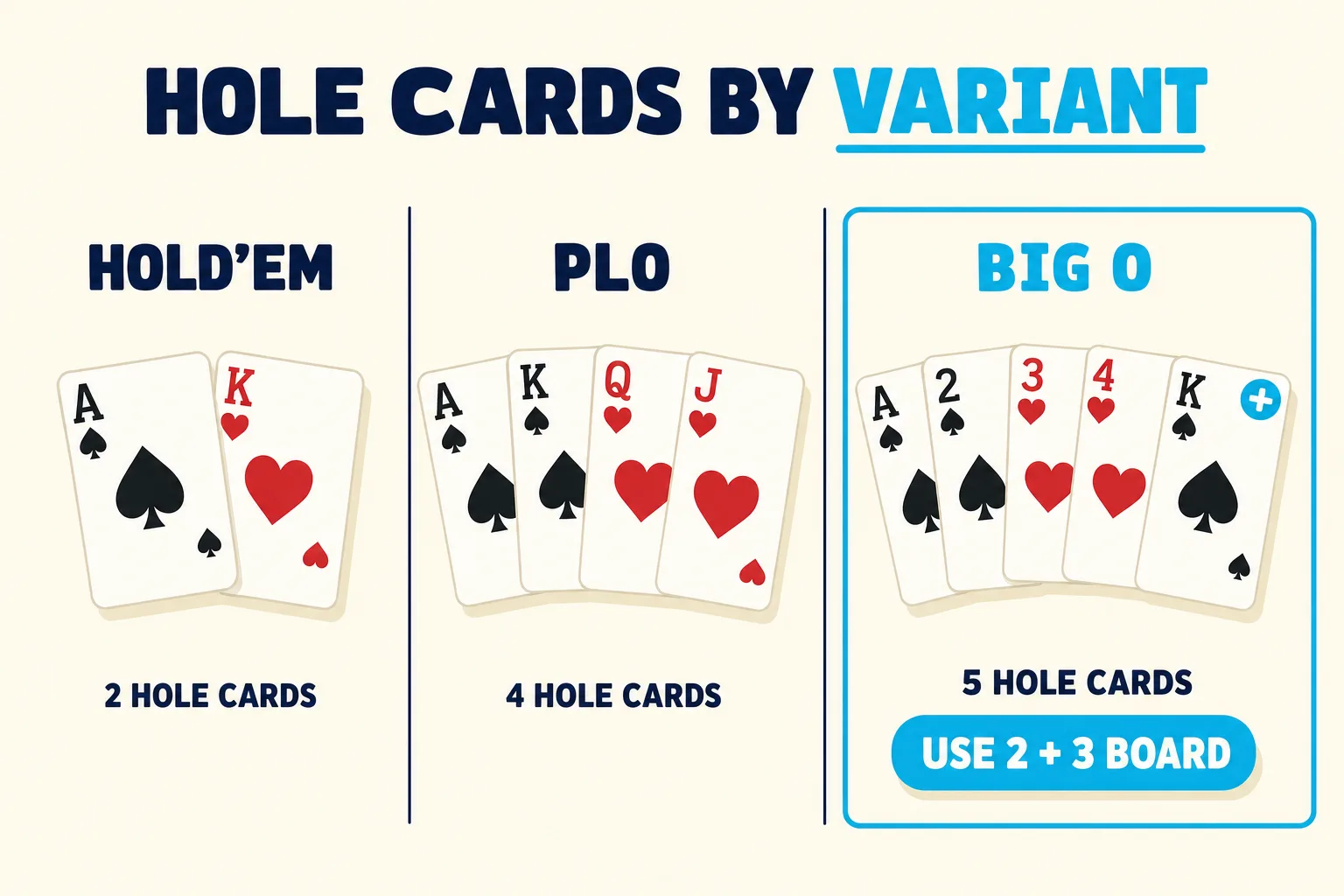
Big O vs PLO vs Hold’em at a glance
The rules look small on paper. The strategic gap they open is enormous.
| Trait | Big O | PLO | Hold’em |
|---|---|---|---|
| Hole cards | 5 | 4 | 2 |
| Two-card combos per hand | 10 | 6 | 1 |
| Hand construction | 2 hole + 3 board | 2 hole + 3 board | Any 5 from 7 |
| Betting structure | Pot-limit | Pot-limit | No-limit |
| Pot split | High + qualifying low | High only | High only |
| Low qualifier | 5 unmatched cards 8 or below | None | None |
| Typical action | Multi-way, big pots | Multi-way | Often heads-up by the turn |
The two-card combos number is the one to keep in mind. With ten combinations per opponent, somebody’s equity almost always beats a hand that would be premium in Hold’em. That is why Big O is a nut-leaning game first and a betting-line game second.
When the must-use-two rule changes your decisions
The rule that “you must use exactly two hole cards plus exactly three board cards” sounds like a footnote and is the single biggest source of beginner errors. Three places it matters:
- Flushes need two suited cards in your hand. A board with four hearts does not give a flush to a player holding one heart, because you cannot use a single card from your hand and four from the board.
- Straights need two connecting cards in your hand. A board of 9-T-J does not give a player with a single Q a straight; they need a second card that bridges the run.
- A pair on the board is just one of your three board cards. If the board is K-K-7-2-2 and you hold A-K-Q-J-T, your best high hand is three kings, built from K-A in your hand plus K-K-7 from the board.
Hold’em players read their own hand instinctively and then add the board. In Big O you have to do the opposite: pick two from your five, then pick three from the board, and check that those two pairs of choices give you a legal five-card hand. Hold’em is the only game Poker Skill teaches, and there its lessons even have you play the board when no hole card helps, as A♥ K♦ does on a 3-4-5-6-7 board, something Big O never allows.
Example: building a hand in Big O
You hold A♠ 2♠ 3♥ 4♥ K♠. The board comes K♥ 7♣ 6♦ 5♠ 8♠.
A Hold’em player looking at this would see a spade flush, a wheel and a pair of kings, three made hands at once. In Big O you have to find one legal hand each for the high and the low.
High side. Take 3♥ 4♥ from your hand and 5♠ 6♦ 7♣ from the board: that builds a seven-high straight, 7-6-5-4-3. Could you do better? An eight-high straight would need a 4 plus a second hole card from 5 to 8, since only three board cards can play; you hold only the 4. The flush looks tempting because you have three spades (A♠ 2♠ K♠), but the rule says exactly three spades from the board, and the board has only two (5♠ and 8♠). The flush is not available. Two pair is out as well: the K♠ pairs the board’s king, and none of your A, 2, 3 or 4 pairs another board card. The best legal high hand is the seven-high straight.
Low side. Take A♠ 2♠ from your hand and 5♠ 6♦ 7♣ from the board. That gives 7-6-5-2-A, a qualifying low (five unmatched cards eight or below). It is also the nut low on this board: no two hole cards make a lower five with three of these board cards, so the worst that can happen to your low is sharing it with another A-2.
So one hand does two jobs: a seven-high straight on the high side and a 7-low on the low side, both built off the same 5-6-7 board cards but using different pairs of hole cards.
Common Big O mistakes
- Treating top pair top kicker as strong. With ten two-card combos per opponent, somebody usually has a draw, a wrap, or a better made hand. One pair almost never wins a contested pot.
- Drawing to non-nut flushes and non-nut lows. The second-nut low (you hold A-3 when somebody else has A-2) is one of the most expensive hands in poker. Big O punishes hands that are “pretty good.”
- Forgetting the must-use-two rule on the river. New players announce a flush or straight that requires using one or three cards from their hand and find out the rule the hard way.
- Overplaying low-only hands without counterfeit protection. A-2-X-X-X with no third low card means a paired ace or deuce on the board wipes your low. The third and fourth low cards are the insurance that keeps the hand alive.
- Calling pot-sized bets with second-best anything. Pot-limit means a pot-sized bet is the maximum, and players make pot-sized bets with the nuts or strong draws to the nuts. Calling with a second-best hand is the slowest way to lose a stack.
For deeper hand-selection rules, three worked starting hands, and the way real Big O hands play out across all four streets, read the longer guide at Big O Poker: Rules, Hand Selection, and Beginner Mistakes.
Where Big O fits in the variant family
Big O sits between Pot-Limit Omaha (four hole cards, high-only) and PLO8 (four hole cards, hi-lo with an eight-or-better qualifier). The five-card hi-lo combination is what makes the game distinctive: more two-card combos per hand, more nut draws per range, more multi-way action, and more split pots. Players who already know PLO pick up Big O faster than Hold’em-only players, because the must-use-exactly-two rule and pot-limit betting are already familiar. The shift is just that every hand has ten two-card combos to track instead of six, and the low half of the pot adds a second contest most boards will resolve.
Big O hands are won by structures that can scoop, high and low together, not by hands that look strong from a Hold’em or PLO frame. That is the whole game in one sentence.
Big O checklist
- Count your hole cards: five, not four.
- Build hands using exactly two from your hand plus exactly three from the board, every time.
- Treat low qualifiers as a real second pot, not an afterthought.
- Aim for hands that can scoop both halves; non-nut hands lose chips fast.
- Read the longer Big O strategy guide before sitting in your first Big O game.