


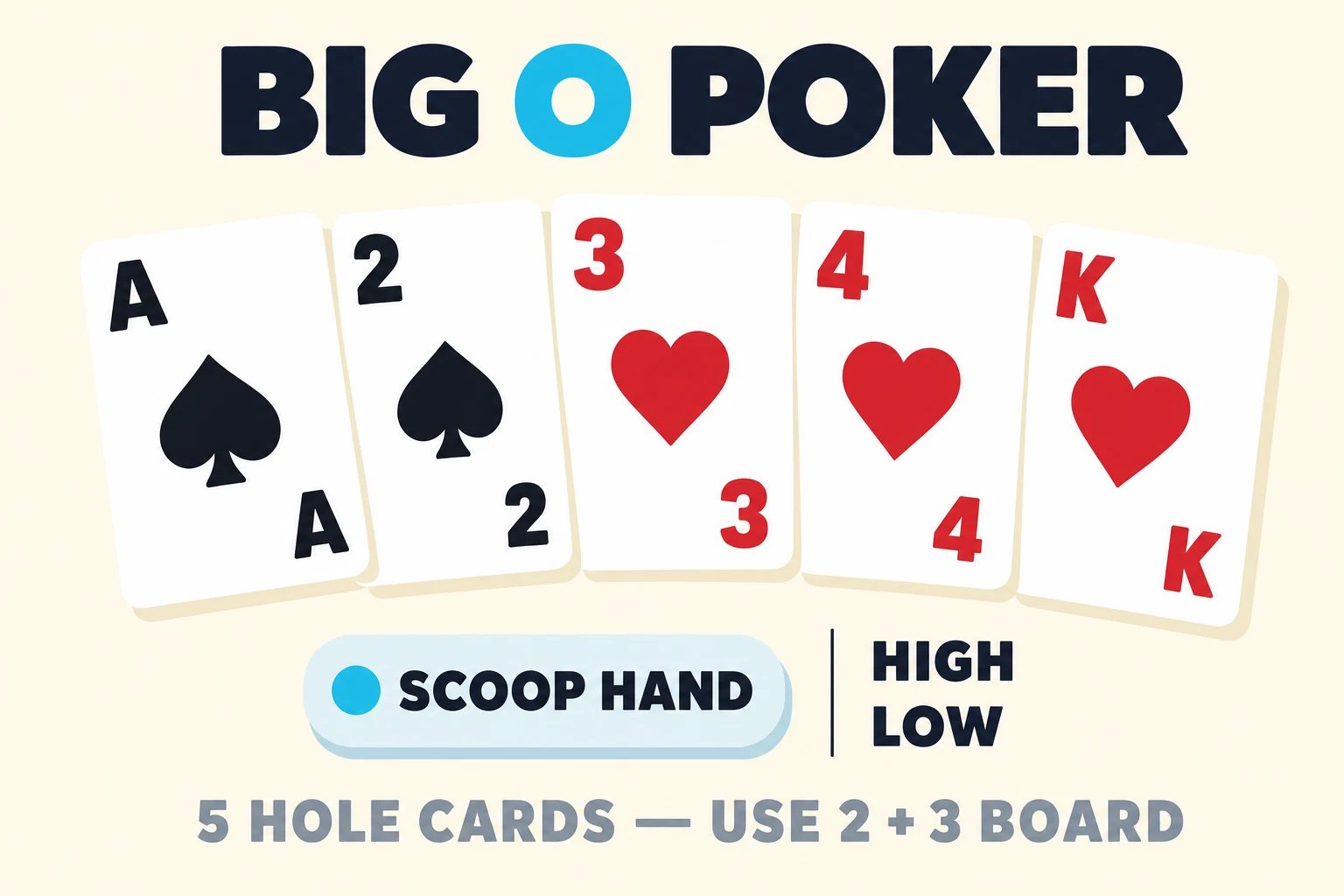
Big O is five-card pot-limit Omaha hi-lo with an eight-or-better qualifier: the same Omaha you might know, plus one extra hole card and a split-pot wrinkle that punishes Hold’em instincts hard. You get five cards, must use exactly two of them with three board cards, and the pot splits between the best high hand and the best qualifying low (five unmatched cards eight or below). If no low qualifies, the high scoops. Big O looks like PLO and plays nothing like it.
The shortcut, in one line
Play A-2 hands with low support. Draw to the nuts. Fold non-nut almost everything. The whole game is a contest to scoop (win both halves of the pot), and hands that can only win one side are how new players go broke.
Big O at a glance
| Trait | Big O | PLO | NLH (Hold’em) |
|---|---|---|---|
| Hole cards | 5 | 4 | 2 |
| Two-card combos per hand | 10 | 6 | 1 |
| Hand construction | Use 2 hole + 3 board | Use 2 hole + 3 board | Any 5 from 7 |
| Betting structure | Pot-limit | Pot-limit | No-limit |
| Pot split | High + qualifying low | High only | High only |
| Low qualifier | 5 unmatched cards 8-or-lower | None | None |
| Typical action | Multi-way, big pots | Multi-way | Often heads-up by the turn |
The most-common Big O variant is hi-lo eight-or-better, often called 5-Card PLO8. A pure-high version exists in some California rooms; that’s just five-card PLO. This article covers the hi-lo version because it is the one searchers mean when they say “Big O.” If the split-pot format itself is new to you, the hi-lo glossary entry explains the high half, the low half, and the eight-or-better qualifier.
The rules in one read
Five hole cards are dealt face down. Blinds and betting rounds match Hold’em: a preflop round, a three-card flop, a turn, a river. Every raise is capped at the size of the pot.
At showdown you build your best high hand using exactly two hole cards plus exactly three board cards, and your best low hand the same way. The two pairs of hole cards do not have to be the same: A-2 might play for the low while two other cards play for the high. A qualifying low is five unmatched cards ranked eight or lower; straights and flushes do not count against the low, and ace plays low. The best low is 5-4-3-2-A, the wheel, which is also a five-high straight on the high side. The worst qualifying low is 8-7-6-5-4. If no player has a qualifying low, the entire pot goes to the best high hand.
Two ranks decide your game more than anything else: the ace and the deuce. They sit on the seam between the high and low halves, and almost every strong Big O hand is built around at least one of them.
What makes a Big O hand strong
The shape that wins money is A-2 plus low support, ideally with suited high cards. The A-2 anchors the nut-low draw. A third low card behind the deuce, like a 3 or 4, protects against counterfeiting (when the board pairs your ace or deuce and your low evaporates). The leftover cards do work on the high side: an ace suited with a king or queen draws to the nut flush; a paired ace draws to top set. Hands like A-A-2-3-K double-suited are the gold standard.
Three categories sort the rest:
- Scoop hands. A-2-low-high-high, ideally double-suited. Nut-low draw plus a route to win the other half. Raise these and build pots.
- Low-only hands. A-2-X-X-X with no high-side equity. They win half a pot if a low qualifies and you don’t get quartered, and lose money when no low runs out. Play smaller, in late position.
- High-only hands. K-K-Q-Q-J with no low draw. They look strong from a Hold’em frame and lose ground because half the pot is gone any time three cards eight-or-lower hit the board.
The five-card hand makes almost every deal look playable. It is not. Combinatorics push action multi-way, most boards complete a low, and a hand with no scoop route is mostly playing for a quartered share.
Three worked starting hands
A♠ 2♠ 3♥ 4♥ K♥, the scoop hand
The nut-low anchor (A-2) is there. The 3 and 4 give counterfeit protection: if the board pairs your ace, 2-3-4 still plays for low; if it pairs your deuce, A-3-4 still plays. The spade-suited ace draws to the nut flush, the heart-suited 3-4-K covers a second flush draw, and a wheel draw is built in. Raise from any position. The hand has a route to scoop on any low-textured flop and still carries nut-flush potential plus kings on dry boards.
A♣ 2♦ 9♠ T♠ J♥, the trap hand
Beautiful to look at, leaky in play. The A-2 is naked: no third low card, so any board that pairs your ace or deuce wipes the low. The 9-T-J makes straight combinations, but only the J-T two-card combo plays the broadway nuts, and most boards do not run that out. No nut-flush draw, no nut-low backup, no double-suited structure. Limp or fold from middle position.
K♥ K♣ Q♠ J♥ T♣, the high-only hand
A monster in Hold’em, a marginal hand in Big O. Kings make an overpair on most flops and K-Q-J-T draws to broadway, but none of that gets you a low. On any flop with three cards eight-or-lower you are playing for half the pot at best, and your kings will get checked into by hands that have you beaten. Limp or fold early, play it in late position when nobody has shown strength, and brake hard if a low draws on a low board.
Five mistakes that drain new Big O players
- Treating it like NLH. Top pair top kicker is rarely the winner. With ten two-card combos per opponent, somebody’s equity is usually higher than yours when the pot gets big.
- Drawing to the non-nuts. Non-nut flushes, non-nut lows, and non-nut straights are the leak that quietly costs the most. The second-nut low (A-3 in your hand when somebody else has A-2) is one of the worst places to spend chips.
- Overplaying one-pair hands. A pair of aces with no low support and no nut-flush draw is a check-call hand at best. Building a big pot with it is a shape-of-hand mistake.
- Ignoring counterfeit risk on low-only hands. A-2-X-X-X without a 3 or 4 means one paired ace or deuce on the board wipes your low. The third and fourth low cards are the insurance.
- Calling pot-sized bets with second-nut anything. Pot-sized bets in pot-limit are the maximum, and players fire them with the nut hand or a strong draw. Calling with second-best is the slowest, most expensive way to lose a stack. Paired boards are the sharpest version: the Zeebo theorem says nobody folds a full house, so the second-best boat pays off the best one every time.
When the rules of thumb lie to you
The standard advice is built for full-ring, multi-way Big O at low and mid stakes, which is where the game lives. Three textures pull the heuristic sideways.
Heads-up Big O plays differently. The multi-way scoop math goes away, equities run closer, and you can value-bet thinner and bluff more often. Heads-up Big O is rare in the wild because the whole appeal of the game is the multi-way action.
The pot might never qualify a low. A low only qualifies when three cards eight-or-lower hit by the river. On boards with two big cards and a brick you are effectively playing pure-high pot-limit Omaha with five hole cards, and the big-card hands you were ready to fold play closer to NLH-style strong.
Getting quartered with the bare nut low is the most common way Big O loses you money on a “good” hand. If you have A-2 and somebody else also has A-2, you split the low half and collect a quarter of the pot. The nut low alone is not enough; the nut low plus a piece of the high side is what scoops.
A live-play pattern
Three reads, in order, before every Big O hand.
First, does my hand have an ace? If no, you are off the most-common scoop route. Fold most of these from early position and limp only with strong low and high coordination (think 2-3-4-5-K double-suited).
Second, does my hand have low support? An ace with no second low card is a half-trap. Three low cards is the strong shape; two is the marginal shape; one is the spew shape if you treat it like more.
Third, do I have a route to scoop? A hand that can win both halves on a believable runout is worth raising. A hand that can only win one half is worth limping at most. Keep that decision honest preflop and the postflop spots get easier on their own.
Where this fits in your decision
Big O sits at the intersection of three skills you can practice cleanly: reading a hand for the nuts versus the second-nuts, counting outs for two halves of a pot at once, and bringing pot-limit discipline to close equities. Two of the three are Hold’em skills too, and Poker Skill’s lessons cover them in their one-pot form: nut versus non-nut flush draws and clean versus dirty outs. Strong Big O players have a sharp nut advantage in their preflop ranges and treat the flush draws and low draws as separate equity buckets to add up before deciding how much to put in. The same decision craft Hold’em rewards, applied to a game that demands more of it.
FAQ
Is Big O the same as PLO? No. PLO is four hole cards and high-only. Big O is five hole cards and almost always hi-lo split with an eight-or-better qualifier. The extra hole card and the split pot change which hands are playable and how you bet.
What’s the best starting hand in Big O? A-A-2-3-K with at least one suited ace is at the top of most rankings. Structure matters more than any chart: nut-low anchor (A-2), counterfeit protection (a 3 or 4 behind the deuce), nut-flush potential, and one big card for a strong pair. Double-suited is the cherry.
Why is Big O called a “scoop game”? Because winning half a pot is often a losing line once rake is factored in. The hands that make money are the ones that can win both halves on the same showdown. A-2 with low support and a high-side draw is a scoop hand; bare nut-low hands and naked-ace hands are not.
Can you play Big O without the hi-lo split? A few rooms spread “Big O” as a pure-high game, which is just five-card pot-limit Omaha. Most Big O games are hi-lo eight-or-better. Confirm the variant before sitting down. The right starting set of hands for the two versions barely overlaps.