


Straight Flush
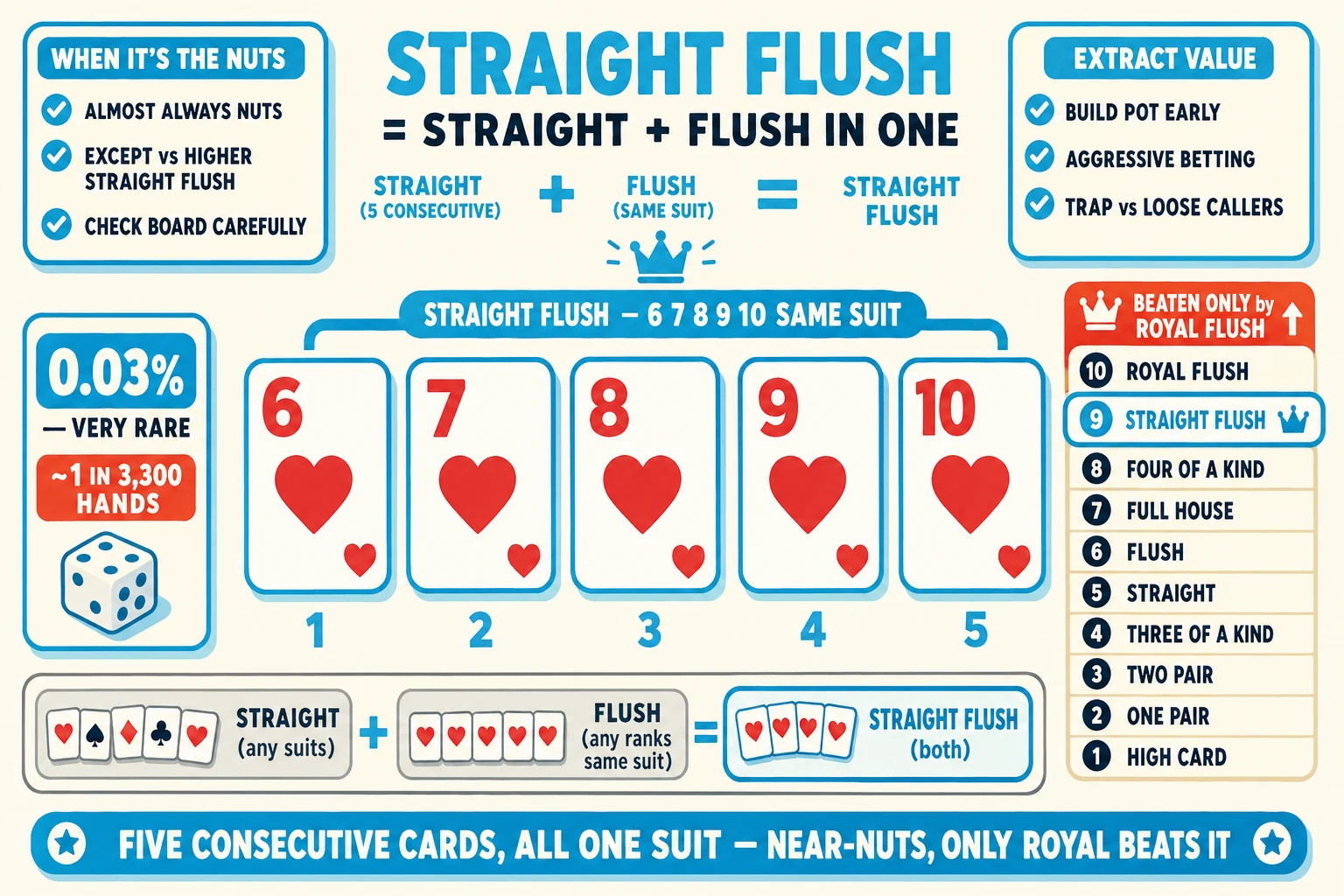
A Straight Flush is five consecutive cards of the same suit. Example: 6♠ 7♠ 8♠ 9♠ T♠. It combines two hand types - a straight (sequence of ranks) and a flush (all one suit).

Practice this in Poker Skill. The Straight Flush & Royal lesson checks the suit and the sequence separately, so a heart flush whose run is missing the six counts only as a flush.
Get the free appStraight Flush (No-Limit Texas Hold’em)
What a Straight Flush Is
A Straight Flush is five consecutive cards of the same suit. Example: 6♠ 7♠ 8♠ 9♠ T♠. It combines two hand types - a straight (sequence of ranks) and a flush (all one suit).
Think of it as a sequence where suit matters. A 4♦ 5♦ 6♦ 7♦ 8♦ is a straight flush just as 9♥ T♥ J♥ Q♥ K♥ is. The only straight flush that ranks above all others is the Royal Flush - 10-J-Q-K-A of the same suit.
For the full order of hands, odds, and tie-break examples, see the poker hand rankings chart.
How It Ranks and When It’s the Nut Hand
A Straight Flush ranks just below a Royal Flush. Between two straight flushes, the one with the higher top card wins. For example, a J-high spade straight flush beats a T-high spade straight flush.
“Nut hand” means the best possible hand given the board and unbeatable at showdown (final hand comparison). A Straight Flush is typically the nut hand. Main exceptions occur when an opponent can hold a higher straight flush or a Royal Flush in the same suit. Always check the board and likely hole-card combinations before assuming you’re unbeatable.
Example: You hold 6♠7♠ and the board shows 8♠9♠T♠. You have a 6-10 spade straight flush using 6♠7♠8♠9♠T♠ - nearly unbeatable. But if the board were 7♠8♠9♠T♠K♠ (five spades on board), someone with J♠ would have a higher straight flush than someone with 6♠.
How Rare Is a Straight Flush
A Straight Flush is extremely rare in No-Limit Hold’em. The chance of being dealt a straight flush is approximately 0.03%. Because it almost never appears, hitting one usually creates a huge swing in a session or tournament. Most pots resolve with much weaker hands, so a Straight Flush is a high-impact event.
Strategic Play in No-Limit Hold’em
No-Limit lets you bet any amount up to your entire stack, which magnifies a Straight Flush’s value.
- Play aggressively to extract maximum value with large bets and all-ins.
- Balance aggression with reads; size down if opponents fold to big bets.
- Consider board texture - how community cards interact, including draws and pairs - before committing to an all-in or stepwise value bet.
A couple of terms that come up below: showdown is the final comparison of hands at the river, and board texture is how the community cards interact (flush or straight draws, paired boards, etc.).
Extracting value and avoiding common pitfalls
Practical steps to get paid when you flop or turn one:
- Build the pot early when possible. Entering with a reasonable raise increases eventual payoff.
- Slow-play only when the board and opponents make them likely to bet, such as against loose callers or many draws.
- Trap when profitable: let opponents commit chips on draws, then raise aggression on later streets.
- Avoid overprotecting the hand. Immediate large bets can fold everyone out; size bets smaller if opponents fold to pressure.
Always check for a higher straight flush possibility on the board and size bets accordingly. Focus on realistic hole-card combinations opponents might hold.
Compare all ten poker hand rankings, best to worst to see where a straight flush sits.
For how a straight flush measures against four of a kind and everything under it, see what beats what in poker.
Quick checklist
- Know the definition: five consecutive cards, same suit.
- Treat it as the nut hand unless a higher straight flush is possible.
- Bet aggressively in No-Limit but tailor lines to opponent tendencies.
- Remember rarity - capitalize on the moment to extract maximum value.