


Give-Up Node
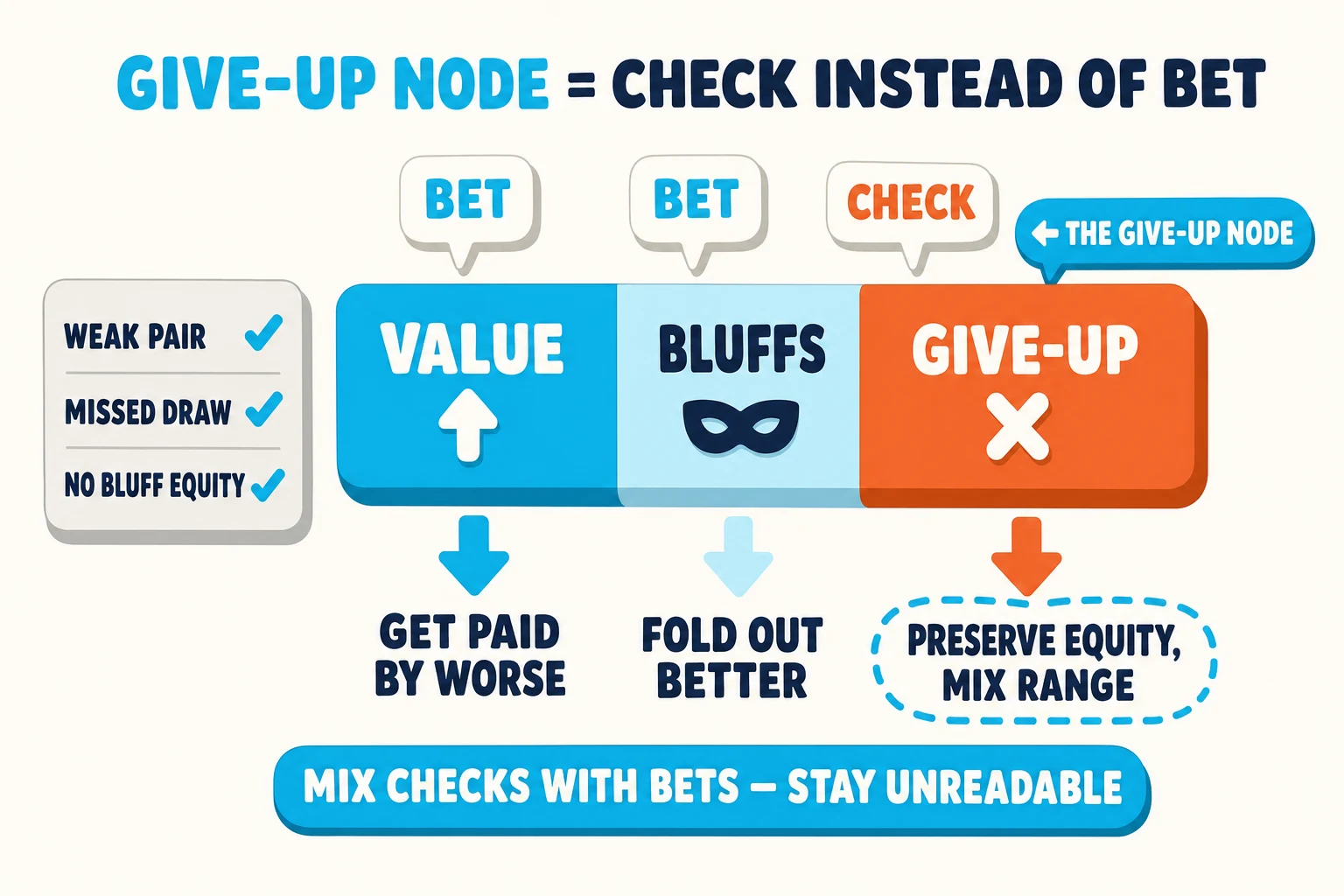
A give-up node is a decision point where you stop aggressive play with part of your range and take a passive action-usually checking or folding-rather than betting or raising. It marks the moment you cede the pot initiative with a specific hand or segment of hands. Your range (the set of hands you could plausibly hold) splits: some hands continue aggressively, others become give-up hands. A give-up node occurs when further aggression with those holdings has non-positive expected value (EV); betting or raising won't improve long-term results for those cards.
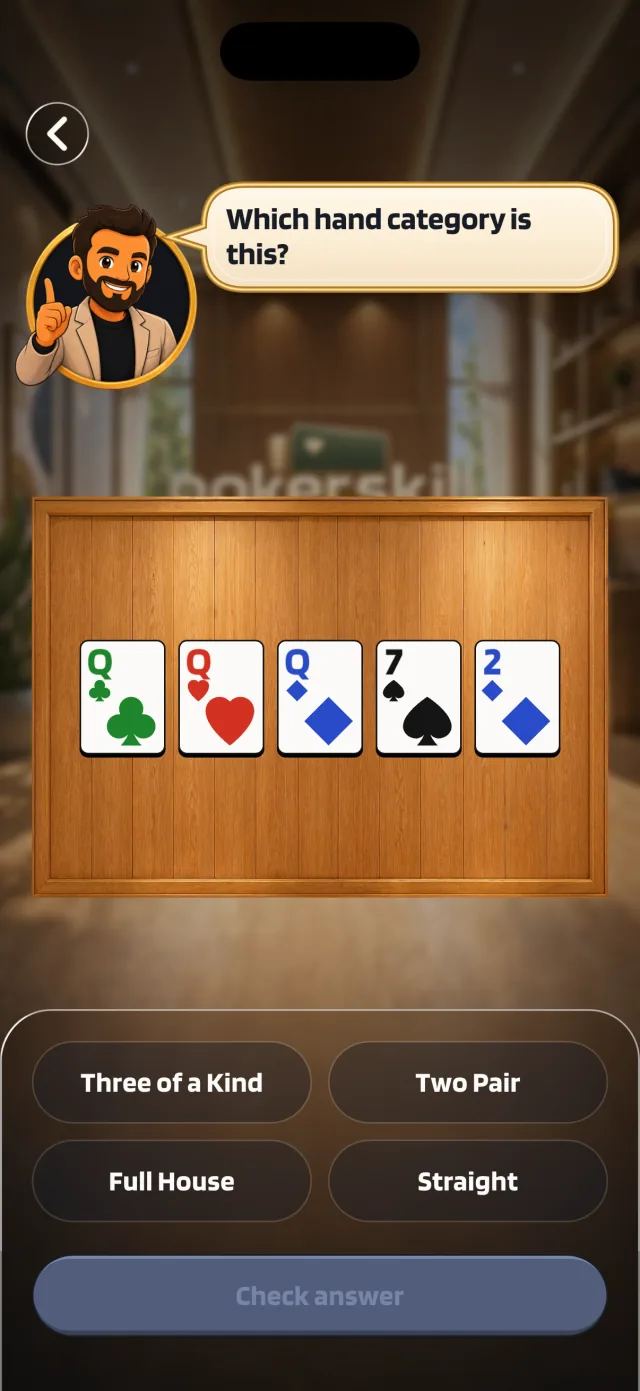
Practice this in Poker Skill. Ace-nine that picked up nothing by the turn checks and gives up in the Give Up on Purpose lesson, while top pair with a ten kicker calls a turn lead, because give-ups are for dead hands.
Get the free appGive-Up Node in No-Limit Texas Hold’em
What a give-up node is
A give-up node is a decision point where you stop aggressive play with part of your range and take a passive action-usually checking or folding-rather than betting or raising. It marks the moment you cede the pot initiative with a specific hand or segment of hands. Your range (the set of hands you could plausibly hold) splits: some hands continue aggressively, others become give-up hands. A give-up node occurs when further aggression with those holdings has non-positive expected value (EV); betting or raising won’t improve long-term results for those cards.
Example: on a dry flop you hold bottom pair with no backdoor draws. Betting won’t fold better hands or get calls from worse hands often enough to be +EV, so you check and classify that holding as a give-up node.
Why give-up nodes matter for GTO play
In game-theory-optimal (GTO) play, give-up nodes preserve balance across your ranges. If you always bet marginal hands or always fold weak hands, opponents adjust and exploit you. Including give-up actions keeps your checking range mixed with strong and weak hands, preventing a single predictable counterstrategy. Give-up nodes also protect information: checking weak hands reduces opponents’ ability to assign a precise holding. That ambiguity helps maintain equilibrium, since some hands must remain passive to avoid predictable over-aggression.
Example: always betting two-pair lets opponents call only when they beat you and fold otherwise. Mixing checks with value hands thwarts that straightforward counterplay.
Checking vs folding: when to use each give-up action
- Explain terms briefly: checking declines to bet while staying in the hand; folding discards your hand and concedes the pot.
- Checking is the primary give-up action when you face no bet or when it preserves equity. Use checking to see another card, realize showdown equity, or keep your range ambiguous. Example: out of position on a K-7-2 rainbow flop, checking bottom pair often beats thin bluffing.
- Folding is the correct give-up only after facing a bet when calling or raising is unprofitable. If a bet makes your continuation EV negative, folding ends the hand for those cards.
- Avoid preemptive folding when checking is free. Folding before a bet when you could check is dominated, since checking preserves your chance to win at showdown.
How to build give-up nodes into your ranges
- Designate a portion of your range to check after aggressive preflop or flop actions. This prevents opponents from isolating pure bluffs or pure value hands.
- Mix weak and medium-strength hands among your checked holdings to force harder defensive decisions. Avoid clustering all weak hands together.
- Identify which checked hands will fold to further aggression and which can become turn bluffs, depending on runouts and opponent tendencies.
- Rebalance after significant strategy changes-if you add more bluffs in one spot, increase give-up frequency elsewhere to preserve balance.
Example: after a small c-bet on the flop, keep weak top pairs and missed draws in your check-back range. Some will fold to a turn bet; others can bluff later.
Common errors and practical table guidance
- Error: folding too often when checking is available. You lose equity and concealment.
- Error: betting every marginal hand. That pattern becomes exploitable.
- Rule of thumb: check to realize equity and keep ranges ambiguous. Fold only when a bet makes calling or raising EV-negative.
Checklist:
- Define which hands on each street are designated give-up hands for your ranges.
- Prefer checking as the default give-up action when no bet faces you.
- Fold only when a bet makes calling or raising EV-negative.
- Mix checked hands across strengths to avoid predictable patterns.
- Reassess give-up allocations after big strategy shifts or when opponents adapt.
Use these principles at the table. When in doubt, check to preserve options. Fold only when the math of the faced bet clearly rules out profitable continuation.