


Pay Ladder
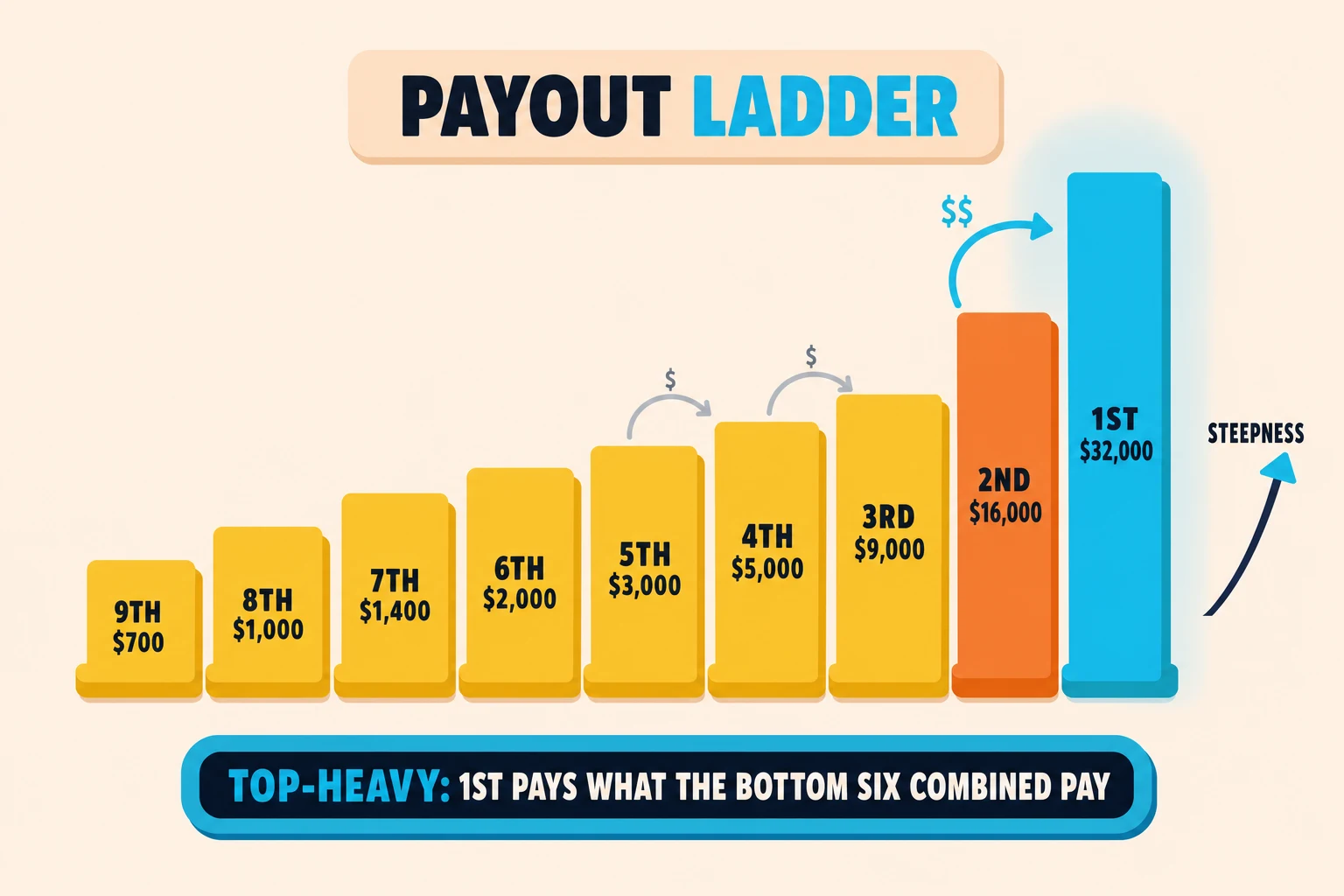
A pay ladder is the full ordered list of dollar prizes a tournament pays out, from the lowest paid finish all the way up to first place. Where a pay jump is one step on that staircase, the pay ladder is the whole staircase: how many rungs there are, how steep each one is, and where the steep ones cluster. Two events with the same buy-in and same field size can have very different ladder shapes (flat satellite seats, broad cash payouts, top-heavy live finals), and that shape, more than any single number on the page, controls how loose or tight correct play actually is.
Pay ladder: the prize structure you climb across a tournament
What a pay ladder is
A pay ladder is the full ordered list of dollar prizes a tournament will pay out, from the lowest paid finish at the bottom up to first place at the top. Most fields publish it on the lobby screen before cards are in the air: 100th pays one number, 99th pays a slightly bigger one, and the list keeps stepping up through the bubble, the early money, the mid-money, the final table, the final three, and finally heads-up. Where a pay jump is one step on that staircase, the pay ladder is the whole staircase. The shape of the staircase (how many rungs there are, how steep each one is, and where the steep ones cluster) is what changes from event to event, even when the buy-in and the field size are identical.
Related terms
A useful pre-game habit: before the first hand, read the published payout structure and write down three things. How many spots get paid. What share of the pool goes to first. Where on the ladder the steepest single jumps sit. Those three answers are most of what you need to know about how the rest of the event will play, because they tell you whether you are climbing a long gentle staircase, a short steep one, or a flat plateau with one cliff at the very top.
Pay ladder versus pay jump and bubble
These three terms are easy to mix up because they all live on the payout sheet. Keeping them straight is how the rest of tournament strategy gets simpler.
| Term | What it names | Units | Where you read it |
|---|---|---|---|
| Pay ladder | The full ordered list of payouts from min-cash to first | dollars by position | The whole payout sheet |
| Pay jump | The dollar gap between two consecutive finish positions | dollars per step | One row of deltas |
| Bubble | The threshold one elimination away from the money | tournament stage | One specific rung, usually the largest jump in the bottom half |
Pay ladder is the structure. Pay jump is the unit: every step on the ladder is a pay jump, and the size of each jump is what makes that rung steep or shallow. The bubble is one specific (and usually large) pay jump on the ladder, plus the stage it defines. A reader looking up “pay jump” wants to know what one gap is and why it matters; a reader looking up “pay ladder” wants the whole shape, because the shape is what tells them which rungs to fight for and which to fold around.
Four ladder shapes you actually meet
Most tournaments fit into one of four ladder shapes. The shape is set before the tournament starts and does not change while you play, but how you play absolutely should change between them.
| Shape | First-place share | Where the steep rungs sit | Right strategic posture |
|---|---|---|---|
| Flat-paid MTT | ~25% | Spread across many small steps | Closer to chip-EV; fewer ICM-driven folds |
| Top-heavy MTT | ~30% | Money bubble + final-table bubble + 2nd to 1st | Standard ICM play near jumps; chip-EV elsewhere |
| Super-top-heavy live event | 30%+, often 40%+ | Final-table bubble + every late rung | Heavy ICM weight late; survival earns real dollars |
| Satellite (seat-flat) | One prize, all qualifiers equal | One huge step at the seat bubble | Survive only; chip accumulation past the lock is wasted |
A flat-paid MTT spreads the pool across many paid spots and steps up the dollars in small increments. Once you reach the money the next dozen rungs each add only a little, so ICM pressure stays moderate through the middle and most of the strategic action lives near the bubble and the very top. A top-heavy MTT, the standard online and mid-stakes live shape, concentrates roughly 30% of the pool at first and most of the rest in the top few finishes, so the steep rungs cluster at the money bubble, the final-table bubble, and the 2nd-to-1st jump. A super-top-heavy live event pushes that further still, with the largest single jumps clustered at and after the final-table bubble. A satellite collapses the entire ladder to one rung: every qualifying seat is worth the same dollars, so the only “jump” that matters is the one from “out” to “in the seats.”
The point of naming the shape is not to memorize four templates. It is to read the payout sheet for what kind of staircase you are actually climbing before you take any action that is sensitive to it.
Why ladder shape matters at the table
Ladder shape decides how loud ICM pressure gets, when it gets loud, and which stack bands feel it most.
Shape matters more when:
- The next steep rung is close, your stack can be eliminated in the hand, and the rest of the ladder still has room above. This is the classic bubble factor setup.
- The shape is severely top-heavy. The 2nd-to-1st jump on a super-top-heavy live final is often the biggest single rung in the whole event, which means heads-up plays nothing like cash even when the chip math looks similar.
- The structure is satellite-flat. Survival is the only goal once you have enough chips to lock; a chip-EV-positive spot can be a hard fold because the ladder collapses to one rung.
- A short stack at the table is about to blind out. Medium stacks can fold past them and ladder for free; that ladder is only valuable if the next rung is steep.
Shape matters less when:
- It is the first orbit of the day and hundreds of players are still to bust. The ladder is real but distant; chip accumulation dominates.
- You are deep in the middle of a flat ladder. Ten consecutive small jumps add up, but no single hand turns on them.
- You are heads-up after the runner-up money is locked. The remaining decision is one big pay jump (2nd to 1st), and on a flat-paid event that single jump can be small enough that the play moves back toward chip-EV.
- The format is winner-takes-all. There is no ladder, only one rung. ICM mostly disappears.
A second lever worth holding in your head: the bigger the next steep rung is relative to the chips you would risk, the louder the pressure. A $4,000 jump is dominant in a $200 buy-in; the same $4,000 jump is a rounding error in a $25,000 main event. The dollars matter less than where they sit on your local ladder of choices.
Example: same 12 BB shove, two ladder shapes
You are 12 big blinds on the button with A♣ Q♦, late stage of a small-stakes event. Action folds to you. The cutoff covers you with 30 BB. Pure chip-EV says shove almost always: A♣ Q♦ has plenty of fold equity from late position, and when called you have decent equity against most continuing ranges.
Same hand, same stack, same opponent, two different ladder shapes.
Shape A: a flat-paid daily MTT. The structure pays the top 18% of the field; first gets 22% of the pool and the rest steps down in small increments. You are 14 from the money. The next steep rung is the bubble itself, and the bubble jump is a modest 1.6 buy-ins; after that, every rung in the money pays only a little more than the one below. The cutoff is going to call your 12 BB jam with the same band of hands they would call in a chip-EV environment, because their own ladder pressure is mild. Your A♣ Q♦ shove reads cleanly through to dollars: profitable, comfortable, the kind of late-stage shove this format is built for.
Shape B: a super-top-heavy live final-table satellite. Same effective stack, same cards, same cutoff. But the structure pays nine seats of equal value to a $10,000 main event, and you are at the seat bubble with ten players left. The next “jump” is the only jump, the seat, and it dwarfs every chip you could win in this hand. The cutoff is reading the same ladder you are. Their calling range collapses to a tight band that mostly beats A♣ Q♦; your fold equity goes up sharply, but the times you get called you are usually crushed against AQ-plus and pocket pairs. The chip-EV math has not changed at all. The dollar math has flipped: what was a routine shove in Shape A becomes either a tighter shove against fold-prone opponents or a fold against a tight covering stack who also wants the seat.
Two takeaways. First, the same hand can be a clear shove on one ladder shape and a marginal-or-fold shove on another, purely because the shape is different. Second, the right reading skill is not “compute exact bubble factor at the table” but “look at the ladder shape on the lobby screen before the first hand.” That single read tells you most of what you need about how every late-stage decision will play.
Common pay-ladder mistakes
1) Not reading the structure before the first hand
The single biggest amateur leak. A player buys into an event without checking how flat or top-heavy the ladder is, then plays the same default tournament style they always play. They tighten on the bubble in a flat-paid event where the bubble is small and the ICM hit is mild; they accumulate aggressively at the final table of a super-top-heavy live event where survival is paying more than chips. The fix takes one minute on the lobby screen. Read three numbers: paid spots, first-place share, biggest single jump. Then you know which kind of staircase you are climbing.
2) Treating every ladder as top-heavy
Most online tournaments are top-heavy, and most regulars build their tournament intuition off online play. That intuition gets misapplied to flat-paid live structures (where laddering inside the money pays very little) and to satellites (where laddering inside the money pays the same, and the only rung that matters is the seat lock). Treating a satellite like a top-heavy MTT is one of the most expensive mistakes available because chip accumulation past the seat lock is wasted dollars.
3) Ignoring the late-stage steepening
On most ladders the rungs get steeper later: the final-table bubble and the 2nd-to-1st jump are usually steeper than anything in the early money. Players who fold tight through the bubble often relax the moment the bubble bursts, then run into the next steep rung at the final table without re-tightening. The right read is that ICM pressure rises into every steep rung, falls afterward, and rises again into the next one. Folding into the money and then maniacing into 9th place is the same mistake repeated.
4) Confusing the money bubble with the final-table bubble
These are not the same rung. The money bubble is “cashing at all,” usually a moderate jump on top-heavy ladders and a sharp one on flat-paid events. The final-table bubble is “making the televised stage,” often the largest single rung on top-heavy ladders. A short stack on the money bubble has a different right play than a short stack on the final-table bubble, because the rung above looks different in dollars and because the field above plays differently. Calling them both “the bubble” without qualifying which one tends to flatten that distinction in your head.
FAQ
How is a pay ladder different from a pay jump?
The pay ladder is the structure: the full ordered list of payouts from min-cash up to first. The pay jump is the unit: the dollar gap between two consecutive rungs. A ladder is made of pay jumps, the way a staircase is made of steps. When you say “this ladder is top-heavy,” you mean the steps near the top are much taller than the steps lower down. When you say “the next pay jump is steep,” you mean one specific step on that ladder. The ladder is what you read pre-game to set your strategy; the jump is what you read mid-hand to price one specific decision.
Where do I find the pay ladder for a given tournament?
The lobby screen of any online site posts it before registration closes, usually as a “Payouts” tab on the tournament listing. Live events publish the structure on the venue’s website and again on the printed tournament sheet handed out at registration; both list every paid finish in dollars, plus the field size that triggered the listed payouts. Read it once before you play, and read it again at the dinner break: final field size shifts the absolute dollars but not the ladder shape, and only the shape changes how you should play.
Does a pay ladder exist in cash games?
No. Cash games convert chips to dollars one for one, so there is no ordered list of finish-position prizes and no ladder to climb. The closest cash-game analogue is the cost of busting your buy-in and having to rebuy, which is a much smaller effect than what a tournament ladder produces. The ladder is the whole reason tournament strategy diverges from cash strategy in the first place — when there is no ladder, the chip-EV baseline takes over and most of the ICM-driven advice in this entry stops applying.
Poker Skill runs no tournaments, so its lessons all sit on that chip-EV baseline: cash-game hands with no ladder behind them.