


ICM Pressure
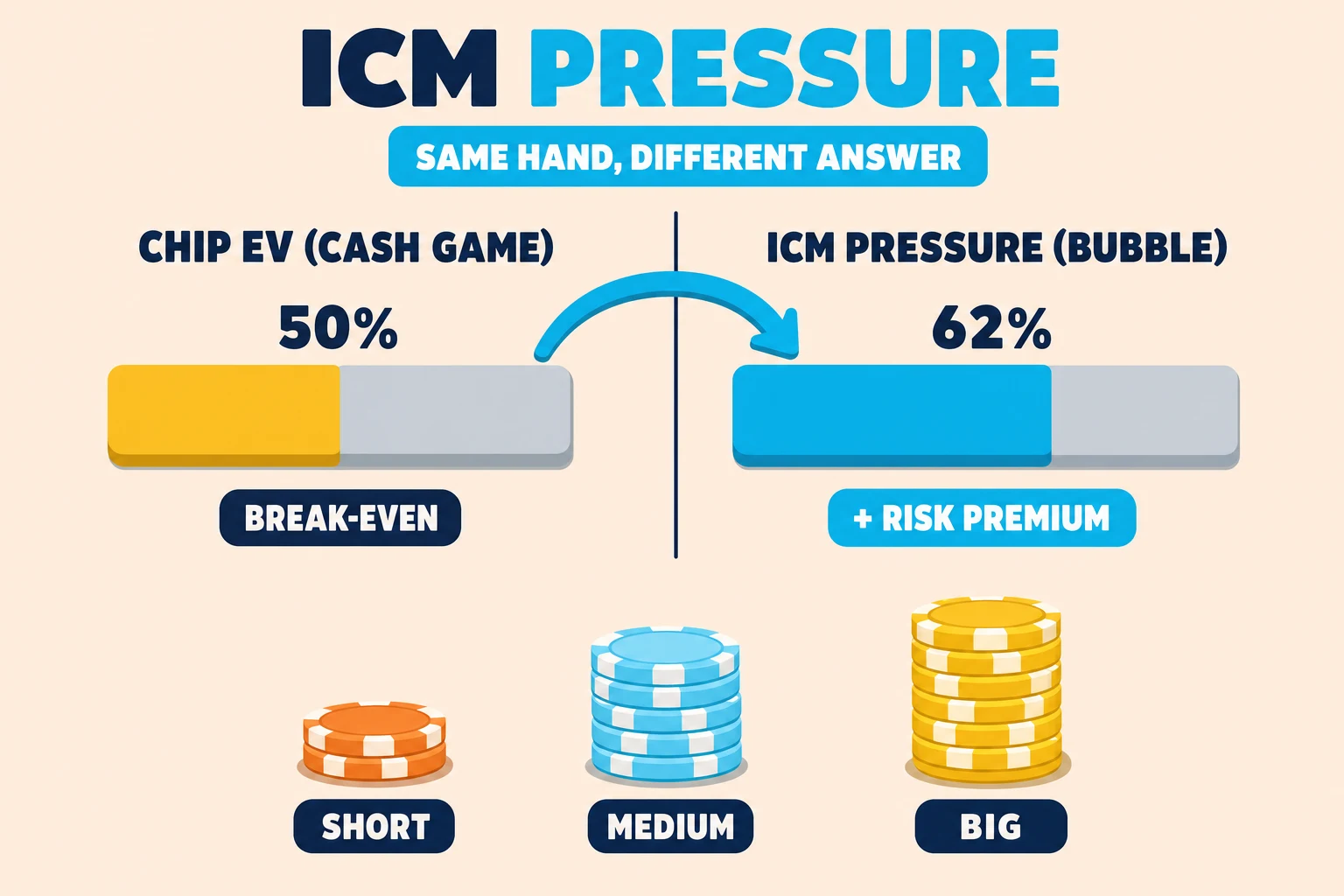
ICM pressure is the felt decision environment in tournaments where chip math and dollar math diverge. Medium stacks avoid busting, big stacks can apply pressure with steals and three-bets, short stacks face raised call-off bars — same hand, very different right answer than a cash game.
ICM pressure: how the dollar ladder changes the felt decision
What ICM pressure means (quick definition)
ICM pressure is the felt decision environment that tournament payouts create at the table. Because each chip you have is worth less in dollars than each chip you risk, the right play in chip terms and the right play in dollar terms come apart. You feel it as folds you would never make in a cash game, jams you can suddenly run with any two cards as the chip leader, and call-offs that need extra equity before they break even. ICM is the model behind that feel; ICM pressure is the experience.
Related terms
A useful mental shortcut: in a cash game every chip is dollars, so the right play is whatever wins the most chips on average. In a tournament near a payout jump, that stops being true. The chips you can win are worth less per unit than the chips you can lose, so a hand that wins chips on average can still lose dollars on average. ICM pressure is the live awareness of that gap while you act.
ICM pressure versus ICM, bubble factor, and pay jump
These four travel together but mean different things. Keeping them straight is how tournament strategy gets simpler.
| Term | What it names | Units | Where it lives |
|---|---|---|---|
| ICM | The model that turns stacks into expected dollars | finish-position probabilities | the math behind the screen |
| ICM pressure | The felt decision environment the model creates | seats and ranges | the table while you act |
| Bubble factor | The multiplier that quantifies ICM pressure on one decision | unitless multiplier | a calculator output |
| Pay jump | The dollar gap between two consecutive finishes | dollars | the payout sheet |
ICM is the framework. ICM pressure is what you actually feel: medium stacks reluctant to play big pots, a chip leader free to attack, a short stack who can jam wide but should call narrow. Bubble factor is the number that quantifies how strong that pressure is in a given matchup. Pay jumps are the dollars at risk on the ladder that drive the multiplier higher or lower. A reader looking up “icm pressure” usually wants the felt environment, not the formula; the formula lives in the bubble-factor entry, the dollars in the pay-jump entry, and the model itself in the ICM entry.
When ICM pressure matters most
ICM pressure is strongest when three things line up: a meaningful payout jump is close, your stack can actually be eliminated in the hand, and the remaining payouts care about who finishes ahead.
It matters most:
- Approaching the money in a tournament that pays the top 10 to 15 percent of the field. The first jump from “no money” to min-cash is usually the largest single jump in the bottom half of the ladder.
- At the final-table bubble and through the next two or three pay rungs. The dollars between finish positions get steep fast.
- In flat-payout satellites where every surviving seat is worth the same fixed prize. The “jump” from one-out to in-the-seats is the only one that matters and it is enormous relative to a marginal call.
- Medium stacks with a short stack about to blind out. The medium stack can fold its way past the short stack and lock in a higher payout without playing a hand.
It matters less:
- Very early in a tournament, hundreds of players from the first paid spot. Chip accumulation dominates and survival is mostly background.
- In the middle of the money, where ten or twelve consecutive payouts each step up by a small amount. The deltas add up across orbits, but no single hand turns on them.
- Heads-up at the very end. Both players have locked in the second-place payout, and there is no further ladder to climb.
- Winner-takes-all formats. Without intermediate pay jumps, ICM pressure collapses and chip-EV play takes over again.
The other big lever is stack distribution, not just the moment in the tournament. Pressure is asymmetric between two roughly equal medium stacks (high), between a short stack and a big stack (highest on the short stack, lowest on the big stack), and between two short stacks of similar size (much lower than amateur intuition suggests). Reading the stacks before pulling the trigger is the actual skill.
Example: a medium stack on the bubble
You have 28 big blinds on the money bubble of a tournament that pays the top 10 percent. Five players are still to bust before everyone cashes. The chip leader at your table covers you with 70 bb and opens the cutoff to 2.2 bb. You look down at A♣ Q♠ on the button.
Pure chip-EV reading:
- A♣ Q♠ is a comfortable three-bet against a wide cutoff opening range. Folding is fine; calling is fine; three-betting to about 6 bb is the chip-EV-best play in many ranges.
- If you three-bet and the cutoff jams for an effective stack of 28 bb, you have roughly 38 to 42 percent equity against the cutoff’s continuing range. Pot odds at the call would say you need around 35 percent. So a chip-EV stack-off looks fine.
Poker Skill’s Button vs CO Open lesson teaches that chip-only answer at 100 big blinds, where suited ace-queen 3-bets a cutoff open from the button instead of calling.
ICM pressure changes the picture without changing the hand:
- The bubble is one of the steepest jumps on the ladder, and the cutoff covers you. Bubble factor for a medium stack against a covering big stack on the money bubble often sits in the 1.5 to 2.0 range, sometimes higher.
- That means the equity you need to call a jam shifts up. Where chip-EV asks for about 35 percent, dollar-EV often asks for closer to 55 to 65 percent against the same range.
- A 38 to 42 percent hand sits comfortably below that bar. Calling is now a clear ICM mistake even though it is a chip-EV winner.
Two takeaways. First, three-betting and calling a jam are not the same decision once ICM pressure is on. A three-bet that gets folds is great; a three-bet that gets jammed and turns into a call-off needs the dollar-EV math, not the chip-EV math. Tightening the three-bet range to hands that can call a jam is the safer adjustment than betting on fold equity that may not be there. Second, the same A♣ Q♠ would be a happy three-bet-and-call 200 from the money. The shape of the equity has not changed; the price of busting has.
Common mistakes
1) Calling chip-EV-light when ICM says fold
The single biggest ICM-pressure leak. A spot looks profitable in chips, the math is “a call by a few percent,” and the player snaps it off. On the bubble or near a steep pay jump, the same call can be clearly minus in dollars. Run the dollar question first: would I still want this call if I needed sixty percent equity instead of fifty? If the honest answer is no, fold. Folding hands that are barely chip-EV winners is one of the highest-EV moves available to a medium stack on the bubble.
2) Treating bubble pressure as one fixed level
There is no single “bubble setting.” ICM pressure rises and falls with stack distribution at the table and with how steep the next jump is. A 1.4 multiplier is plausible for two big stacks who cover the room; a 2.5 multiplier is plausible for a medium stack about to call off into a covering chip leader. Players who memorize one tightness band and apply it everywhere either fold hands they should be playing early in the money or call hands they should be folding once the chip leader sits down. The right read is per matchup, not per stage.
3) Failing to apply pressure as the big stack
The mirror image of the calling leak. As the chip leader you can lose less per chip than anyone you cover, which means your fold-equity steals and three-bets are paid for by their bigger downside. Many players sit on a chip lead and play it like a medium stack. The book advice is unambiguous: steal blinds wider, three-bet players who fold too often, and in big-cover-vs-covered matchups the pressure is closer to maniac play than to “tighten up.” Not bullying when the table is begging you to is the most common silent leak in the chip leader’s seat.
4) Staying tight after the bubble bursts
The minute the last bubble player busts, the multiplier drops sharply for everyone except those approaching the next steep jump. Players who folded their way through the bubble often keep folding while the rest of the table widens up, missing a clean window where chip-EV play comes back into its own. The right move after the bubble bursts is to widen immediately, especially against opponents who have not. The same pattern repeats at every later pay jump: ICM pressure rises into the jump, falls afterward, then rises again into the next one.
FAQ
Is ICM pressure the same as bubble factor?
They are tightly linked but not the same. Bubble factor is the number — a unitless multiplier on the equity you need to break even on a single decision. ICM pressure is the broader felt environment that the model creates at the table: who can attack, who has to fold, who has to widen their jamming range and tighten their calling range. A reader looking for the formula wants the bubble factor entry; a reader trying to play the table well wants this one.
How do I feel ICM pressure without a calculator?
Three live questions get you most of the way. First, how steep is the next pay jump on the sheet, in big blinds, not dollars. Second, can my stack actually be eliminated in this hand against the player who has the action. Third, how does the table look once the next short stack busts — am I the one who ladders past, or am I the short stack everyone else folds around. The first question sets how loud the pressure is; the second decides whether it applies to this hand at all; the third tells you whether you are the bully, the medium stack waiting it out, or the short stack who needs to find a jam.
Does ICM pressure exist in cash games?
No. Cash chips convert to dollars one for one, so there is no diminishing chip value, no payout ladder, and no busting mechanic that ends your participation. The only cash-game analogue is the cost of going broke and having to reload, which is a much smaller effect than what tournaments produce. The contrast is one of the reasons the chip-EV baselines of Nash push/fold charts have to be adjusted before they become useful in any spot where a real pay jump is approaching.