


Pay Jump
A pay jump is the dollar difference between two consecutive finish positions in a tournament payout. Some jumps are tiny (a few extra buy-ins between 81st and 80th), and some are huge, like the leap from runner-up to winner. The size of the next pay jump is what makes ICM pressure real, because risking a stack matters more when the next bust costs you a steep ladder rung than when it costs you a few buy-ins.
Pay jump: the dollars between consecutive finish positions in a tournament
What a pay jump is
A pay jump is the dollar difference between two consecutive finishing positions in a tournament’s payout structure. Move from 5th to 4th and you collect the gap between those two payouts; that gap is one pay jump. The bubble is the most famous pay jump on most ladders — the leap from “no money” to “min-cash” — but every step up the prize list is its own pay jump, and the sizes are uneven. A typical multi-table tournament has tiny intra-money jumps near the min-cash and steep jumps between the final-table positions, especially the last three rungs.
Related terms
A useful way to read the prize list before a session: do not look at the dollar amounts, look at the deltas between adjacent positions. That second list is the actual map of where ICM pressure lives, because the deltas are the dollars at risk on every all-in.
Pay jumps, the bubble, and bubble factor
These three terms travel together but mean different things. Keep them straight and the rest of tournament strategy gets simpler.
| Term | What it names | Units | When it applies |
|---|---|---|---|
| Pay jump | The dollar gap between two consecutive payouts | dollars | Every step on the payout ladder |
| Bubble | The threshold one elimination away from the money | tournament stage | Pre-money, plus secondary “bubbles” at major thresholds |
| Bubble factor | The equity multiplier that turns chip-EV into dollar-EV | unitless multiplier | Any spot where bust risk and pay-ladder progress matter |
Pay jump is the unit. Bubble is one specific (and usually large) pay jump on the ladder. Bubble factor is the multiplier that converts the chip math into dollar math, and the size of that multiplier is largely set by the size of the next pay jump. Bigger upcoming jump means the multiplier rises; smaller upcoming jump means it falls back toward 1.0. That is why a bubble factor can swing from near 1.0 deep in a tournament back up to 1.5 or 2.0 again right before the final-table jump.
When pay jumps matter most
Pay jumps matter when three things line up: the next jump is steep relative to the chip cost of an at-risk decision, your stack can actually be eliminated in the hand, and the payout structure cares about who finishes ahead.
Pay jumps matter most:
- Approaching the money in tournaments that pay 10–15% of the field. The first jump (the bubble) is usually 1.5 to 2 buy-ins. That is a steep jump from zero.
- At the final-table bubble. Going from 10th to 9th can be the second-largest jump on the ladder after first place; the next few jumps after that are smaller, then the gap widens again toward the top.
- Near the final three and heads-up. The biggest single jump on most top-heavy ladders is from second place to first. The closer you get, the more weight a single all-in carries.
- In satellite tournaments, especially flat-payout satellites where every surviving seat is worth the same fixed prize. The “jump” from one-out to in-the-seats is the only jump that matters, and it is enormous relative to the chip cost of a marginal call.
- In medium-stack vs short-stack matchups where one player is one orbit away from being blinded out. The folder can ladder past the about-to-bust without playing a hand.
Pay jumps matter less:
- Very early in a tournament, hundreds of players from the first paid spot. Chip accumulation dominates; ICM is mostly background.
- In the middle of the money, where 10 or 12 consecutive payouts increase by tiny increments. The jumps add up over many spots, but no single hand turns on them.
- In winner-takes-all formats. There is exactly one payout, no ladder, no jumps, so chip-EV play takes over.
- Heads-up at the very end. The last two players have already locked in the second-place payout; the remaining decision is one big pay jump (second to first), which is closer to a cash-game framing because there is no further ladder past it.
The size of the next pay jump matters more than the absolute dollar value. A $4,000 jump in a $5,000-buy-in event is small; a $4,000 jump in a $200-buy-in event is dominant.
Example: same shove, two different pay jumps
You are 12 big blinds on the button with A♣Q♦. Action folds to you. Pure chip-EV says shove almost always — A♣Q♦ has plenty of fold equity from late position, and when called you have decent equity against most continuing ranges.
Now anchor the same shove at two different points on the ladder of the same tournament.
Spot A: in the money, 30 players left, $1,100 → $1,200 between the next two paid finishes. The next pay jump is small. Your dollar penalty for busting now is roughly the gap between your current ICM equity and the next paid step — call it a hundred dollars and change. The chip-EV gain from picking up the blinds-and-antes plus the times the cutoff folds is real and worth more than that small jump. Shoving is comfortably profitable in dollars, and the chip-EV math reads cleanly through to $EV.
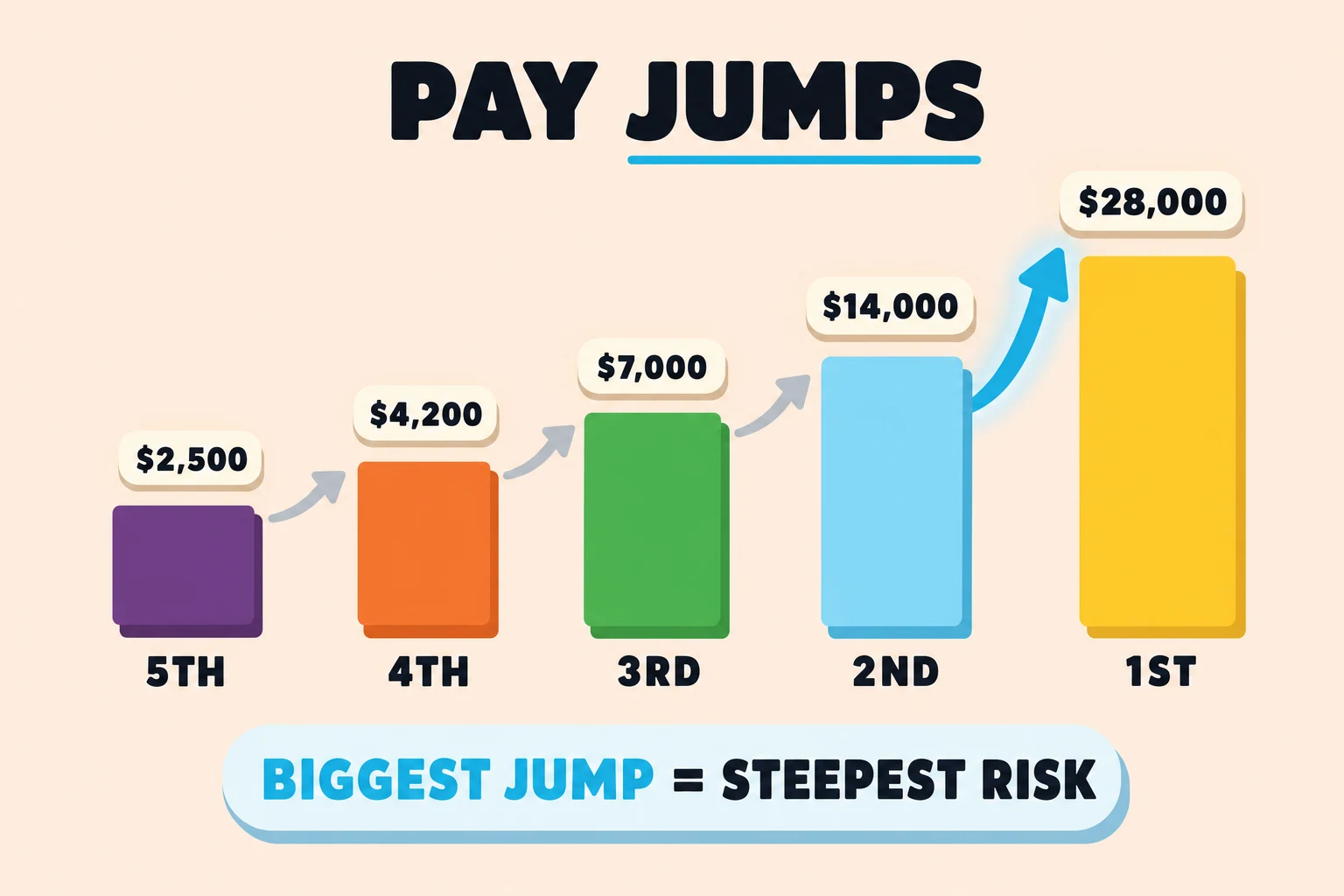
Spot B: nine-handed final table, 4 left, $14,000 → $28,000 between 2nd and 1st with $4,200 between 4th and 3rd. Same hand, same shove, same opponent. The next immediate pay jump (4th to 3rd) is moderate, but the upcoming one (2nd to 1st) is the steepest single jump on the ladder. The effective stack you are putting at risk is now buying you a lottery ticket on a ladder where each surviving spot is worth a full pay jump or more in expected dollars. Even though the chip-EV math has not changed at all, the dollar math has shifted hard toward fold-or-tighten-the-shove-range. A short-stack call with A♣Q♦ might require an extra 15 to 20 percentage points of equity to break even in dollars compared to Spot A.
Two takeaways. First, the same hand can be a clear shove in one part of a tournament and a marginal-or-fold shove in another, purely because the next pay jump moved. Second, the right reading skill is not “compute exact bubble factor at the table”; it is “look at the next two or three deltas on the payout sheet before pulling the trigger.”
Pay jumps never enter Poker Skill’s lessons, since it runs no tournaments: each hand there is a cash-game decision, where a chip won is worth exactly as much as a chip lost.
Common pay-jump mistakes
1) Treating every pay jump as the same size
The most common amateur leak is playing the entire post-bubble period with one fixed level of risk aversion. Most ladders have a few small jumps (the early in-the-money positions), a steep jump at the final-table bubble, a few moderate jumps inside the final table, and a very steep jump from second to first. Treating those as one band means folding hands you should be shoving early in the money, then shoving hands you should be folding at the final-table bubble.
2) Laddering for the small jump and ignoring the big one
A short stack folds into the money for one extra paid step, then immediately busts in the next hand because the post-cash mindset shifts to “now I gamble.” That trades a ~$50 jump for the right to lose a steep $4,000 jump. Lader hard for the steep jumps, not for the rounding error.
3) Misreading big-stack callers
Shoving into a big stack near a steep pay jump is closer to shoving into a player who cannot bust than into a normal opponent. The big stack can call with the worst hand on the ladder and survive; their calling threshold is anchored to chip-EV, not to ICM, because the next pay jump barely affects them. The mistake is using the same shove range against a big stack that you would use against a same-sized stack who fears the bubble too.
4) Forgetting that pay jumps shrink for the big stack
A steep upcoming jump punishes short stacks who can bust into it, but it barely punishes the big stack who cannot. The big stack should be widening calling and shoving ranges into medium stacks, not tightening them. Many otherwise solid players run a one-size-fits-all “tighten near the jump” rule that costs the chip leader real expected dollars by handing over steals that should have been called or three-bet.
FAQ
How is a pay jump different from the bubble?
The bubble is one specific pay jump — the leap from “no money” to “min-cash” — and one specific stage of the tournament. Pay jumps exist at every payout step, including small ones inside the money and very large ones at the top of the ladder. The bubble is usually the largest pay jump in the bottom half of the ladder; the largest jump in the whole tournament is typically second to first. So the bubble is a special case of a pay jump, not a synonym for the broader concept.
How do I read pay-jump sizes during a session?
Look at the payout sheet between hands and write down the deltas: 5th → 4th = $X, 4th → 3rd = $Y, 3rd → 2nd = $Z, 2nd → 1st = $W. Those deltas are what move correct play. The dollar amounts of the payouts themselves matter less than the gaps between them. A second number worth tracking is your current finish-position cushion, meaning how many bustouts away from each delta you are. The combination of “how big is the next jump” and “how close am I to it” is the live read on whether to tighten.
Do pay jumps exist in winner-takes-all formats?
No, in any meaningful sense. Winner-takes-all has exactly one payout, so there is no ladder and no deltas between consecutive positions. Strategy in winner-takes-all reverts to chip-EV play because every extra chip is exactly the same dollars-per-chip up until the moment one player has them all. Pay jumps reappear the instant the structure adds even a second paid spot. Most online satellites are winner-takes-all-by-seat, which is why they read so differently from full-payout multi-table events; for a sense of how much that changes the math, compare to Nash push/fold ranges, which assume a top-heavy structure under the hood.