


Bubble Factor
Bubble factor is a multiplier on how much equity you need to break even on a tournament call. Chip-EV says 50% is enough; bubble factor says you might need 60% or 70% because busting now costs more than doubling up wins.
Bubble factor: how ICM pressure becomes a number
What bubble factor means (quick definition)
Bubble factor is a multiplier on the equity you need to break even on an all-in call in a tournament. In a cash game you need 50% equity to break even on a coin-flip call for your stack. In a tournament near a payout jump, you might actually need 60%, or 70%, because busting costs you more than doubling up gains. Bubble factor is the number that captures that gap.
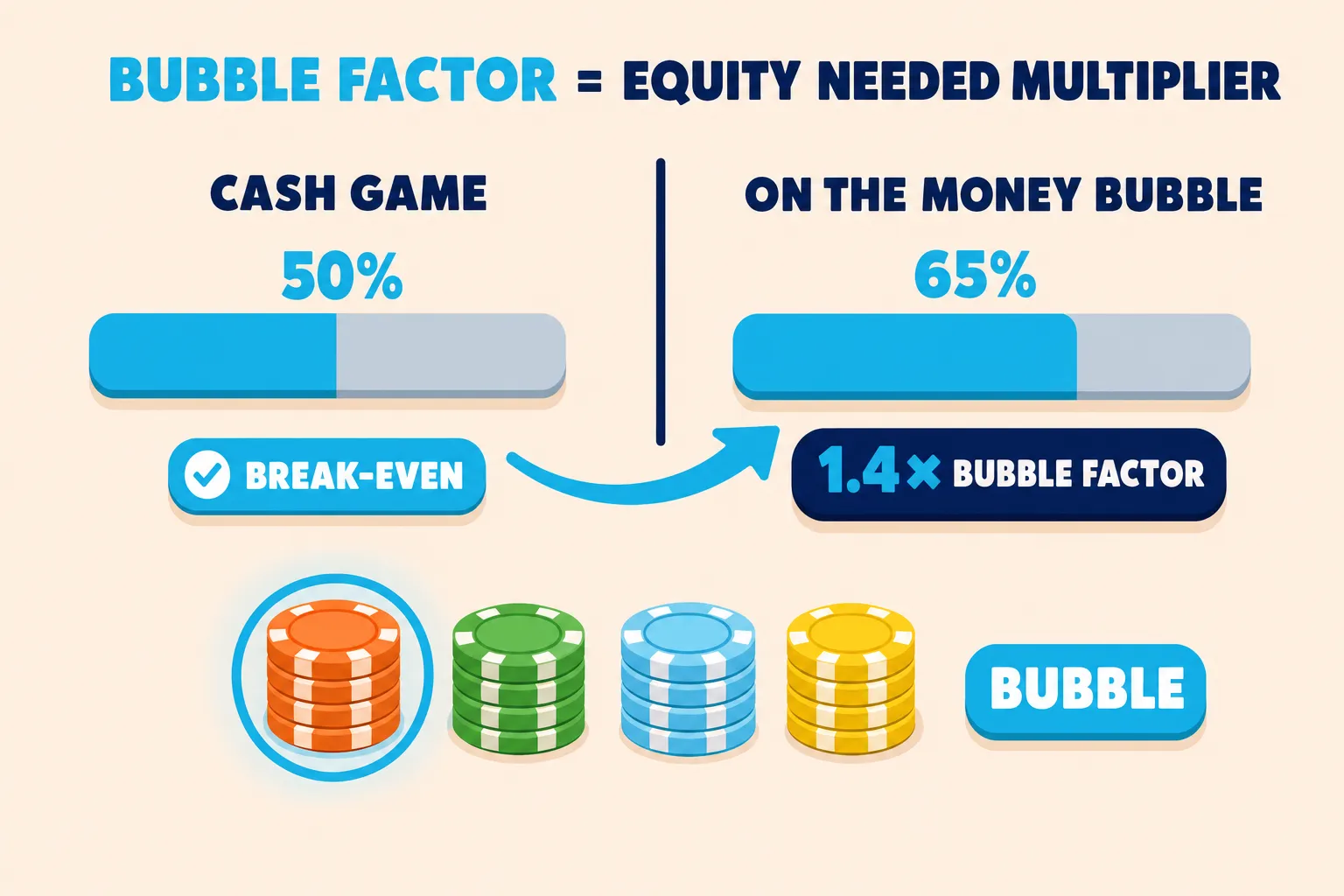
A bubble factor of 1.0 means tournament chips behave like cash — you need the same equity you would need at a regular game. A bubble factor of 2.0 means the price of being wrong has roughly doubled, so the equity you need to call has shifted up sharply. The number rises and falls across a tournament: very low at the start, peaking on the money bubble, dropping after the bubble bursts, then rising again at the next big pay jump.
A useful mental shortcut:
- Low bubble factor (close to 1.0) → play close to chip-EV, take normal spots.
- High bubble factor (2.0 or more) → tighten up; close calls now lose money even when chip math says they win.
- Heads-up at the very end → bubble factor goes back to 1.0, since there is nobody left to ladder past.
Related terms
Bubble factor versus chip-EV
Chip-EV (cEV) treats every chip as worth the same money. Real-money EV ($EV) does not, because tournament chips do not convert one-for-one to cash. Bubble factor is the bridge between those two worlds.
| Metric | What it measures | When you use it |
|---|---|---|
| Chip-EV (cEV) | Average chips gained per decision | Cash games; deep-stack early MTT |
| Bubble factor | Equity multiplier from cEV to $EV | Money bubble, final-table bubble, satellite bubble |
| $EV | Average dollars gained per decision | Any spot where bust risk and pay jumps matter |
A spot can be clearly chip-EV positive and clearly $EV negative at the same time. That is not a contradiction; that is the whole reason bubble factor exists. The most common version is calling an all-in with a hand that wins more chips on average but costs you more dollars on average, because the times you bust eat the times you double up.
When bubble factor matters most
Bubble factor matters most when three things line up: a payout jump is close, your stack can actually be busted in the hand, and the pay structure cares about who finishes ahead.
Higher bubble factor:
- Approaching the money in a tournament that pays the top 10–15% — most multi-table fields.
- Sitting on or just inside a final-table bubble. The next jump is bigger than the chips you would risk.
- Satellite tournaments, especially flat-payout satellites where every surviving seat is worth the same fixed prize.
- Medium stacks at a table with one short stack about to blind out. You can fold your way past them.
Lower bubble factor:
- Very early in a tournament, hundreds of players from the money.
- Heads-up for first place. There is no ladder left to climb.
- Winner-takes-all formats. Without intermediate pay jumps, bubble factor collapses to 1.0.
- Cash games. Bubble factor does not exist there at all; chips are dollars.
Bubble factor also depends on the stack matchup, not just the moment in the tournament. A short stack jamming into another short stack faces a smaller multiplier than that same short stack jamming into a big stack — the big stack stands to gain less per chip and can therefore call more loosely. Two roughly equal medium stacks running into each other on the bubble can face the highest factor of all, because each is risking the most relative finish position. The ICM table on Poker Skill’s push/fold charts turns that pattern into ranges: on the money bubble, calling ranges tighten hard, medium stacks are the most constrained and the chip leader can shove wider.
Example: a 12 bb stack on the bubble
You have 12 big blinds on the money bubble of a tournament that pays the top 100. Two players are still to bust before everyone cashes. You open-jam the cutoff with A♣ Q♦ and the big blind tank-calls all-in for an effective stack of 12 bb with 7♠ 7♣.
The math by chip-EV alone:
- Your hand has roughly 44–46% equity against pocket sevens preflop.
- The big blind calls 11 bb to win 13.5 bb, so pot odds ask for about 45% equity to break even.
- By chips alone the call is easy, and for you the called jam is roughly a coin-flip you are losing slightly.
The math through a bubble-factor lens:
- On a money bubble, bubble factor for a short stack against another short stack often sits in the 1.5 to 2.0 range.
- At 2.0, the big blind would need about 62% equity to make the call profitable in real-money terms, not 45%.
- Sevens, at about 55%, fall short of that bar; the call costs the big blind dollars even though it wins chips on average.
Two takeaways from this single hand:
- Your shove looks much better than you might think. The big blind’s call is a bubble-factor mistake, which means it is also a gift to every surviving player who stayed out of the hand.
- The same hand played 200 from the money would be a routine call. The shape of the equity has not changed; the price of busting has.
You do not need to compute the exact bubble factor at the table. What matters is the direction: when payouts loom, the bar for calling rises, and rises faster for the side that loses more by busting.
Common mistakes
1) Treating bubble factor as a fixed multiplier
There is no single bubble factor for “the bubble.” It changes with stack distribution, with how many players are still to bust before the money, and with the shape of the payout curve. A 1.4× factor is plausible at a final-table bubble between two big stacks; a 2.5× factor is plausible between two short stacks one bust from cashing. Treating any single number as universal leads to two-bet-sized errors in either direction.
2) Ignoring stack distribution at the table
Bubble factor is a stack-vs-stack number, not a player-vs-tournament number. A short stack faces the biggest multiplier when the player about to call is a big stack, because the big stack can fold and survive easily. The same short stack faces a much smaller multiplier when the call comes from another short stack who is roughly as desperate. Reading the stack distribution before pulling the trigger is the actual skill; the term is just a label for it.
3) Calling chip-EV light when ICM says fold
This is the most common bubble leak. A player sees a hand that is “obviously a call” by chip-EV — say, top pair on a dry board — and snaps off all-in for stack. The bubble-factor question is the one that should run first: would this same call still be profitable if I needed 60% equity instead of 50%? Often the answer flips. Folding hands that are barely profitable in chips is one of the highest-EV moves a short stack can make on the bubble.
4) Forgetting bubble factor flattens after the bubble bursts
The minute the last bubble player busts, the multiplier drops sharply. Players who were folding tight stay folding tight, and miss the period where chip-EV play comes back into its own. The right move after the bubble bursts is to widen up immediately, especially against the players who have not. The same thing happens at every later pay jump: bubble factor rises into the jump, then falls afterward, then rises again.
FAQ
How do I calculate my exact bubble factor at the table?
You usually do not. The actual number comes from an ICM calculator that accounts for every stack at the table, the payout curve, and the spot you are in. At the table the practical version is qualitative: “is this a bubble or pay-jump spot, and which stack matchup am I in?” That gives you a direction (lean tighter, lean closer to chip-EV), which is enough for almost every real decision.
Is bubble factor the same as risk premium?
They are closely related but framed differently. Risk premium is the extra equity you need on top of the chip-EV requirement: a coin-flip call that needs 50% by chips needs 60% at a bubble factor of 1.5, a risk premium of 10 percentage points. Bubble factor is the multiplier that produces that premium. Many coaches use the two terms loosely and interchangeably, but if you are reading a solver output, look at the labels carefully.
Do bubble-factor effects show up in cash games?
No. Cash chips convert to dollars one-for-one, so there is no diminishing chip value, no payout ladder, and no busting mechanic that ends your participation in the format. Bubble factor is a tournament-only concept. The only cash-game analogue is the cost of going broke and having to reload, which is a much smaller effect on any single decision.