


Bubble
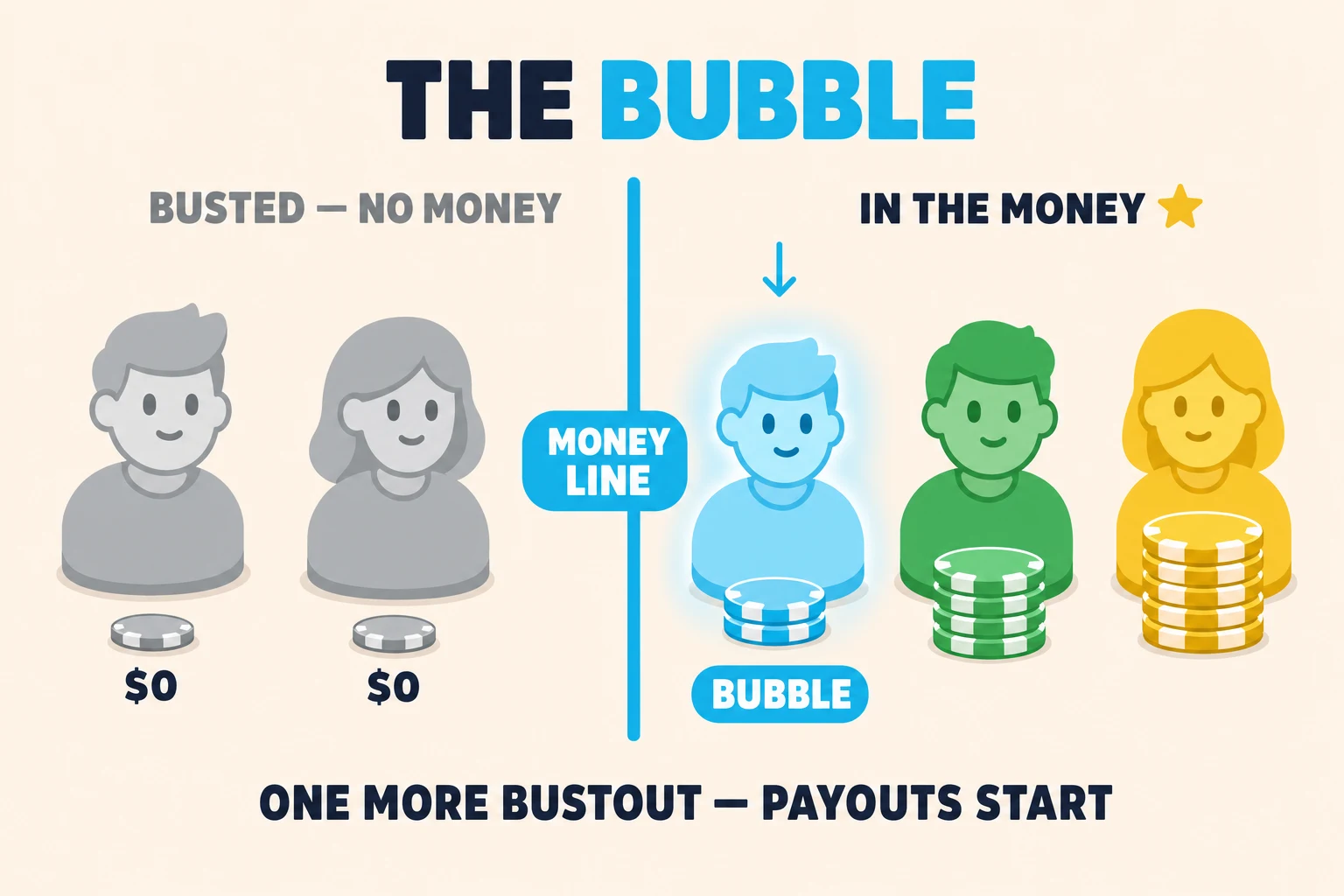
The bubble is the tournament stage one elimination away from the money — when busting earns nothing and surviving locks in a min-cash. Pay-jump pressure twists correct play: short stacks tighten their calling ranges, big stacks attack medium stacks wider, and medium stacks shrink up waiting for someone else to bust. ICM (Independent Chip Model) math says a chip you risk on the bubble costs more in dollar value than a chip you risk earlier, which is why the same shove that works on day one is a fold near the money.
Bubble: the tournament stage right before the money
What the bubble is
The bubble is the period in a poker tournament when one more elimination starts the prize pool paying out. Everyone still alive is one bustout away from cashing; the unlucky player who busts at exactly that moment is the “bubble boy” and goes home with nothing. The bubble is one stage, but the same dynamic repeats at every meaningful pay-jump after it — final-table bubbles, three-handed bubbles, heads-up bubbles. In each case, an upcoming payout threshold warps correct play, because survival is suddenly worth real dollars and a chip lost is more painful than the same chip lost earlier.
How bubble pressure changes correct play
Bubble math is driven by ICM (the Independent Chip Model), which assigns a dollar value to each stack based on its share of the remaining prize pool. ICM says chips you might win are worth less than the chips you already have, because doubling your stack rarely doubles your equity in the prize pool. That gap shows up at the table as risk premium: the extra equity you need above the chip-EV breakeven before a call or shove is actually profitable in dollars.
A few practical effects fall out of that:
- Calling ranges tighten harder than shoving ranges. The caller is the one most exposed to busting, so calls require more equity than they did earlier in the tournament.
- Fold equity goes up almost everywhere. Players who would happily flip on day one will fold borderline hands when busting hands them zero.
- Big stacks gain power because they cannot be eliminated. Medium stacks lose power because they have the most to protect.
- The same shove that was clearly good at 60 big blinds deep on day one can become a fold on the bubble, because the dollar cost of busting outweighs the chip-EV gain.
Poker Skill’s Big Blind: Call or Fold lesson drills that calling decision with no bubble in play: against an under-the-gun open, A♠ J♠ calls and 6♣ 5♦ folds, the chip-only baseline a bubble then tightens.
Hard bubble vs. pay-jump bubbles
The “bubble” most people mean is the money bubble: the exact pre-money moment where one more bustout starts payouts. That is the hard bubble. Once the money bubble pops, smaller bubbles keep showing up at every payout jump that matters: the final three, the final table, the moment second locks in. None of those are formally the bubble in the strict sense, but the math behaves the same way: an approaching payout threshold pulls correct play tighter for the stacks that have the most to lose. Coverage and forum chatter usually call the money bubble “the bubble” without a qualifier and call later thresholds “pay-jump bubbles” or “ICM spots”.
How each stack should play it
Stack-band guidance on the bubble is the most-confirmed pattern in tournament study material:
- Big stacks attack. With cover on the table, you can lean on medium stacks who do not want to bust. Open wider, three-bet the medium-stack opens that fold to pressure, and put medium stacks all-in with marginal hands they cannot call. You are using their fear of busting as your edge.
- Medium stacks shrink up. Tighten opens, avoid marginal three-bet wars, and let the short stacks bust before you take a flip. The cost of a wrong call is one of the biggest you face in the tournament; the upside of a thin chip-EV add is usually small.
- Short stacks shove or fold, but lean on shoving. With 10–15 big blinds you are in Nash push/fold territory. Pushing all-in keeps fold equity in play; calling someone else’s all-in throws fold equity away and exposes you to the worst part of ICM. Look for late-position open opportunities where one fold from the blinds wins you the pot uncontested.
The general rule across the three stack bands: shove ranges loosen relative to calling ranges, and the smaller the stack the more important it is to put the chips in first.
Example: 12 BB on the button, eight from the money
Late stage of a 9-handed online tournament. Two more bustouts and the field hits the money. You have 12 big blinds on the button with A♣Q♦. The cutoff, a tight regular with a 30 BB stack, opens to 2 BB. The blinds are both medium stacks (~25 BB) who have been visibly tightening for the last orbit. Action folds to you. Pure chip-EV, this is a clear all-in: A♣Q♦ has plenty of equity against the cutoff’s continuing range, blinds-and-antes pickup is a meaningful add, and the folds behind are very likely.
Now overlay ICM. The cutoff is one of the bigger stacks at the table and is not afraid to call you off; they have the cover and the read on you. Worse, your effective stack is exactly the size that hurts most: too small to fold, too big to ignore. If you shove and the cutoff calls, you are flipping for your tournament life two players from the money. If you shove and they fold, you pick up roughly 4 BB. The chip-EV math says shove. The dollar-EV math says it is much closer, and against a cutoff who knows the spot, it tilts toward fold.
The clean read here is to tighten your shoving range from the button by one or two notches: jam A♣Q♦ when the cutoff is loose or short, fold or just-call when the cutoff is the chip leader and tight. Same hand, same stack, same cards, but a different correct decision because the bubble has bent the math.
Common bubble mistakes
- Calling too wide near the money. Calling-range mistakes cost more than shoving-range mistakes on the bubble, because the caller absorbs all the bust risk. Hands that are clear calls in cash games or on day one are folds on the bubble.
- Posting blinds passively and waiting it out. “Folding into the money” sounds safe and is usually expensive. The blinds-and-ante drip eats short stacks, and tightening to a tiny range hands every steal opportunity to the table. The bubble rewards selective aggression, not invisibility.
- Fearing the wrong opponents. Big stacks like to call off short-stack jams light because the bust risk is asymmetric — they cannot bust. The mistake is treating every short-stack shove as the threat. The medium-stack open is the one you should usually attack, because medium stacks fold under bubble pressure and short stacks do not.
- Treating the min-cash as the goal. Most tournament structures are top-heavy. The biggest pay jump is usually from the bubble to the first paid finish, but the second-biggest is from runner-up to first. A strategy built around min-cashing every time gives up too much upside — the goal is the win, the min-cash is the floor.
Checklist
- Know which bubble you are on: the money bubble (hard bubble) or a later pay-jump bubble.
- Tighten calls before you tighten shoves. Calling ranges absorb the most ICM damage.
- Big stack: attack medium stacks. Medium stack: avoid medium-stack collisions. Short stack: shove first, call second.
- Match your shove range to the cover stack and the opener. The same hand can be a jam against one cutoff and a fold against another.
- Aim at the win, not the min-cash. Folding into the money costs you the upside that pays for the rest of your tournament losses.