


Timing Tell
A timing tell is information you infer from how quickly or slowly an opponent acts. Snap-checks, snap-calls, long tanks, quick bets, and delayed raises can all hint at hand strength. The signal is noisy. Auto-buttons, multitabling, lag, distraction, habit, and deliberate misdirection all pollute it. Treat timing as one clue alongside action, board texture, and confirmed showdowns, never as a single-spot confirmation.
Timing Tell
What a timing tell is
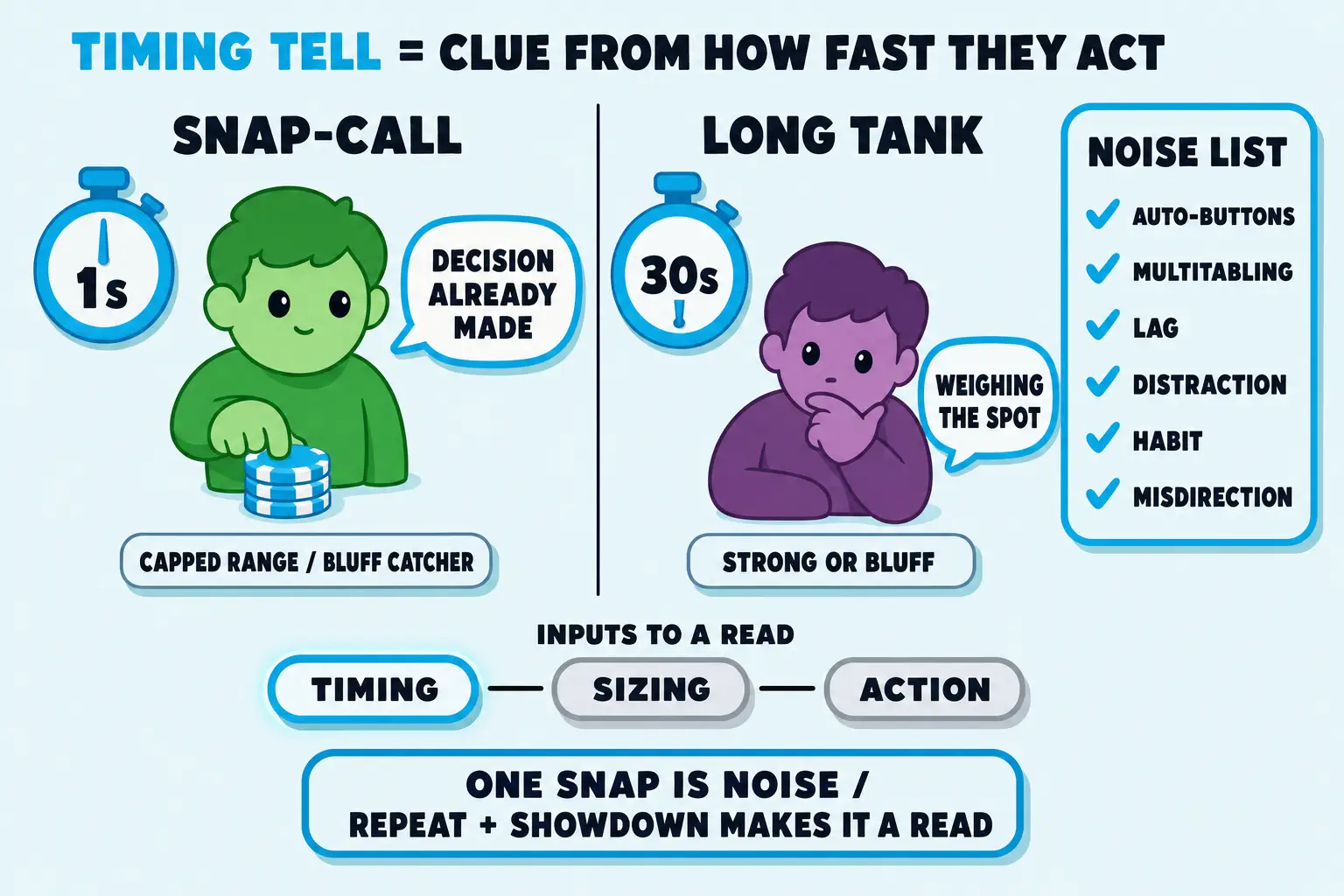
A timing tell is information you infer from how quickly or slowly an opponent acts. The action is the same (a check, a call, a bet, a raise), but the speed adds a layer. A snap-call usually means the decision was easy or pre-resolved. A long tank usually means the decision was hard. Both are clues about the range the opponent is choosing from, not about the exact hand. Speed of action is one of the lowest-confidence inputs in poker, useful only when it repeats and gets confirmed at showdown.
Common timing patterns
These are the shapes that show up most often. Each one points in a direction without proving it.
- Snap-check on the flop. Often a pure miss after a c-bet line, especially in position. Sometimes a slowplay with a strong hand the player wants to disguise. Pure-miss is the more common cause.
- Snap-call on the river. Often a bluff catcher the player has already decided to keep, or a made hand with a capped range. They are not weighing fold equity, so the call was pre-decided.
- Long tank before a raise. Often a polarized decision: a strong hand sizing up, or a bluff being talked into. Watch what happens on the next street to retro-fit the read.
- Quick bet on the river after slower action earlier. Often value the player has been waiting to extract. Less often a planned bluff a thoughtful player has rehearsed.
- Delayed check in a spot where most players bet. The pause itself is a flag. The player considered a bet and chose not to.
A pattern is only useful if you can repeat it. One snap on its own is noise.
Timing tell vs neighboring concepts
The label sits next to several others that point in different directions.
| Concept | What it reads | Built from |
|---|---|---|
| Timing tell | Speed of an action | How quickly or slowly a player acts |
| Sizing tell | Bet size of an action | How much a player bets relative to pot |
| Tell (general) | Any leak from an opponent | Action, sizing, timing, body language, talk |
| Player read | Whole-player inference | Many actions, sizes, timings, and showdowns |
| Table image | What the table thinks of you | What others have seen you do at this table |
| Bet sizing | The size you choose to bet | Your strategy decision |
| Showdown | The card reveal at the end of the hand | Procedure, not inference |
A general tell is the umbrella; timing and sizing are two specific subspecies. A player read is your whole-opponent inference, built from many tells stitched together. Table image runs the other direction, since it is what the table reads about you. Bet sizing is your own action, not an inference. Showdown is the procedure where unverified reads become verified data.
Why timing is noisy
The list of things that change action speed without changing hand strength is long.
- Auto-action buttons online (auto-check, auto-fold, auto-call). A snap-check or snap-fold can simply be a pre-selected click.
- Multitabling. A player with eight tables open is responding to a queue. Their tank can be another table, not your river bet.
- Lag and disconnects. Cellular hiccups, browser stalls, and reconnects all distort timing.
- Distraction. Live or online, players take phone calls, eat, talk to a friend, or just zone out.
- Habit. Some players always tank for the same beat regardless of holding. Some always snap. Their default is a personality, not a read.
- Deliberate misdirection. Experienced opponents fake snap-decisions to look weak and fake long tanks to look strong. Once they know you are timing them, the signal flips.
- Bet sequencing. A river bet that follows two big turns can prompt a tank because the spot is hard, not because the holding is weak.
Anchor a timing read in repeated observations from the same player on the same platform, ideally backed by a showdown that confirmed or denied the pattern. One snap, one tank, or one delayed raise is not enough.
When timing is most useful
Live, pace cues sit alongside posture, hand movement, and breathing. They are easier to anchor because the player is in front of you. Compare a player’s tank time on a river bluff-catch decision against their tank time when you watched them think through a thin value bet at showdown. You are looking for patterns relative to that one player, not against the population.
Online, the visible signals collapse to bet sizing, action speed, and the showdowns that happen. Pre-action buttons can leak information when a player misuses them. A snap-check on a turn where most players would consider a bet often means the opponent pre-clicked check-fold and is ignoring the spot. The leaks are real, but they show up best across many hands of the same opponent at the same site.
After a showdown, retroactively check the timing of the hand you just saw. If a player snap-called the river with a bluff catcher, and that becomes their pattern, you can lean on it next time. If their snap-call turned out to be a strong made hand, the pattern flips. The showdown is what converts timing from a guess into evidence.
Common mistakes
Acting on a single snap or single tank
The biggest leak is treating one timing event as a confirmed read. Wait for the second observation before changing your line.
Ignoring the platform context
Four seconds offline feels like a snap. Four seconds online while an opponent is on eight tables is a default queue wait. The platform sets the baseline. Build that baseline first, then look for deviations from it.
Forgetting reverse tells
Players who know they are being read can fake the timing pattern they want you to project. The fix is showdown grounding. If a slow-then-fast pattern is reliably a value setup at showdown, the read holds. If the pattern shifts the moment you act on it, the opponent is reverse-telling you.
Mixing timing with bet sizing
Timing and sizing are two different inputs. A snap big bet is not the same as a thoughtful big bet, and treating them as one move compresses the signal. Track them separately, then combine.
Worked example
You are in a 6-max $1/$2 cash game online, several hundred hands deep with the same regular at the table.
Hand one. You open the cutoff with K♣Q♣, the regular calls in the big blind. Flop comes Q♥7♠2♦. They check, you bet, they snap-call. Turn 5♠ goes check, you bet, they tank for ten seconds and call. River 4♦ goes check, you check back, they show A♠Q♦. Their flop snap-call was a hand they were happy to continue with. Their later tanks were genuine river indecision with a thin top pair. The timing matched a real decision tree, confirmed at showdown.
Hand thirty later. Same regular, same seat. They open, you flat in position with 8♠8♣. Flop K♠7♣4♥. They c-bet small, you call. Turn J♣. They snap-bet pot. Three things matter. First, snap-bet pot is a sizing tell on top of a timing tell. Second, that earlier showdown showed slow value and snap aggression in similar spots. Third, you have an underpair on a board that smashes their preflop range. The timing read alone is not enough. The timing read, the sizing pattern, and the board run-out together push toward a fold rather than a call. You fold and write a tag against this player: snap pot turn after small flop equals lean toward bluff or merge, needs another data point to act on it.
Three hands later they show down a different snap-pot turn that was a flopped set. Tag updated. The timing pattern was not a clean signal. It was one input in a noisy mix.
Poker Skill’s lessons leave timing out and train the steadier inputs in that mix, reading each spot from the board and the betting alone.
Practical use checklist
- Track timing per opponent, not as a population read.
- Match the timing observation to the platform. Live tank, online tank, and multitable tank are not the same thing.
- Wait for at least two repeated observations before adjusting your line.
- Anchor every read in a confirmed showdown when possible.
- Track timing and bet sizing as separate inputs that combine.
- Assume strong opponents may reverse-tell. Update fast when a pattern stops paying.
FAQ
Is a snap-call always weak?
No. A snap-call usually means the decision was pre-resolved. That can be a bluff catcher the player chose to keep, a strong made hand with a capped range, or a planned hero call on a river they expected. Speed alone does not point to weakness. It points to a decision that was already made.
Are online timing tells real?
Yes, but quieter. Auto-action buttons, multitabling, and lag pollute the signal more than live play does. The strongest online timing reads come from a single regular at a single site over many hands, anchored by showdowns you can audit in the hand history.
Can a strong player fake a timing tell?
Yes. Once an opponent knows they are being timed, they can fake snap-decisions to look weak and fake tanks to look strong. The fix is to ground every timing read in repeated, showdown-verified evidence. If the read keeps producing accurate predictions, the pattern is real. If it inverts the moment you act on it, you are being reverse-told.