


Trap
A trap is a postflop or preflop line that hides a strong hand and invites the opponent to put chips in with worse. It is the plan-level cousin of slow play: pick a villain you expect to bet, build a pot they think they are leading, and collect on a later street.
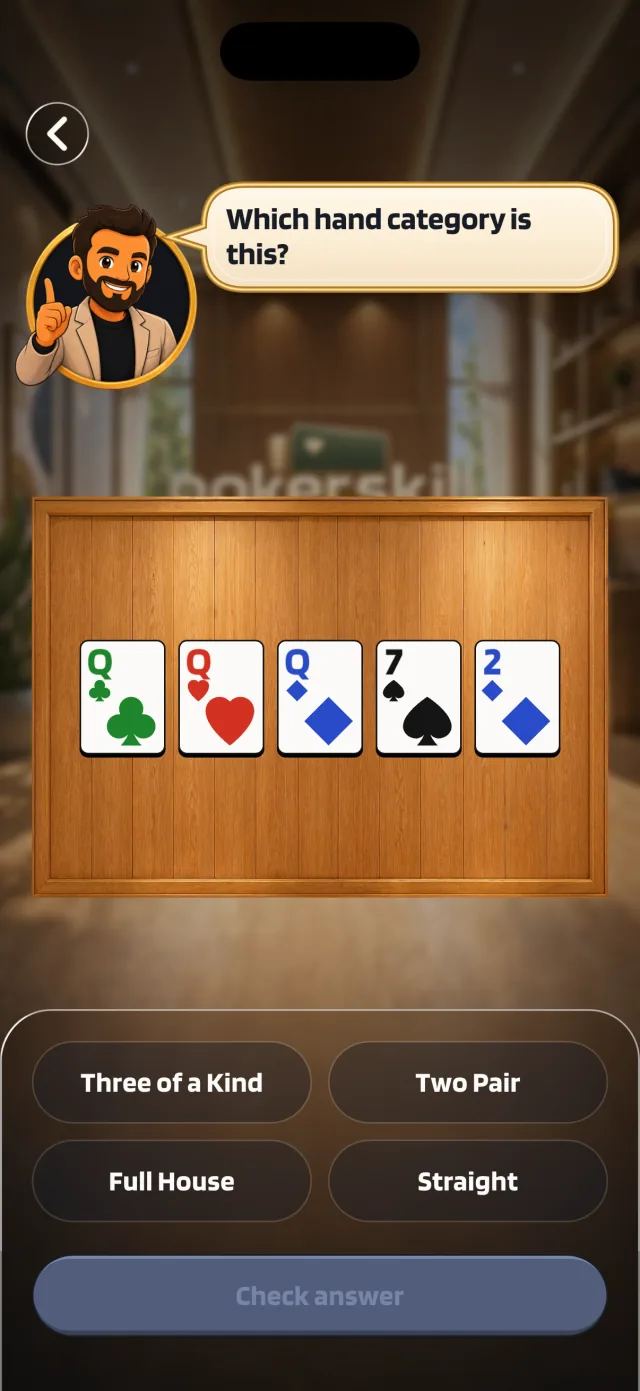
Practice this in Poker Skill. The Check-Raise lesson draws the line on trapping, where top pair with a jack kicker calls the bet, strong enough to stay in but not strong enough to trap with.
Get the free appTrap: hide strength now, get paid later
What a trap actually is
A trap is a line you take with a hand strong enough to bet for value, where you deliberately check or call on the current street so a specific opponent will keep firing with worse. The point is the same as a slow play — disguise strength and let the bluffs and thin value come to you — but the framing is sharper. A slow play is the action category: any strong hand played weakly. A trap is the plan: you have a villain you expect to bet, a board safe enough that giving up the street is cheap, and a later street where the money goes in.
Most traps are slow plays. Most slow plays are traps. The vocabulary varies more than the strategy does, and the term shows up in two places that are easy to confuse: postflop, when you check a flopped set into a c-bettor, and preflop, when you flat a pocket pair instead of 3-betting so a tight 4-bettor can’t fold a worse hand.
A useful contrast:
- Trap vs. slow play: A slow play is any check or call with a hand strong enough to bet. A trap is a slow play aimed at a specific bettor; you are not just hiding the hand, you are choosing the player you want to invite. If you check and nobody bets, the slow play is still a slow play; the trap simply did not spring.
- Trap vs. thin value: A thin value bet puts in a small bet now to get called by slightly worse. A trap forgoes that street to set up a fatter bet later, accepting the risk that the later street never arrives.
- Trap vs. thin value trap: The two phrases mean opposite roles. A trap is the line you set. A thin value trap is what happens to you when you bet thin and a slow-played monster check-raises.
Related terms
- Slow play: the action category most traps execute as.
- Check-raise: the second half of many trap lines.
- Value bet: the line a trap defers.
- Protection bet: the value-side cousin a trap declines on wet boards.
- Thin value trap: the spot you become the prey, not the trapper.
Trap vs. slow play vs. thin value trap
| Concept | Who is doing it | Meaning |
|---|---|---|
| Slow play | You | Any check or call with a strong hand instead of betting |
| Trap | You | A slow play aimed at a specific bettor; the line is built around their tendency to fire |
| Thin value trap | The opponent (against you) | You bet thin for value and walk into a slow-played stronger hand |
The row that matters most: a trap is named for intent, slow play is named for action. If you check a flopped set into a c-bettor you respect, you are slow-playing and trapping. If you check a flopped set into a passive opponent who never bets, you are slow-playing and not trapping anyone.
When a trap earns its keep
Four inputs decide whether the trap is the right line:
- Opponent aggression. Traps need a bettor. Aggressive c-bettors, players who automatically barrel into a check, and recreational players who overplay top pair are the textbook targets. A trap against a passive opponent is a check that ends the action.
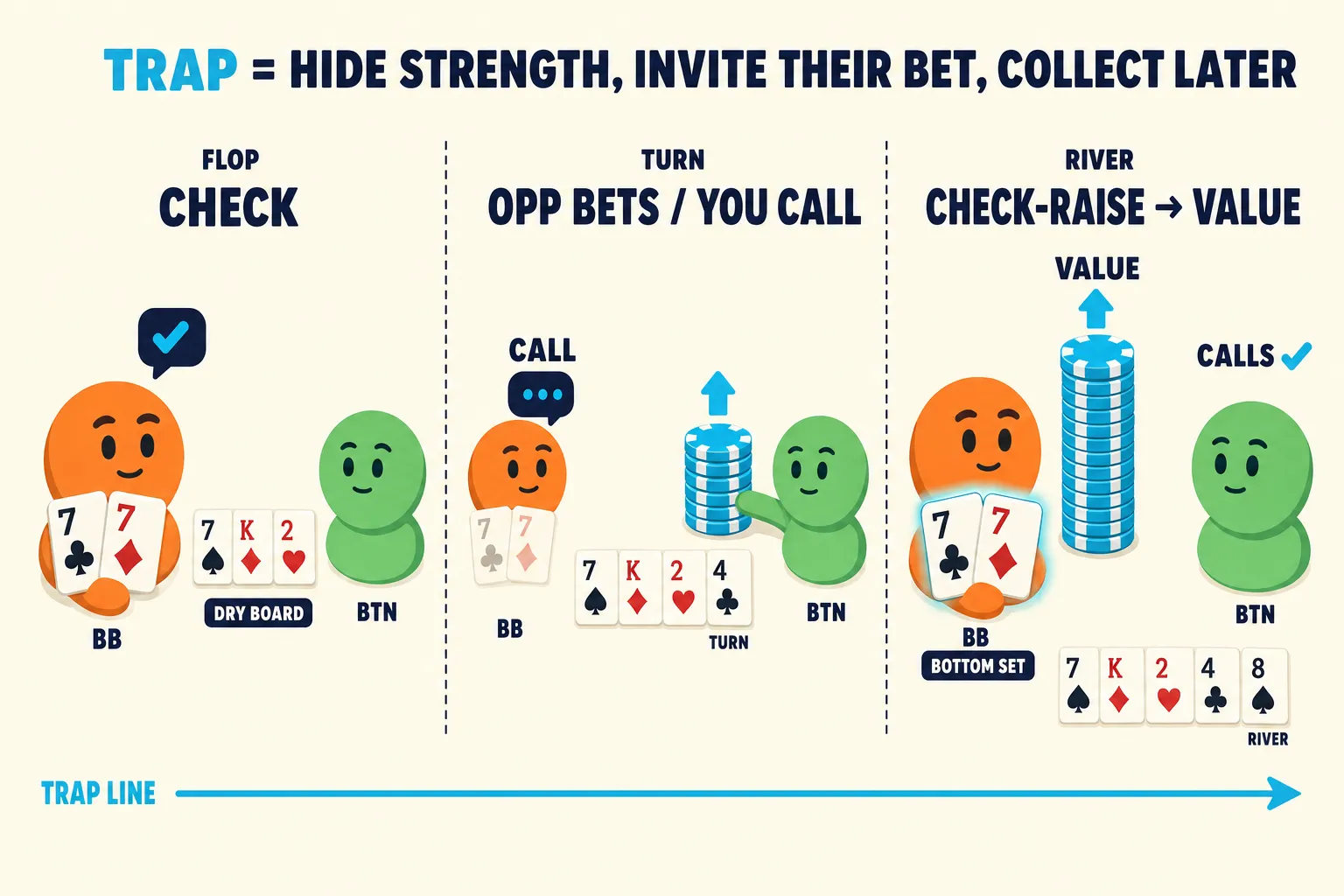
- Board safety. The fewer turn and river cards that can scare you off your hand, the better. Dry, rainbow, low-card flops with one face card (think 7♠ K♦ 2♥ with bottom set) are where traps print. Coordinated boards (8♠ 9♠ 10♣) bleed value to draws on every free card.
- Stack depth. Traps need streets of money behind to make the deferred bet worthwhile. At ~100bb in 6-max cash, a flop check-call into a turn check-raise leaves a real river bet behind. At 30bb, the trap is one bet deep, and the math collapses into “just bet now.”
- Range advantage. Traps work best when villain’s range has hands they will pay off with — overpairs, top pairs, draws — and your hand crushes most of those. If the board favors villain’s range and they can credibly have two pair or better, you are not trapping; you are giving free cards.
- Later-street value capture. The whole point is that the money you forgo on the current street comes back, fatter, on the next one. If the next street doesn’t have a credible bet from villain or a credible raise from you, the trap is theoretical, not real.
When any of those is missing, the trap leaks. The default with a strong hand on a vulnerable board is still to bet.
Worked example
You hold 7♣7♦ in the big blind. The button opens to 2.5bb, you call. Heads-up to the flop: 7♠ K♦ 2♥. Pot is 6bb, effective stacks ~95bb.
This is the trap case. You have bottom set on a dry, rainbow board. The button raised preflop, so their range is full of kings, broadway combos, and overpairs that c-bet most flops. You also know this opponent is a frequent c-bettor — that is the trap part. Without a known bettor, this is just a slow play.
Check. The button c-bets 4bb. Their value range here is mostly one pair (A-K, K-Q, K-J) plus the occasional bluff. Raising now folds out everything that does not at least flop two pair. You call.
Turn is the 4♣. Board: 7♠ K♦ 2♥ 4♣. No flush draw, no obvious straight draw. You check; the button barrels 9bb. This is the spring. Against a known double-or-give-up player, check-raise the turn for value while there is still a street of money left — to about 26bb is enough to get called by their kings and folded into by air. Against a player who triple-barrels with their whole range, flat the turn and let them keep firing.
If the river is a brick (8♠), bet ~two-thirds pot for value or check-raise if they bet first. The trap has done its job: most of the money goes in on a street where you are still ahead of one pair.
Now change one input. Replace the flop with 7♠ 8♠ 9♠. You still have a set, but three spades are out, the straight is live, and a turn or river card can easily promote a worse hand. The trap is leaking equity to draws. Bet (small to a normal size) — this is a protection bet, not a trap.
Common mistakes
1) Trapping on wet boards
Bottom set on K♣ 7♣ 6♣ is not a trap candidate. Three flush cards, a straight draw, and overcards mean every free card costs you equity. The better line is a protection bet. Wet board → bet your strong hands.
2) Trapping passive opponents
A trap is only profitable if someone bets behind it. If the opponent in the pot rarely fires on missed flops, the trap simply burns a street of value. Bet small and let them call with whatever pieces they have.
3) Trapping one-pair-class hands
Top pair with a weak kicker is not strong enough to trap, even when it feels strong. Worse hands rarely call a later-street bet you make, and better hands never fold to a check. The line for top pair is to bet now and reassess on the next street.
4) Trapping without a plan for the next street
A trap is a multi-street line, not a flop check. If you do not know whether the spring is a turn check-raise or a river check-call, you are not trapping — you are hoping. Decide the spring street before you check the flop.
5) Treating “trap hand” the same as a trap line
In some books, trap hand means a hand likely to flop the second-best holding (K-J, A-T, Q-J), and the advice is to avoid them. That is the opposite of trapping. Same word, different concept; do not borrow the warning into your trap-line decisions.
FAQ
Is a trap the same as a slow play?
Mostly. The difference is intent and target. A slow play is any strong hand played passively. A trap is a slow play aimed at a specific opponent you expect to bet, on a board where checking is cheap. Most traps are slow plays. Most slow plays against an aggressive bettor are traps. If you only learn one of the two words, “slow play” covers more ground; “trap” is the version with a named villain.
When does a trap actually beat a value bet?
When checking puts more money in over the rest of the hand than betting would, on average. That is the only test. The clearest cases: dry boards where draws are scarce, an opponent who bets when checked to but folds to a bet, and a hand crushing the field so badly that turn and river cards rarely flip the lead. Most strong hands play better fast; the trap is the deliberate exception, not the default.
Is a check-raise always a trap?
No. A check-raise is one possible action; a trap is a multi-street line. Many traps end in a check-raise on the turn or river, but plenty end in just calling down. And many check-raises are not traps at all — a flop check-raise with a flush draw is a semi-bluff, not a trap. The shorthand: every trap has a planned action that springs it; the check-raise is the most common spring, but not the only one.