


Triple Barrel
A triple barrel is the third bet in a flop-turn-river sequence, fired by the player who took the betting lead before the flop. The first barrel is the c-bet, the second is the double barrel, and the third commits the largest portion of the stack. Triple barrels split into a value version (your hand still beats their calling range) and a polarized bluff version (your hand has no showdown value but the runout makes them fold).
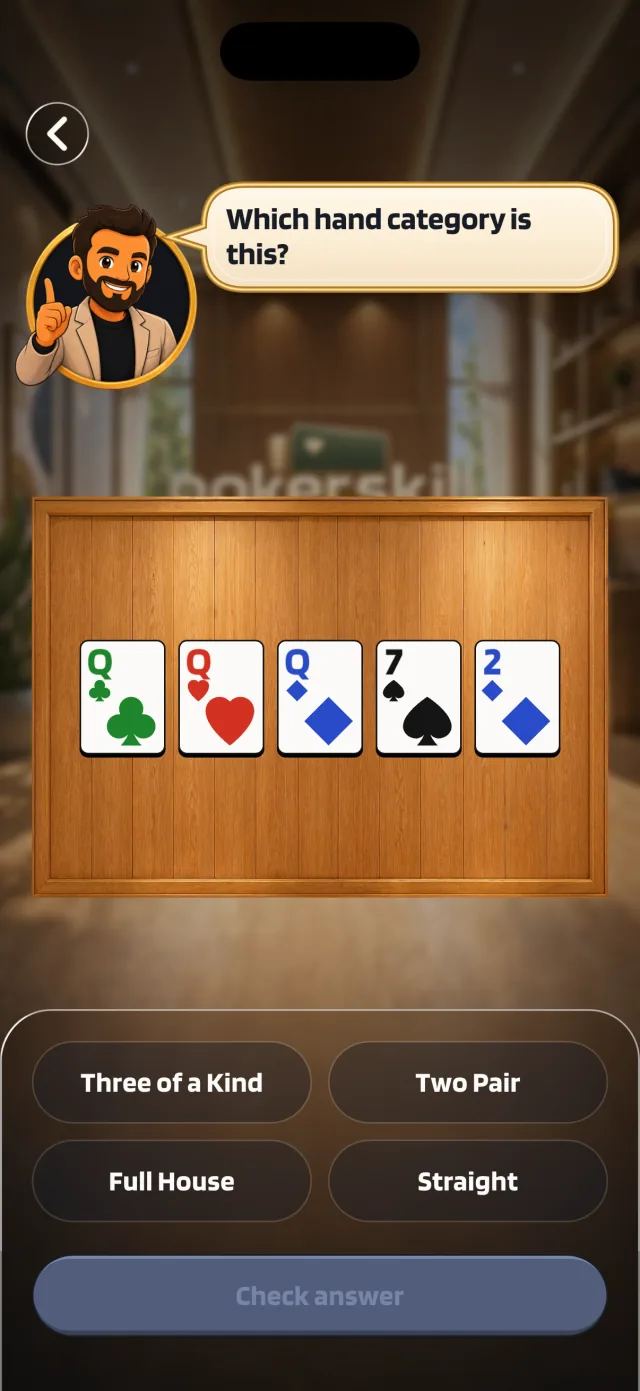
Practice this in Poker Skill. The Hold the Plan lesson keeps showdown value out of the bluffs on the turn, checking back a pair of deuces because a bet would turn it into a bluff that beats almost nothing that calls.
Get the free appTriple Barrel (the third street bet)
What a triple barrel is
A triple barrel is the third bet in a flop, turn, and river sequence, fired by the player who took the betting lead before the flop. The first barrel is the c-bet. The second is the double barrel on the turn. The third lands on the river and usually commits the largest portion of the stack. Same player, same line, three streets in a row. It’s the full extension of staying on the gas after preflop.
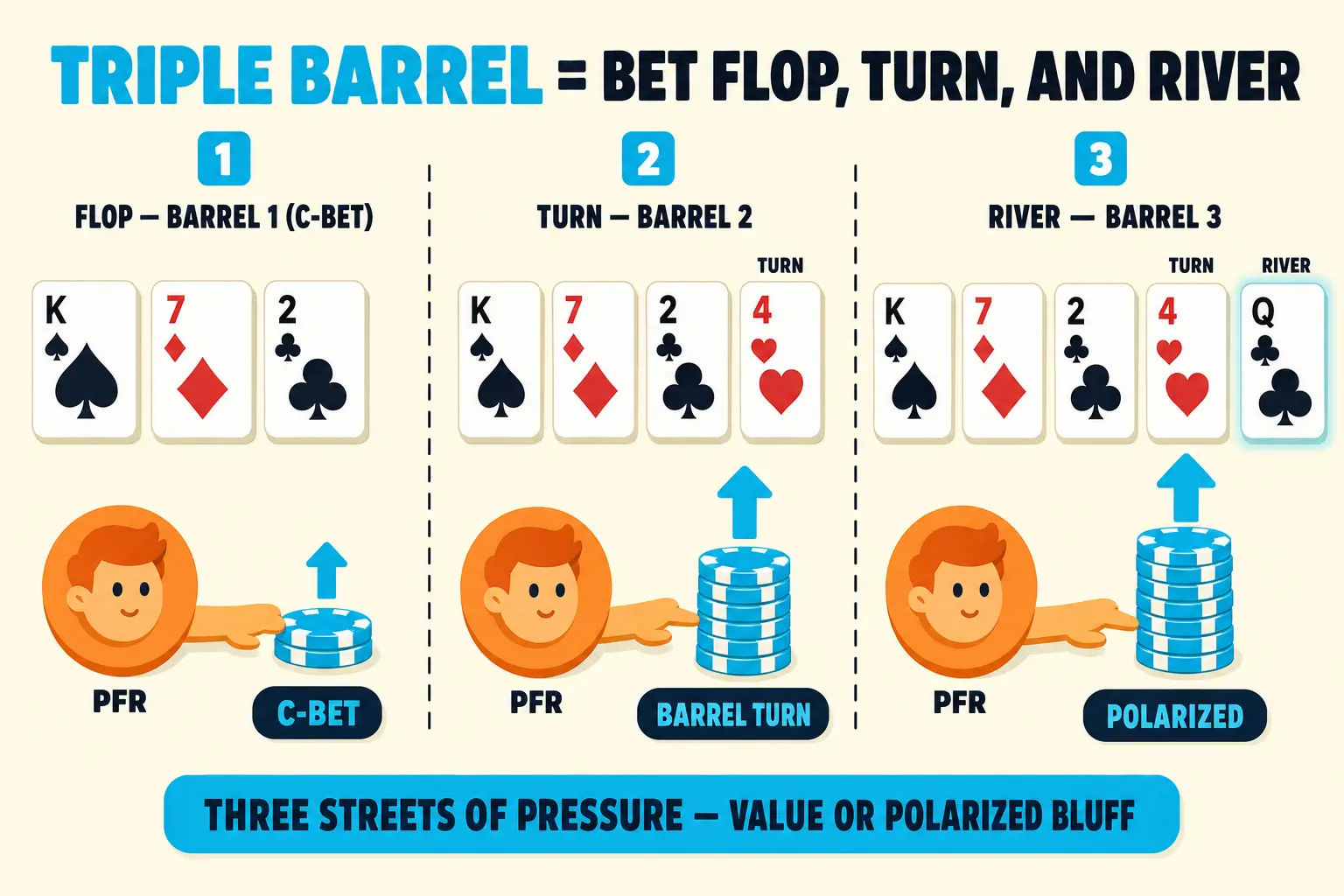
The line splits into two versions: a value triple barrel (your hand still beats the opponent’s calling range and you want them to pay you off) and a polarized bluff (your hand has no showdown value but the river runout makes the opponent fold a hand that beats you).
Triple barrel vs c-bet vs double barrel
The three barrels live on the same line, but each street asks a different question.
A c-bet runs cheap because the pot is small and most opponents miss the flop. A double barrel costs more and leans on turn cards that hurt the caller’s range. A triple barrel is the most expensive bet of the line, has zero protection value (no more cards are coming), and is judged on a single question: will worse hands call, or will better hands fold?
When the third barrel matters most
The right spots for a triple barrel are narrower than most players realize. Fire when the river:
- Brings a clean overcard that’s bad for the opponent’s most likely range (top pair becomes second pair).
- Completes obvious draws (flush-completers especially) when the opponent shouldn’t have the flush in their continuing range.
- Caps the opponent. If the opponent’s range is mostly one-pair hands by the river, a polarized barrel forces them to call off with bluff-catchers.
Pull the brake when the river:
- Pairs the board (full houses are now possible and your bluff loses fold equity).
- Doesn’t shift either range. A meaningless brick gives the opponent no new reason to fold.
- Helps the opponent’s range more than yours (a low connector that completes likely drawing hands they would have called the turn with).
Worked example
Cash, 6-max, $1/$2, $200 effective. You raise A♥J♣ in the cutoff and the big blind calls.
- Flop K♣ 7♠ 4♣ ($13 pot). You c-bet $5. BB calls. You have one overcard, a backdoor flush draw, and an ace-blocker against KA-style top pairs.
- Turn 2♥ ($23 pot). A blank that doesn’t help BB’s range. You barrel $15. BB calls again. Their continuing range is now mostly Kx with a marginal kicker, pocket pairs 88–TT, and a few floats with backdoor equity.
- River Q♣ ($53 pot). A scare card that completes the flush draw and brings a second overcard to most of BB’s likely Kx hands. You shove for $130.
This is a polarized triple barrel. Your hand has zero showdown value, but you block the strongest Kx (AK), the river card credibly turns flushes into your range, and BB’s calling range (Kx with a weak kicker) has every reason to fold. If the river had bricked instead (say, the 3♦), the barrel loses its story; check it back and accept ace-high may sometimes be best.
For value: same line, but you hold K♥Q♠ and the Q♣ river gives you top two pair. Now you bet the same $130 because BB’s Kx hands and any pocket pair turned into a bluff-catcher will pay off. Same sizing, opposite reason.
Common mistakes
1) Treating the triple barrel as automatic
After a c-bet and a double barrel get called, the temptation is to fire the third just to stay consistent. The river bet is the most expensive of the three and has the worst fold equity, because by the river opponents have already invested heavily and feel committed. If the runout doesn’t credibly hurt their range, check.
2) Bluffing with hands that have showdown value
A hand like middle pair or weak ace-high can sometimes win at showdown. Turning it into a bluff converts a hand that would have caught a few thin showdowns into a costly fold. Pick bluffs from the bottom of your range: gutshots that bricked, busted backdoor draws, hands with no realistic way to win unimproved.
3) Building an under-bluffed line
Some players only triple barrel when they have a strong hand. That’s an under-bluffed line. It works once or twice, then observant opponents fold every river to your big bet and you stop getting paid. A river-betting range needs both value and bluffs in roughly the right ratio. By the time the river arrives, your range is naturally a polarized range of strong hands and bluff candidates; pick from both sides.
4) Underbetting the river to “stay safe”
A small river bet looks like a discount, but it telegraphs a thin value range and sets up a cheap fold for the opponent. Triple barrels work best as polarized bets, large enough to put a real decision on the opponent, paired with stack geometry planned from the flop. If the river bet has to be small to fit your stack, the line was probably mis-sized two streets earlier.
FAQ
When should I check the river instead of triple barreling?
Check when your hand has some showdown value but isn’t strong enough to value-bet, and when the river card doesn’t credibly hurt the opponent’s range. A useful rule: if the only hands that can call you are better than yours, it’s not a value bet. If your hand can win unimproved at showdown, it’s usually not the bluff candidate either.
How big should a triple barrel be?
Default to a polarized size (pot-sized or larger when stacks allow) and plan the geometry from the flop forward. If you want a pot-sized river bet with $200 stacks and a $20 starting pot, work backward: roughly half-pot on the flop, two-thirds on the turn sets up a near-pot river bet without having to overbet. A small (third-pot) river bet ships with a much narrower value range and almost no bluffs.
Should I triple barrel against calling stations?
Not as a bluff. Calling stations call river bets at very high rates because, by the river, they’re emotionally invested in the pot and want to see your hand. Against that opponent profile, switch the line: cut bluffs entirely, and lean on thinner value bets with hands that beat second pair. Save the polarized triple-barrel bluffs for opponents who can actually fold one pair on the river.